From Behind Bars, a Top Figure in the Luffy Robbery Gang Reveals Their Initial Target


The Contact Unit That Controls Black Market Part-Timers Through Fear the Terrifying Truth Behind It
【Episode 1 – Synopsis】

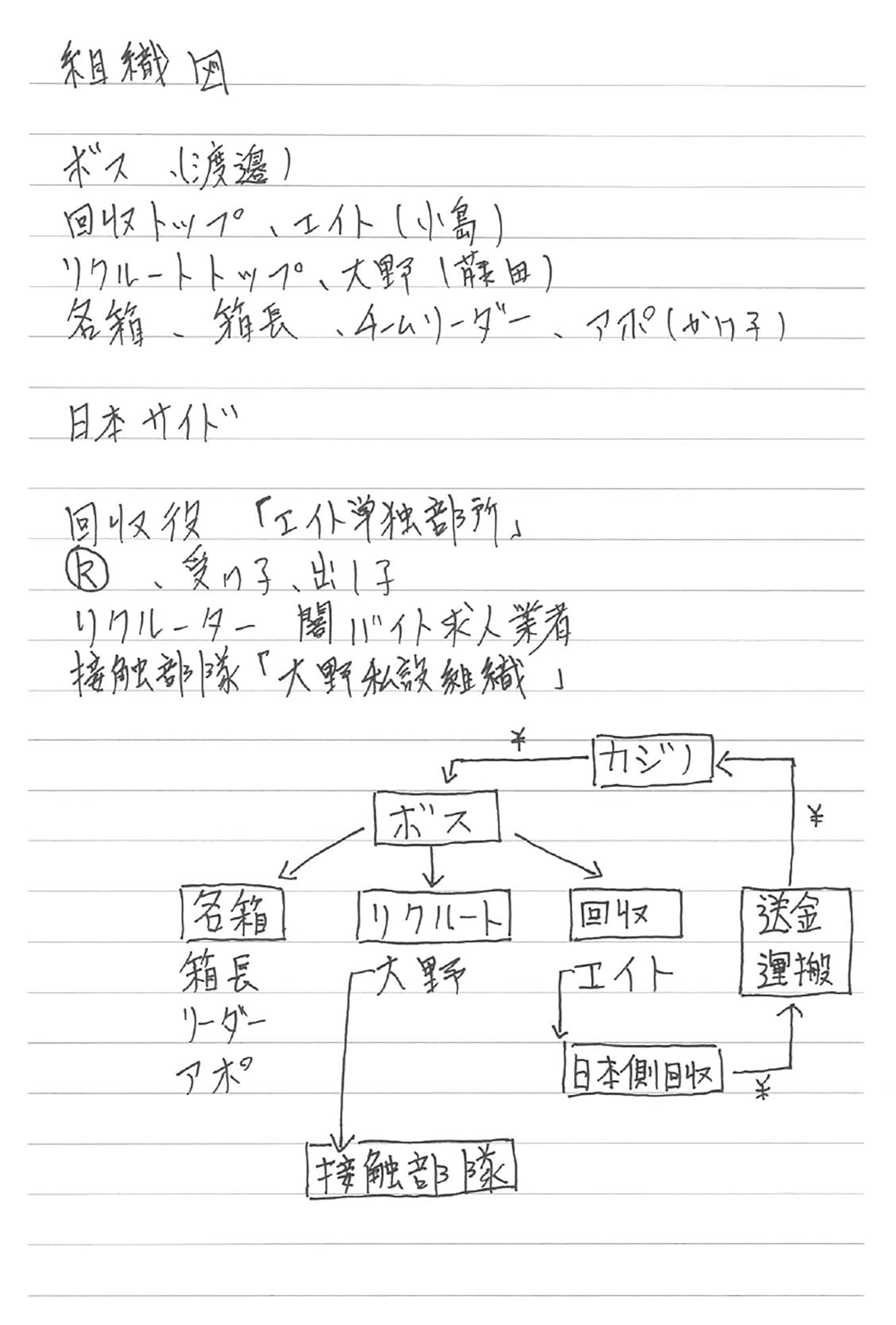
The special fraud group founded by Watanabe (hereafter without the defendant title)—the predecessor of the so-called “Luffy robbery gang”—was originally formed by gathering his local friends from Hokkaido. They were assigned to important roles, such as team leaders of units called boxes and cash collectors.
One of the executives, Kiyoto Imamura (41), was a friend Watanabe had met some 20 years earlier through an event circle he organized during his university days. He also had ties with Seiya Fujita (41), who joined the group after Kojima and later became an executive, as they had both worked in nightlife businesses together in Sapporo.
As Kojima describes, “Watanabe basically doesn’t trust anyone,” and it was precisely this cautiousness that allowed the group to expand. Even so, there were still instances where couriers absconded with the money or collectors disappeared.
Why then did Watanabe appoint Kojima—a newcomer he hadn’t even met before, and who had struggled to make progress as a phone scammer—to a central role in the organization? Kojima repeatedly told the writer:
“Maybe because I worked tirelessly to carry out what the boss (Watanabe) wanted. He has a certain personal charm, so supporting him wasn’t a burden. On top of that, he paid off all my debts, so I owed him. Some people probably thought, ‘Kojima rose through flattery and sycophancy.’ That’s what set me apart from Imamura and Fujita.”
How did the fraud group Watanabe built gain power and grow, eventually transforming into the “Luffy robbery gang” that shocked the nation? What were the executives’ lifestyles like? And how did Kojima, once an outsider, rise to become a top executive—and what did he witness from inside the organization?
Shocking Revelation! The Business the “Luffy Robbery Gang” First Set Its Sights On
Around January 2019, the boss wanted to start a business swindling Philippine currency exchange dealers by using counterfeit Japanese yen. As I helped scout out dealers and prepare the fake bills, I gradually earned the boss’s trust.
The counterfeit money scheme didn’t succeed, but in February, the boss ordered me to establish a recruitment division to gather operatives, with me as leader.
The boss named this project the “Harem Plan,” demanding that we recruit only female recruiters. However, we couldn’t gather enough people and the plan stalled. That’s when we began looking for “R”—the term members used for fraud couriers who received the cash. The word “R” came from the initials of “Rider” and “Receive.”
By March, we started building a new base in Little Tokyo, the Japanese district of Makati City, Philippines. At the same time, we applied for a license under the name “Usagi Japanese Language School.” With such a license, we could bring in telephone scammers (“kakeko”) under work visas.
The Little Tokyo base housed the main group (with Watanabe at the top) and two spinoff franchises: “K-box” led by Imamura, and “ST-box” led by M, who had broken away from the boss’s group.
I managed spreadsheets showing revenues for each box, clarified their finances, supported their operations, helped collect scammed money, and worked as a recruiter. It was grueling, but my only desire was to gain the boss’s recognition—and I even felt a kind of pleasure from it. In April, my monthly income topped 1 million yen for the first time since joining the group. Later, my salary was fixed at 2 million yen, with success-based bonuses added on top.
In June 2019, under Watanabe’s direction, “A-box” was launched, led by a newcomer rather than the senior members. Within just four months, A-box was pulling in 200 million yen a month, making it a top earner alongside ST-box. Meanwhile, K-box—run by Imamura, who later took the name “Luffy”—was performing disastrously.
Without my support, Imamura couldn’t accomplish anything. His fraud operations looked sloppy and careless. Personality-wise, he seemed like a cheerful, gambling-loving uncle who enjoyed baccarat. But that carelessness later created rifts between us—and in the large-scale robberies that followed, Imamura’s nature would come back to haunt him.
From the September 12-19, 2025, issue of “FRIDAY”
Interview and text: Shimei Kurita (Nonfiction writer)