Japan as the Main Victim of Super Extreme Weather — Mie Univ. Professor Had Predicted 40°C World


Japan has already set one foot into another world
“In my book Future Predictions of Extreme Weather (Poplar Publishing), which came out this July, I wrote that the world is now standing at the threshold of another world brought on by global warming. By that I mean a world where 40°C summers are the norm and in Japan, that future prediction of 40°C summers has already become reality.
Extreme weather is advancing faster than I imagined, and Japan has already stepped halfway into this another world. People here tend to think of it as something distant, but it’s precisely the Japanese who should be most sensitive to abnormal weather.”
So says Yoshihiro Tachibana, professor at the Graduate School of Bioresources, Mie University, with a strong tone.
After a short rainy season, Japan’s summer of 2025 was immediately hit by extreme heat. In Isesaki, Gunma Prefecture, a record-breaking 41.8°C was observed, while other regions across the country also exceeded 40°C. When the sun shines, it’s a deadly heatwave; when it rains, it’s torrential downpours. Many Japanese must be feeling firsthand that they are exposed to disaster-level extreme weather.
In Future Predictions of Extreme Weather, Tachibana explains the mechanisms behind these violent climate shifts, warning that the root cause is global warming. We asked him about the environmental changes surrounding Japan and the abnormal weather.
“Extreme weather goes hand-in-hand with global warming, and it is progressing faster than scientists originally forecast. Take the Arctic, which is most strongly affected. At first, people said permafrost will begin melting around 2030, but by 2010 it was already thawing rapidly. As permafrost melts, methane gas and other substances are released, which accelerates global warming even further.
This year’s temperatures above 40°C in Japan have so far occurred only in a few regions where geography makes high heat more likely, so most Japanese have not experienced it themselves. But if we just sit idly by, in the future even major cities will be hit with temperatures exceeding 40°C. Some cities may even reach 45°C,” Tachibana warns.
It isn’t just temperature. Precipitation, snowfall, and more—words like highest on record have become commonplace in Japan in recent years, with new records being set annually. What, then, has caused the climate to become so extreme?
Jet stream meanders have become fixed
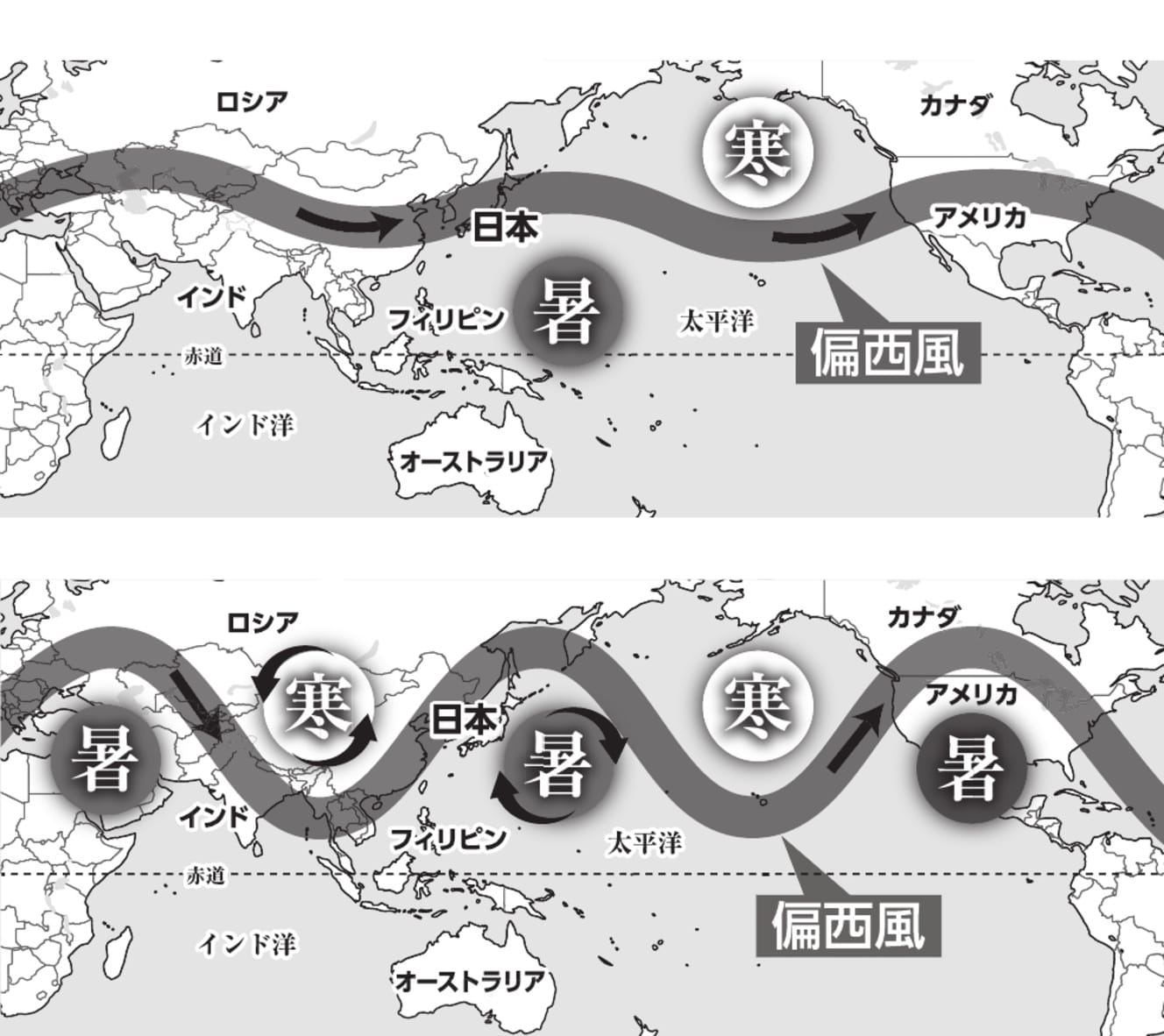
“In the mid-latitudes of the Earth, the jet stream flows from west to east, separating cold air to the north from warm air to the south. Normally, the jet stream meanders gently north and south as it moves. When the temperature difference between the cold and warm air is large, the jet stream flows faster and its north-south meanders are smaller. Conversely, when the temperature difference is small, the flow slows down and the meanders become larger.
Warming in the Arctic has reduced this temperature difference, causing the jet stream to meander more dramatically. This started around 2010. That was the first regime shift—a fundamental structural change in climate and ecosystems.
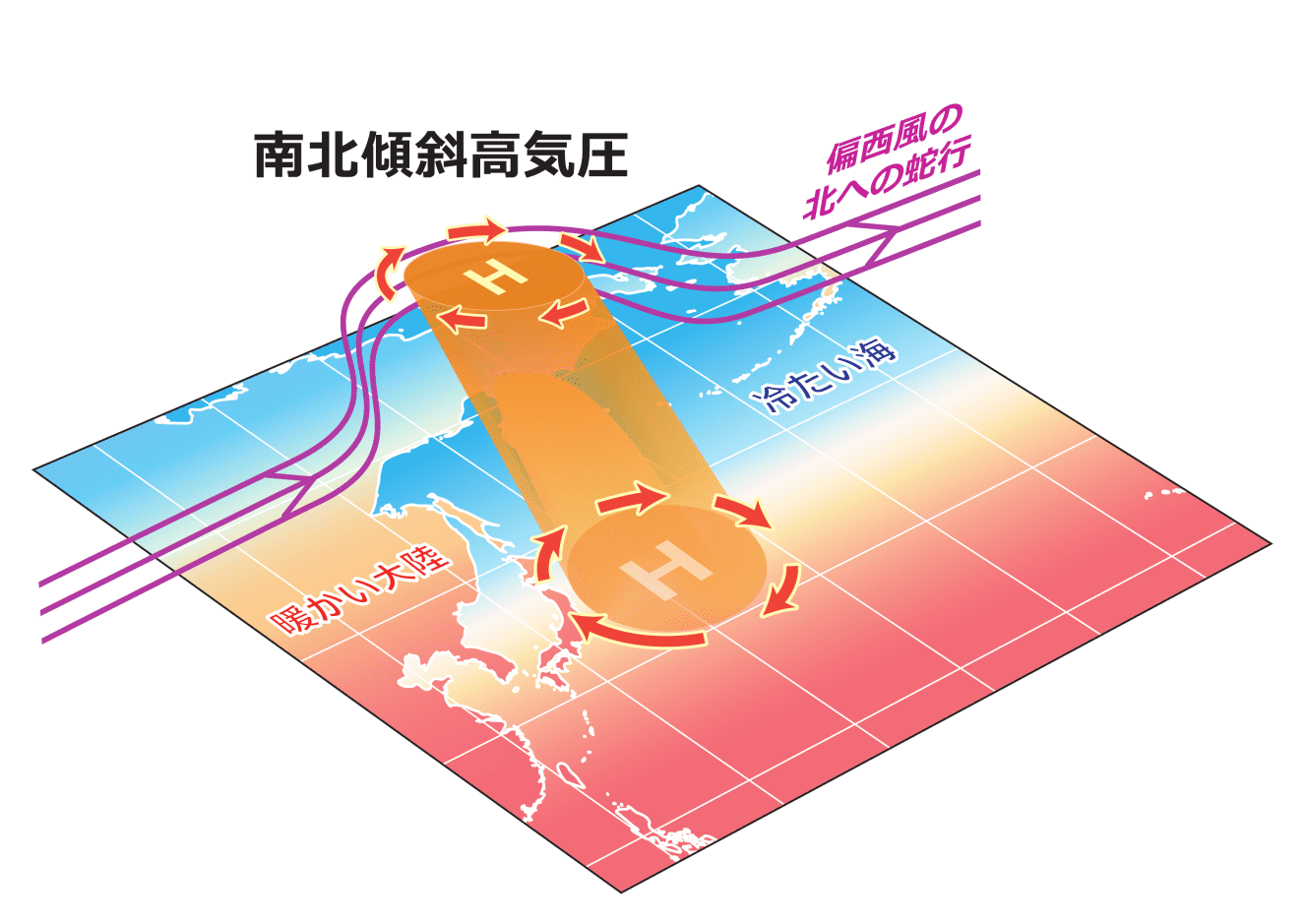
Even if the jet stream meanders, there’s no problem if it continues moving west to east at its usual speed. But if a large meander becomes fixed, low- or high-pressure systems stall in that area, and the weather itself becomes fixed,” explains Tachibana.
When people think of global warming, they often focus on rising air temperatures, but 70% of the Earth’s surface is ocean. Ocean temperatures are harder to raise than land, but once they rise, they are slow to drop.
“Since the end of 2022, sea surface temperatures have risen worldwide. The extent varies by region, but overall the oceans warmed. In response, in 2023, UN Secretary-General António Guterres expressed concern, calling it a shift ‘from global warming to global boiling.’ This is the second regime shift.
The world’s fastest current, the Kuroshio, flows from the south toward Japan. Warm water from Indonesia and the Philippines is carried northward by the Kuroshio into Japanese waters. Previously, the Kuroshio would hit the Kii Peninsula and flow eastward, but with the jet stream meandering far north, the Kuroshio is also pulled northward, reaching as far as the Tohoku region.
The Tsushima Current, branching from the Kuroshio, flows into the Sea of Japan, raising nearshore temperatures around Japan. Some areas have sea surface temperatures 5°C above average, and locally, near Tohoku, they even match the 10°C-above-average temperatures near Yakushima. Last year’s sea temperatures were already high, but this year has surpassed them. In other words, Japan is like a floating object in a pot of hot water,” he says.

Japan is losing its four seasons
“The large meanders of the jet stream mean that once it’s sunny, the heat persists. With the surrounding sea surface temperatures rising, there is an abundance of water vapor to produce rain, so when it does rain, it results in torrential downpours. Both conditions last for extended periods, causing disaster-level damage.
Because the sea surface is so warm, typhoons do not weaken as they move. The meandering jet stream causes them to wander across the Japanese archipelago, stagnating and amplifying damage. In the future, the rainy season will likely be short, as it was this year, or bring heavy rain. Even areas that previously experienced little damage, such as Tohoku and Hokkaido, may be affected by the rainy season. If the rainy season is short, summer will arrive around the longest day, the summer solstice, bringing extreme heat and drought. Wildfires will occur, and crops will be impacted” (Professor Yoshihiro Tachibana).
The outlook is bleak, but what about winter? Will warming reduce the damage?
“If the jet stream dips south, severe cold waves arrive. Just as summer brought heavy rain, winter will bring heavy snowfall. This February, Obihiro in Hokkaido recorded 120 cm of snow in 12 hours. Snow exceeding 1 meter in half a day is unprecedented nationwide. Transportation networks are completely paralyzed” (ibid.).
Japan, once a country to appreciate the changing seasons, is now, according to Tachibana, essentially experiencing summer, summer, summer, winter—just two seasons instead of four. Summers will become hotter than the tropics, while winters will bring massive snowfall. A climate like no other in the world is emerging.
Tachibana also says it is still possible to avoid such extreme weather:
“Japan is one of the country’s most directly affected by the real impacts of global warming. People living in Japan are the ones experiencing it firsthand. Yet, somehow, many treat it as someone else’s problem. People should be far more sensitive to abnormal weather and global warming. Awareness has improved recently, but consciousness about reducing CO₂ emissions remains low.
However, there is still time. It’s a narrow window, but we are at a tipping point—an irreversible major turning point. If we respond with strong awareness to reduce CO₂ emissions that drive global warming, it is still possible to reverse the trend. That is exactly why I wrote Future Predictions of Extreme Weather”


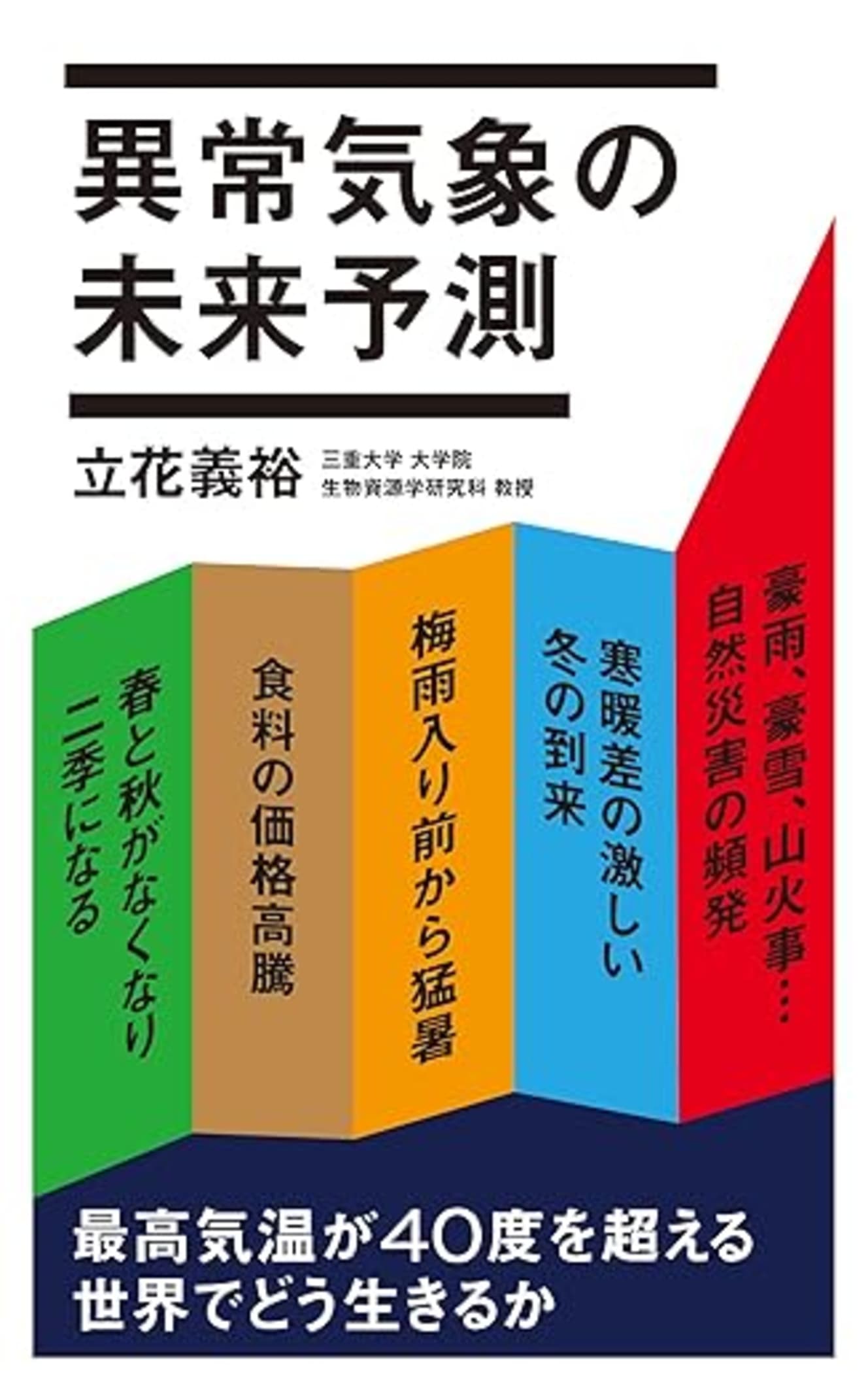
Future Predictions of Extreme Weather (by Yoshihiro Tachibana / Poplar Publishing)