Almost dominated the batting title! This year’s Hanshin Tigers “Manager Kyuji Fujikawa’s ability to correct the situation is amazing!
Urgent Feature Part 1: Almost Sweeping the Hitting Titles and Running Fast with an Astonishing Defensive Ratio!


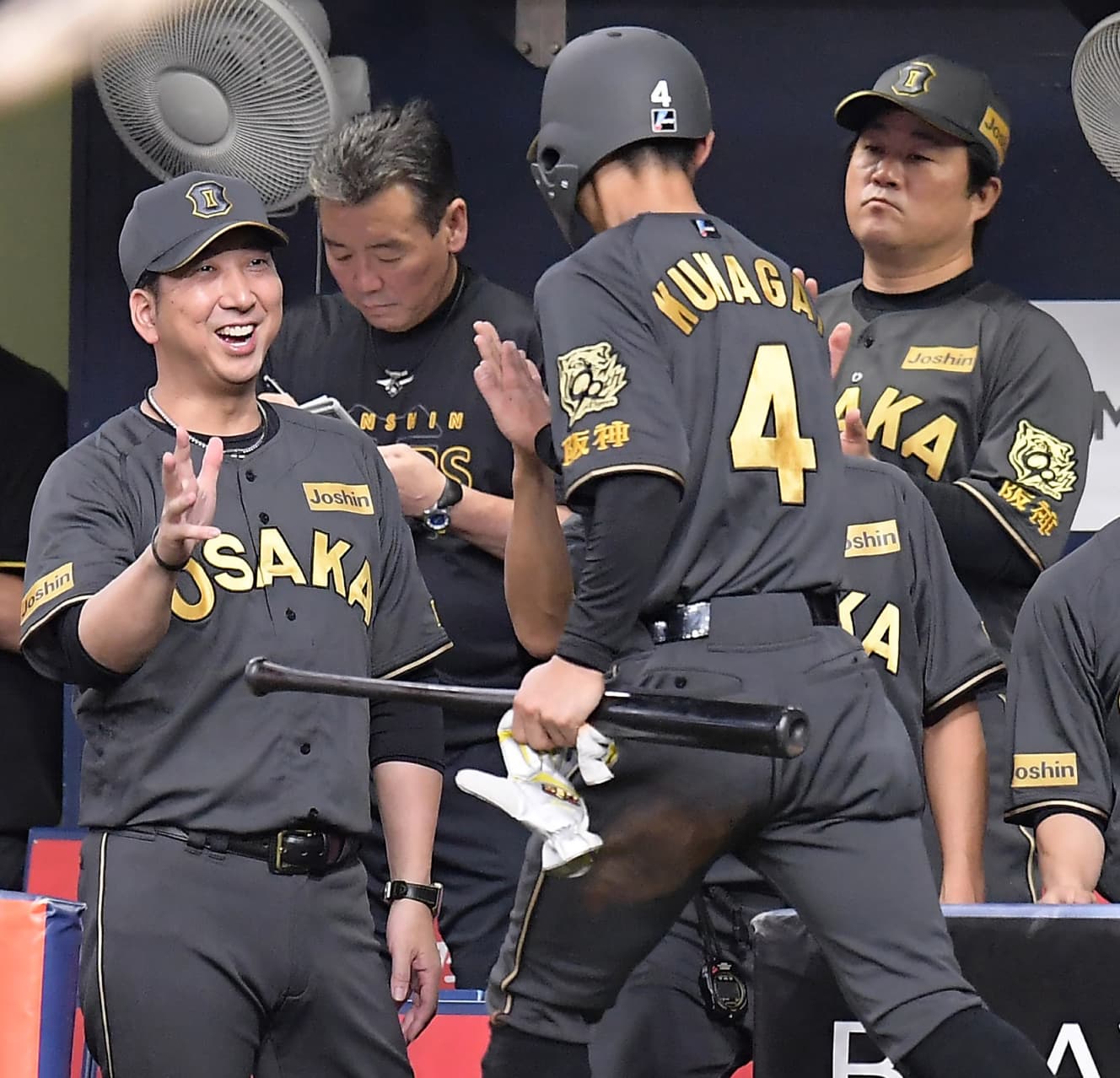
The ballplayers don’t make the same mistakes.
It was early in the spring training camp when Fujikawa received a call on his cell phone from a student of his former teacher, Osami Ueda, who was a baseball coach at Johoku Junior High School and also managed the Kochi Sho baseball team.
He said, “There is also a student of mine, Rinshiro Shimamura (22), a catcher who was drafted second in last year’s developmental draft by the Kochi Fighting Dogs and joined the Hanshin team. The ball players would say, “Sensei, I injured Shimamura,” instead of “Shimamura got hurt. We had to take good care of him so that he would not break down. All the media have pointed this out, but I think the most important factor in Hanshin’s success is that they have kept their players healthy and in good condition, and have not had any breakdowns.
The new Fujikawa Tigers are running fast.
The race for the top batting position involves Koji Chikamoto (30), Takumu Nakano (29), and Teruaki Sato (26), and Sato is alone in the race for the home run crown. Sato, Shota Morishita (25), and Yusuke Oyama (30) of the clinching lineup are vying for the batting title, and the other major batting titles, including stolen bases and most hits, are almost exclusively held by Hanshin players. The team’s defensive rating is an astonishing 2.05, and with 28 games remaining, they lead the league by 14 games over second place (as of August 26, 2012).
The team’s greatest strength is that they have an ideal order with Chikamoto and Nakano, who have high batting averages and have won the stolen base crown, Morishita, who batted fourth in the Samurai Japan team, and Oyama, who has a .350 batting average with runs scored, along with Sato, the double crown winner.
Chikafusa Ikeda, who contributed to Hanshin’s Japan championship as the ace in 1985, praised the offensive lineup, but continued, “It is still too early to call manager Fujikawa a great general. Rather than the manager’s skill, he attributed the victory to the team’s “competitive power,” which had grown in confidence after winning the championship the year before last.
Certainly, there were concerns even before the season started about the tactics and strategies of a rookie coach who had no coaching experience. In fact, there were many managerial errors in the early games, such as a failed squeeze from the third pitch and a failed relay pitch.
Tetsuro Kawajiri, who had been a no-hitter and no-run pitcher during Hanshin’s darkest period of 10 years, when the team finished in the bottom six times and only once in the A class, said, “I was surprised at the manager’s ability to correct the situation.
He said he was surprised at the manager’s ability to correct the situation. “There is a difference between what you see from the outside as a critic and what you see from the inside,” he said. At the beginning of the season, we had a hard time replacing the starters, and it was painful. But ballplayers don’t make the same mistakes. By the time the exchange games started, even if the pitch count didn’t reach 100, if I saw ″signs of danger″ in the balls being thrown by the starter, I would quickly replace him.
The key to getting out of a crowded field
Mr. Nobuyuki Hoshino, a technical left fielder who toyed with batters with his “slow fastball” of 130 km/h at its fastest and his slow curve of around 90 km/h, was one of the Hanshin alumni who was surprised by his “corrective power.
He said, “I think they saw that ‘No. 3, Morishita, No. 4, Sato’ would work better than ‘No. 3, Sato, No. 4, Morishita,’ which was widely touted as the centerpiece of the new Tigers, and they switched them early on, didn’t they? In camp, I had Sato guarding right field, but I fixed him at third. We quickly made adjustments after assessing his aptitude. This is something that is not easy to do.
Kawajiri points out that the key to Fujikawa’s Hanshin team’s success in the trial-and-error process was “the attempted brawl incident.
On April 20, in a game against the Carp, catcher Seishiro Sakamoto (31) was hit by a dead ball to the head, and the ballplayer became agitated. He barked at manager Takahiro Arai (48). I am not sure if he was being serious or posturing, but I am sure the players felt something when they saw him take a stand against Arai, the older manager, in order to protect their own team. In 2011, when the team won the championship, Akifumi Okada (67), then manager of the Bay Stars, protested vehemently against a dangerous play by Yota Kyota (31), and the team came together as one.
Immediately after this “incident,” the Carp won 11 games and lost three, including 10 consecutive wins.
Both Hoshino and Kawajiri, former mainstay pitchers of the Hanshin team, agree that Sakamoto’s lead has contributed to the Hanshin team’s astonishing team defense ratio this season.
For example, in the August 1 game against Yakult, he had Munetaka Murakami (25) throw a two-seam to the inside corner from the first at-bat. Even when he was leading and had a home run to tie the game, he still started with an in-course two-seamer. It’s Murakami at Jingu Stadium, right? He still makes you think he’s still going to go …… and suddenly goes outside. It’s a fearless pitch distribution that goes against the theory, but I have him throw it with some basis in mind, observing the pitcher’s condition that day, the data, and the hitter’s condition in the batter’s box. Pitchers get into the groove because they can get a strikeout, and ineffective pitchers come to life,” said Hoshino.
In the opening game of the second half of the season against the Bay Stars, Fujikawa made a winning move. He replaced ace Hiroto Saiki (26), who had been paired with Ryutaro Umeno (34) since the year before last when the team won the championship, with Sakamoto as his wife.
Saiki had been having a hard time pitching because of the inaccuracy of his go-to pitch, the fork,” Sakamoto said. He had to rely on his powerful straight fastball, and he was always pitching as hard as he could. That has changed drastically. With Sakamoto’s skillful use of sliders and curves, the number of pitches he threw dropped dramatically. I can see a sense of relief that he has been able to control his pitches. Recently, his arm swing has improved and even the fall of his forks has improved,” Kawajiri said.
Since teaming up with Sakamoto, the ace has won five straight games, including two complete games. He has now won five in a row, including two complete games, and is leading the race for the most wins and the best defensive batting average.
Part 2 is here ! The day manager Kyuji Fujikawa of the Hanshin Tigers became a legend.


From the September 12/19, 2025 issue of FRIDAY
PHOTO: Jiji Press