Drought Across Japan Leaves Tourist Destinations Parched—Lake Kawaguchi’s Lakebed Now Exposed


The water level dropped by 120 cm!
“The path leading to the hall usually gets deeper than an adult man’s height when the water is at its fullest. To be able to walk there in August this is a first for me.”
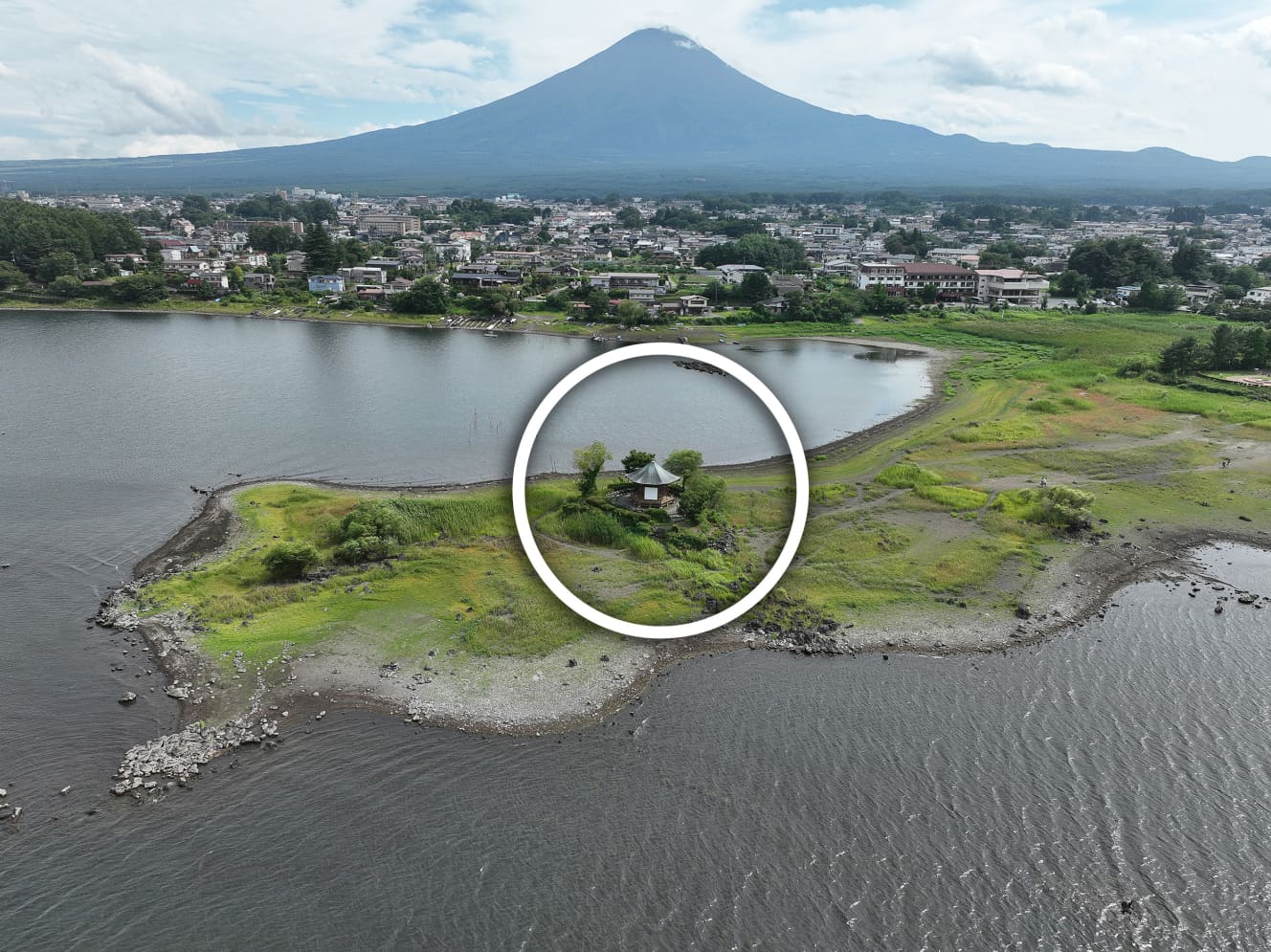
So said a man in his 50s who lives near Lake Kawaguchi (Yamanashi Prefecture), one of the Fuji Five Lakes. His surprise is understandable. As shown in the photo, the water level of Lake Kawaguchi has fallen so much that the floating island’s hexagonal hall is now connected to the shore by land.

According to Yamanashi Prefecture, the water level of Lake Kawaguchi is currently 120 cm lower than the average of the past 10 years. As a result, the lakebed has been exposed, creating a land bridge to the Hexagonal Hall. Similar phenomena have occurred in the past, but usually only from early spring until before the rainy season; it is almost unheard of for it to last into August, as it has this year.
The roughly 150-meter path leading from the lakeshore to the Hexagonal Hall has dried out under the scorching heat and is now overgrown with grass. People can be seen strolling along it, a surreal sight considering it was once the lakebed.
“The cause is the low rainfall in June and July—less than 70% of the usual levels. Not only Lake Kawaguchi but the Fuji Five Lakes as a whole have seen water levels drop. The lack of water has even reduced the number of boats that can be moored at boat docks,” explained an official from the River and Erosion Control Division of the Yamanashi Prefecture Fuji–Eastern Construction Office, Yoshida Branch.
Lake Kawaguchi isn’t the only place affected. The Hii River in Izumo, Shimane Prefecture, nearly dried up completely at one point. At the Naruko Dam in Osaki, Miyagi Prefecture, water storage fell to 0% for the first time in 31 years, and drought conditions continue. A nationwide water shortage is becoming severe.
The Japan Meteorological Agency announced that rainfall in July was at record lows along the Sea of Japan side of the Tohoku region and in Hokuriku. On August 5, Isesaki City in Gunma Prefecture recorded 41.8°C, the highest temperature ever observed in Japan. The backdrop is the rapid progression of global warming. Professor Yoshihiro Tachibana of Mie University, an expert in meteorology and climate dynamics, issued a warning:
“As global warming progresses, high-pressure systems strengthen, leading to large-scale droughts and reduced rainfall. Major droughts can cause poor harvests of rice and vegetables, shortages of water for daily use, and difficulties in cooling factory equipment due to reduced river water. Extreme dryness may also trigger large-scale wildfires, which are already common abroad, to occur more frequently in Japan. Global warming is beginning to cause serious damage around the world.”
The drought at Lake Kawaguchi is not just a local phenomenon—it is a manifestation of the planet’s cry of distress.

From “FRIDAY”, September 5, 2025, issue.