The 40th anniversary of the Japan Airlines Jumbo Crash… A victim man is devastated by what he saw of his father at the morgue.


Determination of the family who lost a family member in the accident: “Don’t let it fade away
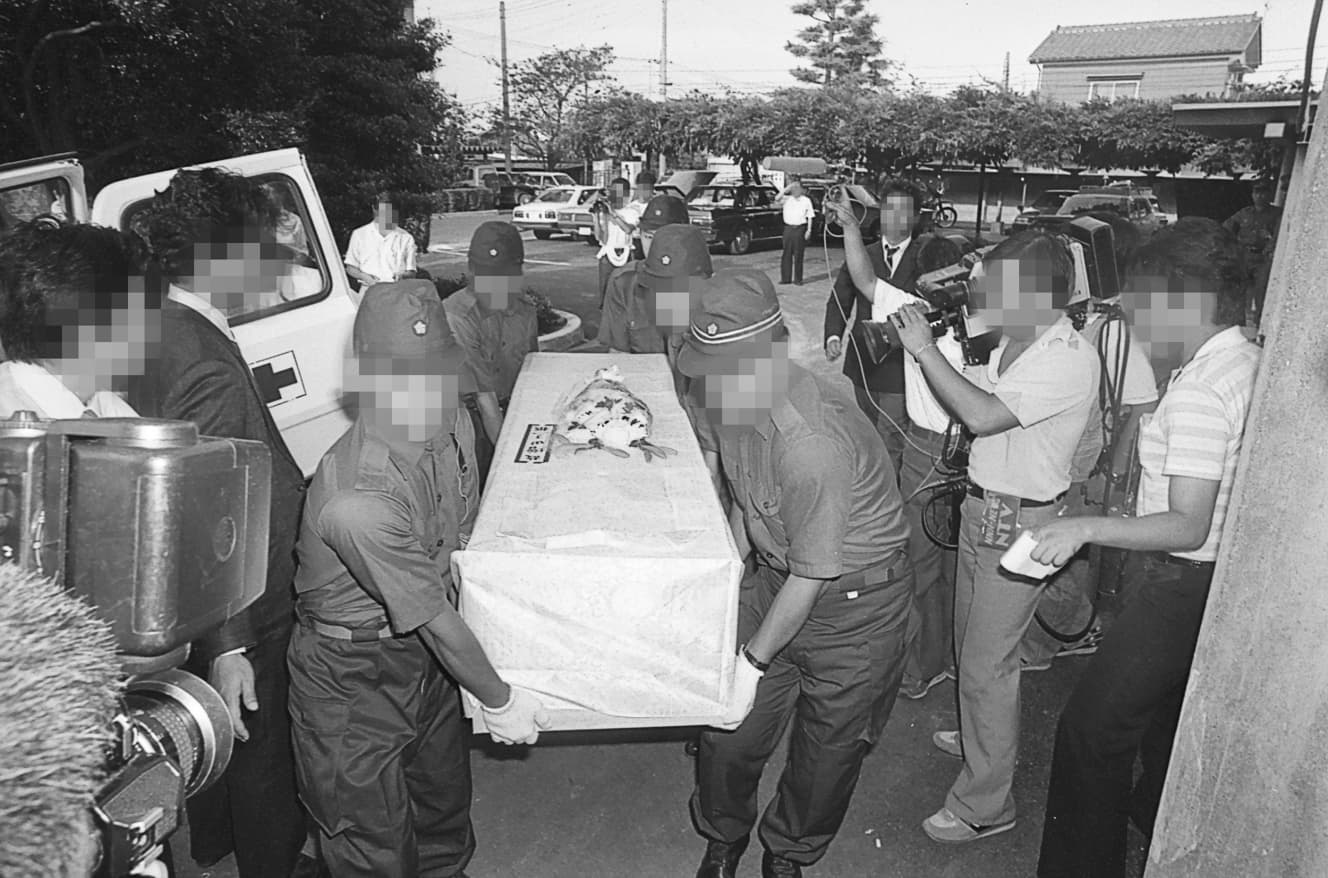
One hand, one leg, and half of the head were missing.
FRIDAY took more than 1,500 photographs during its coverage of the Japan Airlines jumbo jet crash. The photos cover a wide range of locations, including the crash site and the city hospital where the survivors were brought in, but the most numerous are of the Fujioka Municipal Gymnasium in Gunma Prefecture, which was used as a morgue for the bodies of the victims. In the photographs of hundreds of family members in the area, even the lavish floral tributes offered by then Prime Minister Yasuhiro Nakasone and other cabinet ministers seemed to fade away. A bereaved family member in his 50s living in Tokyo recalls how he met his father for the first time at the morgue.
My father was in his coffin, his whole body wrapped in bandages. The staff explained to me that he had lost one hand, one leg, and half of his head when he was found, but he looked like a doll. I just stood there.”
Masayoshi Yamamoto, 45, who lost his father, Kenji, on a business trip to Tokyo, has a bag of his belongings with burnt rice cakes stuck to it burned into his eyelids.
My father was an executive at a chemical company, and whenever he went on a business trip, he would buy me souvenirs. I think the burnt sweets were also bought for us. I was only five years old at the time. It is a hazy memory, but he was a kind father.
Forty years have passed since the accident, and as the bereaved families of the victims continue to age, the number of people who tell the story of the accident is dwindling. The “8.12 Liaison Group,” consisting of survivors’ families, had 280 families participating at the time of the accident, but the number has been reduced by half to about 140 families.
Ms. Imai, the proprietress of the Imaike Ryokan, also commented, “In the past, the bereaved families used to come to stay every year around August 12. But nowadays, we hardly get any reservations. More and more people say, ‘I would like to come, but my age makes it difficult. I am afraid that they will forget about the accident.
In response to this situation, some bereaved families are making efforts to pass on the memory of the accident to the next generation. The aforementioned Mr. Yamamoto established the general incorporated association “Memory Link 1985. On July 25 of this year, he released a video produced with generative AI. It is an animation in which characters modeled after Kenji and his childhood self explain the accident in an easy-to-understand manner.
About 15 years ago, a junior colleague at work said to me, ‘I don’t understand why we are climbing the memorial mountain,’ and this prompted me to continue various efforts to prevent the accident from fading away.
Two years ago, we partnered with KDDI to set up an in-vehicle base station so that we can broadcast the memorial climb via videophone. This animation was created for the younger generation, who are unfamiliar with the accident. We plan to release short videos for young people on a one-off basis, and we have already made a sequel.
I now have a five-year-old son. Now that I have a child the same age as I was at the time of the accident, I can understand how my father feels. I think it must have been very regrettable for him to have to say goodbye so suddenly. We must not repeat such a tragedy. That is why I will continue my activities,” said Yamamoto.
The animation created by Mr. Yamamoto is based on the question, “In today’s technologically advanced world, can such a tragedy as the Japan Airlines jumbo jet crash ever be repeated? to which the protagonist replies, “That depends on us. The most important thing is not to let the Osutaka tragedy fade away, but to pass it on to the next generation as a lesson, as a memorial service.
This is the wish of the bereaved families.

From the August 22 and 29, 2025 issues of FRIDAY
PHOTO: Kengo Okura