Unknown Coach Achieves Koshien Through Gritty Winter Greenhouse Training


Wearing boots on a snow-covered field

“If we want to make it to Koshien, we won’t call on a nobody like you.”
The baseball club was founded in 2001. Until then, the school had been an all-girls school, and when it became coeducational, a baseball team was created to attract male students. The school began looking for a coach, but the employment conditions were tough: an annual salary of 2 million yen and no social insurance.
Kazunori Harada, who had been a high school baseball player but never made it to Koshien, had coached at his alma mater while working and dreamed of one day going to Koshien with his players. He hesitated over the harsh conditions. What pushed him to accept was a single remark from his father, a former high school baseball player and manager of an amateur baseball team:
“Being a high school baseball coach isn’t something just anyone can do. Since you have the chance, you should go for it.”
Despite the poor conditions, Harada went to the interview, only to be told by the principal:
“We don’t intend to focus on baseball. If you aim for Koshien, we wouldn’t hire someone unknown like you.”
Still, the baseball club was established. When they recruited members, only 10 students joined—five with baseball experience and five without, some having been in the geology or Go clubs, with no experience even in playing catch.
“They probably joined with a casual, club-like mindset,” Harada recalled.
Meanwhile, Harada’s goal was: “Aim for Koshien!”
“When I coached at my alma mater, we reached the top four in the prefectural tournament three years in a row, so I was confident in my coaching,” he said.
He used a Spartan-style training method, with morning practice and post-school sessions until 8 PM, including 100-ball knock drills. Naturally, some students couldn’t keep up; by the end of the fall tournament, six had left the team. Yet the following year:
“Even though the team was extremely weak, students who had been second-string in junior high joined because they could play regularly at Sei Ai High School,” Harada said.
In the autumn tournament of 2003, the team defeated the strong Hirosaki Jitsugyo High School and qualified for the prefectural tournament. By 2005, they reached the top four in the Aomori prefectural tournament.
“This led ace-level players from around Hirosaki to join the team,” Harada said.
By 2009, they reached the finals in both spring and autumn tournaments. Despite steadily improving their record, Koshien remained out of reach.
What changed Harada’s mindset was a remark from his father, who was bedridden with cancer:
“Do your best for the Sei Ai baseball team,” he said.
It was his father’s last words. This was on March 12, 2011, the day after the Great East Japan Earthquake.
“I wondered why he said ‘for the Sei Ai baseball team’ instead of ‘Kazunori, do your best.’ I realized until then I had been self-centered. When we founded the team, many thought it would collapse in a year. I was doing it for myself—to prove people wrong, not to be looked down on, and because I wanted to go to Koshien. I realized I needed to do it for the students.”
“As the environment improved, I began to wonder, ‘Is this really enough?’”
From there, the Sei-ai baseball team changed significantly.
“First, I had the players come up with their own practice menus. But since they had always done what their coaches told them in elementary and middle school, they couldn’t think for themselves. At first, they would just propose the practice menus they had been doing. I kept asking them, ‘What is the purpose of this?’ and ‘What’s the intention behind it?’ It was stressful for me, but I think it was stressful for the players too.
However, since we couldn’t win with the old methods, I didn’t want to go back. After about three months, the practices I thought were necessary and the ones the players proposed started to align.”
Perhaps as a result, they made it to Koshien in 2013. From 2018, the coach stopped giving signs, and the players themselves judged the situation and played—this became known as no-sign baseball. In 2021, they made their second appearance at Koshien.
From 2023, they abolished the captain system and moved to a one-leader-per-person system. There are pitcher leaders, catcher leaders, warm-up leaders—everyone has some leadership role.
“If we have a captain system, responsibility concentrates only on the captain. Being a captain allows you to take care of teammates and grow as a person. So I thought, if everyone becomes a captain, everyone should be able to grow.”
From 2024, morning practice was abolished, and as mentioned before, they only use the field three days a week. Practice time is set to three hours. But isn’t it worrying to shorten practice time?
“From the founding of the team, the school hasn’t focused on baseball. We had no night game facilities or indoor practice fields, so we had to be resourceful under disadvantageous conditions.
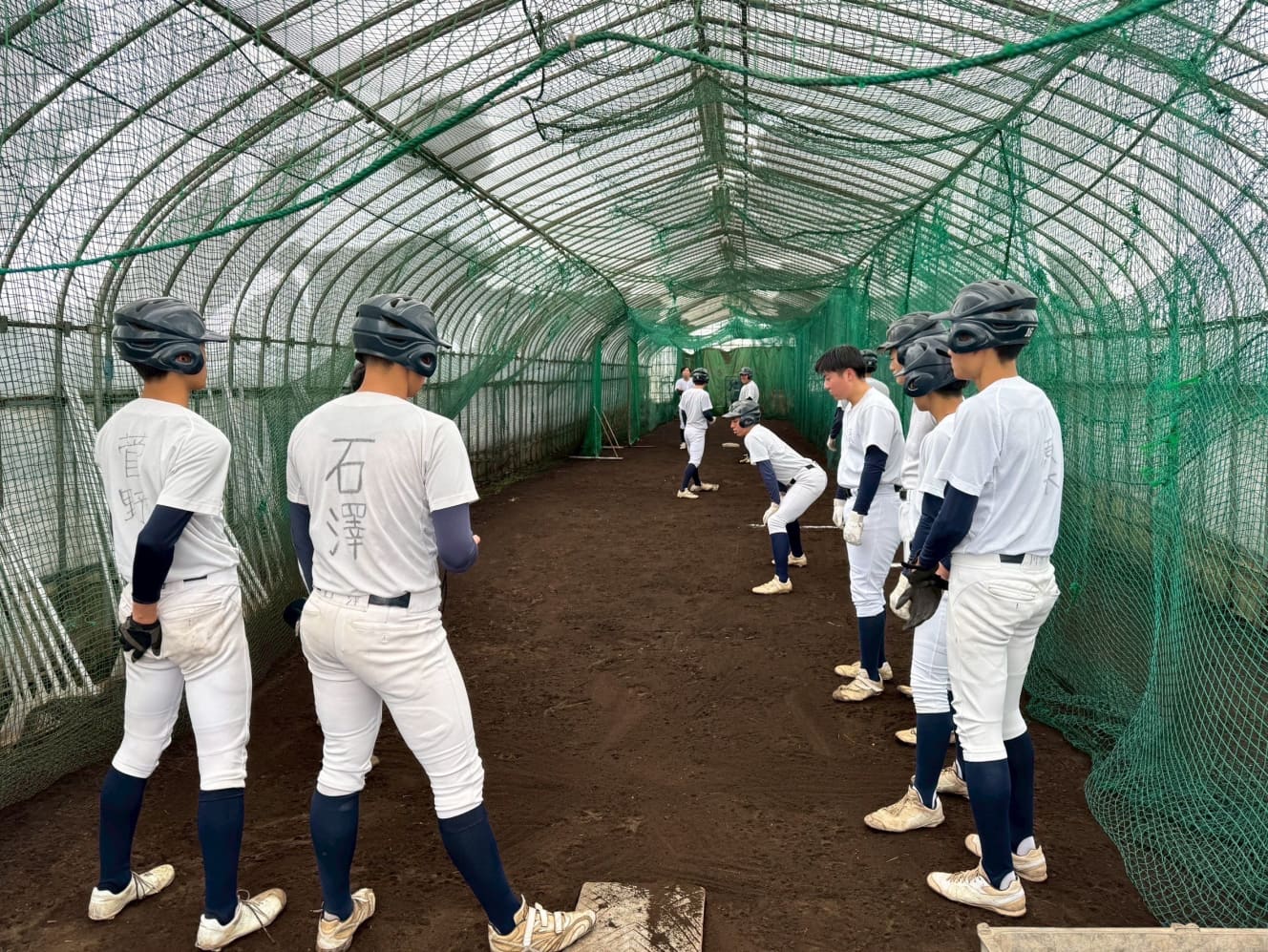
Now, we have night game facilities built thanks to people supporting Sei-ai baseball, and although there’s no indoor practice field, we have a vinyl greenhouse. But when the environment improves, you start to wonder if it’s okay to just stay as we are. I felt it might be better to impose some limitations to develop thinking and resourcefulness.”
When they realize they only have three hours to practice, they don’t want to waste a single minute, so they think of efficient ways to practice. The players are always moving quickly. Their concentration increases. As a result, they secured their third Koshien appearance in four years.
This year, another big change occurred. Until now, they had accepted players from Aomori Prefecture, but now they accept players from anywhere in Japan as long as they understand Sei-ai baseball’s methods and philosophy.
“In 2024, the Japanese team was invited to a tournament in Puerto Rico. We wanted to participate, but unfortunately, it didn’t happen.
However, at that time we made connections with a Japanese team in San Diego, and during summer vacation, players from the San Diego baseball team came to play with us. Even though they are Japanese, those raised in San Diego couldn’t speak Japanese well. Our players couldn’t speak English either. Yet, they stayed in the dorm for a week. After a week, they were able to communicate.
I thought this was a wonderful experience. Meeting kids from different regions broadens your perspective and helps you grow even more.”
This year, there are 27 first-year students. Of them, 15 are from outside the prefecture.
“The idea of gathering good players from outside the prefecture just to get stronger doesn’t exist even one millimeter in my mind. As long as they play baseball, winning is a goal, but the ultimate goal is developing human beings. The main purpose is for them to acquire the qualities to survive strongly in society.”

▼Kazunori Harada – Head Coach of the Hirosaki Gakuin Sei-ai High School Baseball Team. A former player of Hirosaki Technical High School’s baseball team. In 1996, he became a coach at his alma mater. In April 2001, he was appointed head coach with the founding of the Hirosaki Gakuin Sei-ai High School baseball team, and has served as head coach for 25 years to date. Under his leadership, the team has appeared at Koshien three times in summer. He is known for consistently implementing innovative approaches, attracting attention from coaches across the country.

Interview and writing: Izumi Nakagawa PHOTO: Courtesy of Hirosaki Gakuin Seiai High School Baseball Club