Yomiuri Shimbun’s False Report on Ishiba’s Resignation: Why Taro Aso Couldn’t Prevent It


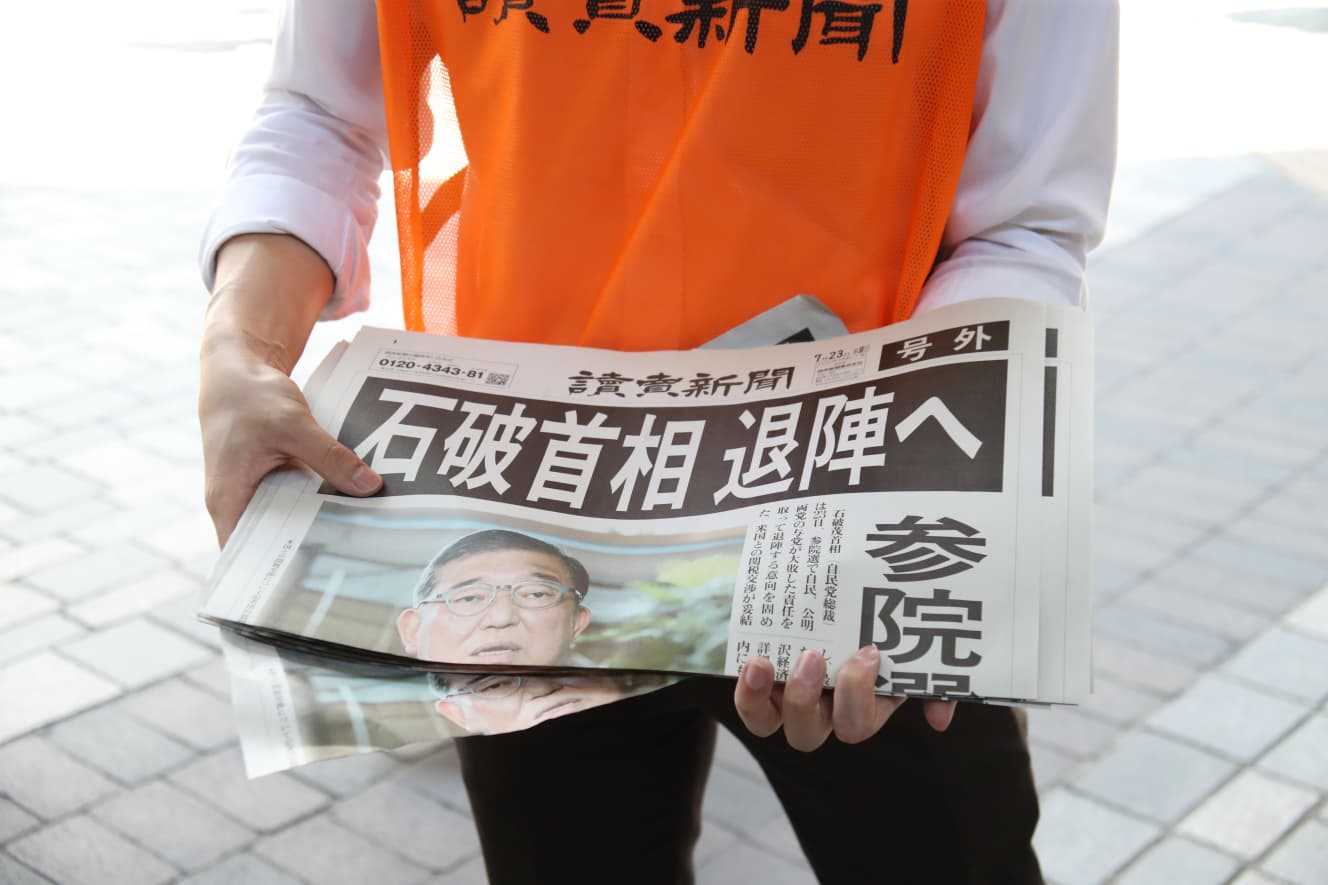
The tones of Yomiuri and Mainichi are subtly different
The turbulent political month of July ended, and August arrived. A national newspaper political reporter lowered their voice.
“Now that makes that Yomiuri Shimbun extra edition false reporting.”
The extra edition in question refers to the Yomiuri Shimbun report on July 23, three days after the Upper House election (voting on July 20), stating that “Prime Minister Ishiba to resign.”
On that day, Prime Minister Shigeru Ishiba (68) achieved a sudden resolution in tariff negotiations with the Trump administration, which he described as a “national crisis.” While succeeding in reducing tariffs from the previous 25% to 15%, he also promised \$550 billion in investment in the U.S., with 90% of the profits going to America.
Putting these evaluations aside for a moment, with the tariff negotiations—a major concern of the Ishiba administration—reaching a tentative conclusion, Yomiuri Shimbun and Mainichi Shimbun confidently reported:
“Prime Minister Ishiba to resign.”
However, the tone of the two newspapers was subtly different.
The Mainichi Shimbun broke the news on its website as:
“Prime Minister Ishiba to resign: Announcement by the end of August following review of Upper House election.”
It suggested that he would review the Upper House election in August and, based on that, indicate his intention to step down.
Meanwhile, Yomiuri Shimbun went so far as to issue an extra edition, stating:
“Prime Minister Ishiba to resign: Takes responsibility for major defeat in Upper House election, to announce within the month.”
The key point was the timing of the resignation. While Mainichi Shimbun stated by the end of August, Yomiuri reported that he would announce his resignation within the month—i.e., by July 31.
However, even after the month changed, Prime Minister Ishiba remained in office. The reporter at the beginning remarked:
“This became a major issue within Yomiuri itself. The political department was proud, saying it was based on thorough interviews with the Prime Minister’s circle, but July 31, the X-Day, has passed. Shouldn’t there be some official announcement externally?”
Not that this is defending Yomiuri, but it is true that during the Upper House election period, Prime Minister Ishiba had muttered to those around him:
“If we suffer a crushing defeat, I’ll have to take responsibility.”
Generally, taking responsibility = resignation is the normal interpretation, but it seems Prime Minister Ishiba’s understanding was different.
The Ishiba ousting was a race against time.
Afterwards, he spoke in an NHK interview:
“I believe taking responsibility means properly settling the tariff issue and ensuring Japan’s survival and prosperity.”
“I act with no personal interest whatsoever, dedicating myself entirely for the people and the future of the nation.”
It might seem like a matter of phrasing but according to someone close to Prime Minister Ishiba:
“There’s a tendency in him to equate truly devoting oneself to one’s duties with ‘taking responsibility.’”
This suggests that Yomiuri, and perhaps even Mainichi, may have misread Ishiba’s thinking.
Demonstrations shouting, “Don’t make Ishiba resign” and various public opinion polls also bolstered the Prime Minister. Immediately after the Upper House election, public sentiment leaned toward “resignation inevitable,” but seeing members of the former Abe faction loudly demanding his resignation likely discouraged many.
As a result, a Mainichi Shimbun public opinion poll conducted on July 26–27 after the election showed 42% saying “He should resign,” surpassing 33% who said, “There’s no need to resign,” with 24% responding “Don’t know.”
Even opposition parties viewed it merely as an internal power struggle within the LDP. Yuichiro Tamaki (56), leader of the Democratic Party for the People, stated:
“I hope the LDP gets its act together. Not having a clear direction or policy could be seen as creating a political vacuum.”
A Nagatacho insider said:
“The ‘Ishiba ousting’ was a race against time. On election day, it was reported that Senior Advisor Taro Aso said, ‘Continuation will not be allowed,’ which signaled that they had to push through quickly. However, with Yomiuri and Mainichi reporting the resignation and the ‘Don’t make Ishiba resign’ demonstrations gaining attention, it gave the Prime Minister an interval. This was a major miscalculation. They had to rethink their strategy.”
It seems unlikely that the LDP could win the next House of Representatives election with Ishiba as Prime Minister but forcibly removing him would also probably not increase approval for a new leader.
“In a sense, Prime Minister Ishiba will brazenly continue governing. It’s not that he will never resign, but I think he is considering the timing of his exit while keeping in mind the possibility of a future return,” said a political correspondent at a TV network.
The post-Upper House election turmoil appears likely to continue into August.
PHOTO: YUTAKA/Afro