Three “wise men” who have eaten instant ramen to the bone have a heated debate: “Let’s decide on the strongest cup noodle!
Scoring Popular Products by Taste, Perfection, and Cost Performance


Cup Noodle Industry in a New Phase of Change
The evolution of ” Cup Noodle,” the absolute champion, continues unabated. On June 9, Nissin Foods launched three new products: “Dashi Shirikomi Cup Noodle,” “Dashi Shirikomi Cup Noodle Seafood Noodle,” and “Dashi Shirikomi Cup Noodle Curry” (279 yen each). Toyo Suisan, following in their footsteps, has also launched new products such as “Menzukuri” and “Maruchan Shomen,” and the cup ramen industry has entered a new period of change.
Which is the best cup ramen of the moment? Food journalist Junnosuke Nagahama, home-made ramen researcher Takero Kanda, and instant noodle hunter Ichiro Yamato had a heated debate to determine the “best cup noodle.
Nagahama: The year before last, Nissin made a splash with ” Misokin ” (300 yen at the time of release), a collaboration with YouTuber Hikakin (36), and this time, “Dashi Shirikomi” was a minor change to the existing Cup Noodles, simply by adding powdered dashi (soup stock). I have the impression that they have taken the high road even further.
Yamato: Although the higher-end series of “Cup Noodle” has been released frequently, the quality of the new “Dashi Shirikomi” is quite high. The curry flavor in particular stands out from the crowd. Curry flavor is a particular challenge for many companies. The king is ” Cup Noodle Curry ” (254 yen), and no one can surpass it. No other product can surpass it. This time, the original “Dashi Shirikomi” has surpassed itself.
–Besides “Cup Noodle”, are there any other products that can be called Nissin’s mainstay?
Yamato: Of course, “Ra-O” is a must. Among them, the “Roasted Sesame Stir-fry ” (307 yen) is outstanding. The spiciness of the chili peppers and the numbing hotness of the “huajiao-kneaded noodles” are a complex combination of spiciness.
The first generation of Nagahama Ra-Oh came in a retort pouch bag with fresh noodles. It was suspended for a while, but the second generation was revived in 2010 with non-fried noodles. Non-fried noodles with a texture similar to fresh noodles was a groundbreaking invention, and a “non-fried boom” followed, with the launch of Sanyo Foods’ “Itadaki” and Toyo Suisan’s “Maruchan Shomen”.
–In terms of quality, Nissin also makes a premium series for Seven-Eleven. Many people recommend the famous restaurant series “Sumire Sapporo Konetsu Miso” (354 yen), “SANTOUKAI Asahikawa Tonkotsu Shio” (354 yen), and “Ippudo Akamaru Shinmi Hakata Tonkotsu” (354 yen).
Kanda: They are all of high quality, but if I had to pick a favorite, I would say “Sumire”. The main restaurant is located in Sapporo, and the soup has fat floating on the surface so that it does not get cold quickly even in cold regions.
Nagahama Sumire also makes use of La-O’s non-fried noodle technology.
–Toyo Suisan, the second largest company in the industry, also has a reputation for its high level of technology.
Kanda My perception of cup ramen changed before and after eating “Maruchan Shomen. Until then, I had the perception that cup ramen and restaurant ramen were two different things, but when I tasted “Maruchan Shomen Houjunkoku Shoyu Aji” (300 yen) in 2003, I felt that it had finally come close to the taste of restaurant ramen. I still remember the shock I felt when I first tasted it.
Yamato: As for Maruchan Shomen, “Niboshaki” (359 yen), which was released in June of this year, is a personal favorite of mine. The soup, which is flavored with niboshi (dried sardines), has an elegant flavor and is filled with crunchy onions. Toyo Suisan is a seafood processor, and they are very good at using dried sardines.
Nagahama: The company has released three “Iida Shoten Ra-men” in the Seven Premium series, all of which are excellent reproductions of the original. They all use the dried sardines to accentuate the flavor.
Yamato “Iida Shoten Shoyu Ramen with Wan Tan” (354 yen) is a middle-of-the-road soy sauce ramen, mellow and rich. I was surprised that they could reproduce it so well at this price.
Nagahama Speaking of Toyo Suisan, the “Gotsuzakari” series cannot be missed. The amount of noodles is nearly 1.5 times that of the company’s “Menzukuri,” yet it can be purchased at drugstores and supermarkets for as little as a canned beverage from a vending machine. Under this inflationary environment, “inexpensive and in quantity” is a friend of the common people. I especially like “Wantan Shoyu Ramen”.
Yamato’s “Gotsubozakari” is one of the two biggest “bucket-type cup ramen” along with Acecook’s “Super Cup”. Nissin Foods also released a bucket-type cup ramen called “Deka-Oh” in 2005, but it could not beat the two giants and was eliminated. The two companies continue to compete fiercely in the “daikon” (large bowl) competition.
If anything, “Gotsusuri” is often sold at a lower price, so if volume is important, “Gotsusuri” has the upper hand.
Kanda I would recommend “Super Cup 1.5x Tonkotsu Ramen ” (259 yen). You can even get a double portion just like the tonkotsu ramen you get at the restaurant. Boil the ramen sticks from Marutai, and if the flavor is too weak, add the powdered soup that comes with the ramen to adjust.
Yamato: I’m actually a Super Cup guy myself, and I recommend the “1.5x Butakimu Ramen” (292 yen). There is a similar product, “1.5X Pork Kimchi Ramen” (259 yen), but Buta Kimchi is sold only at convenience stores and the two are distinguished from each other. The flavors are also different, with Buta-Kimchi having a stronger punch.
Nagahama: I would like to support the quantity and price of “Gotsuzakyu”. In this day and age, it is astonishing to be able to complete a meal for the low 100 yen range. However, since the taste is bland, I recommend topping it with fried bean curd. The fat soaks into the soup and the fried tofu, which absorbs the soup, becomes fluffy and covers the flavor.
Yamato In bucket form, Sanpo’s “Ramen Tengaeten Supervision Tonkotsu Ramen” (292 yen) is another hidden gem. The pork and chicken bone broth, with garlic added afterward, packs quite a punch, but you won’t get tired of it until the end.
–I heard that Acecook has a product that is your favorite.
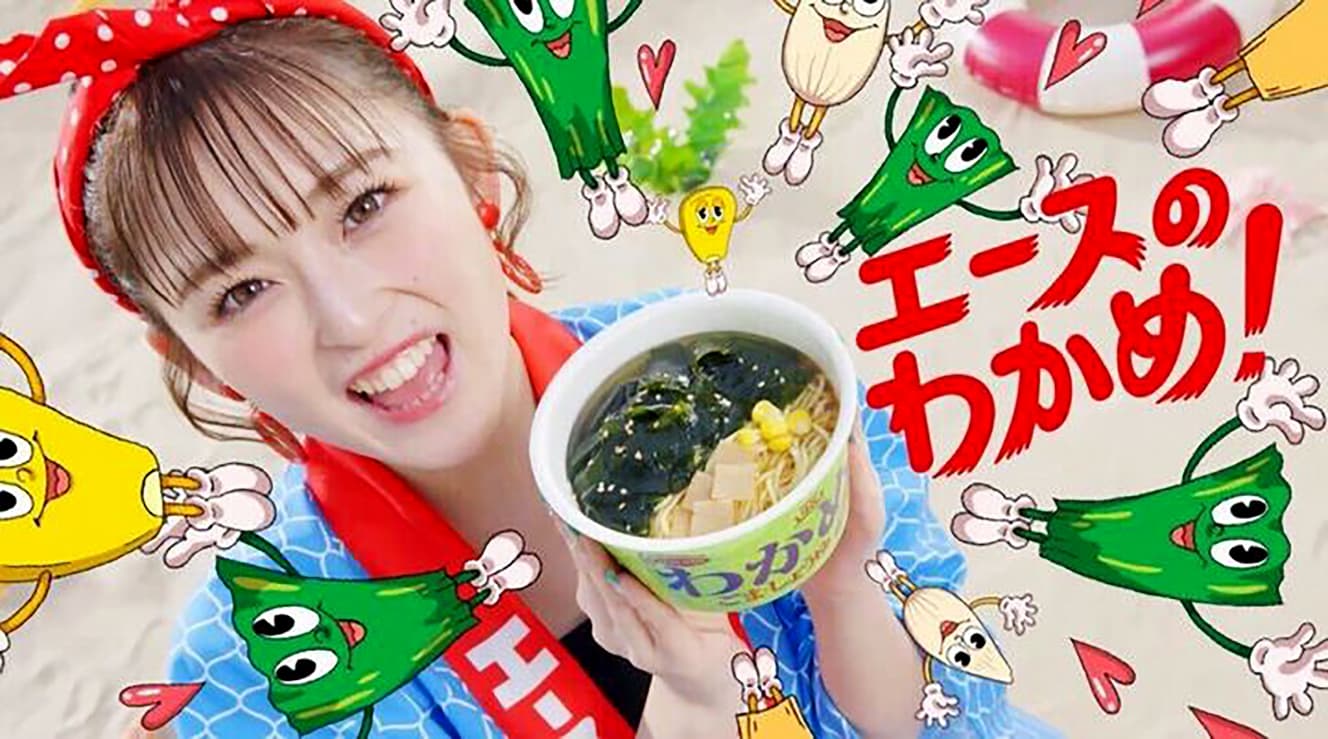
Kanda: If I ask you, “What is your favorite cup ramen? Kanda: If I were asked what is my favorite cup ramen, the Ace Coc’s “Wakame Ramen Sesame/Soy Sauce” (254 yen) would be unquestionably No. 1. The soup is liquid, not powder, and has a strong soy sauce flavor. There is also a large amount of wakame seaweed, and the seaweed broth (dashi) adds depth. The menma is also small but decent. It also comes with a small bag of pepper. It is a cup ramen that has no alternative in my opinion.


For “summer” products, please visit ……
–How about Sanyo Foods?
Yamato “Sapporo Ichiban Gotochi Hot Love Noodle Hakata Junjo Ramen ShinShin Supervision Takidashi Tonkotsu Ramen Tatebig” (278 yen). Mild and sharp pork bone. The combination of flavored vegetables reproduces the ramen of the famous ShinShin restaurant in Fukuoka. The quality of the kata (flat) noodles, which is considered difficult to achieve with instant noodles, is also excellent.
–Now that you are under the umbrella of Nissin Foods, do you have any products of note for Meisei Foods?
Nagahama: Meisei has its own unique techniques, such as thickened soups and oyster balls, and this is well represented in “Meisei Chukazanmai Tatakata Eirin Sour and Hot Noodles” ( 254 yen). The sachet of vinegar is a nice accent, and it’s a taste that makes me want to eat it in the summer.
Yamato “Sour Hot Noodle” is my guess, too. It is neither chili-like hot nor pepper-like numbing hot, but sour and spicy and addictive.
–Now that we’ve talked about “spicy,” what kind of ramen is most popular in the summer?
Kanda Many people must think of Seven’s “Mongolian Ramen Nakamoto Spicy Miso” (259 yen). It is highly favored by lovers of spicy food. The soup tends to catch the eye, but the noodles are also delicious.
Nagahama “Nakamoto” was the best-selling Seven Premium product. It is not in the cup ramen category, but it is number one among Seven Premium products.
Yamato Sugakiya’s “Karasu-o Ramen ” (341 yen), supervised by Menjyo Inosho, is not to be outdone, is it? Personally, I prefer the Karakara Uo Ramen to the Nakamoto Ramen.
Nagahama This product is Sugakiya’s commercialization of the ramen from “Mendokoro Inosho,” which was opened by a man who trained at Nakamoto.
Yamato: Spicy Spicy Fish has been updated every year, and this year it is slightly milder. The flavor and richness of the raayu is wonderful.
Nagahama This is a bit of a stretch, but “Cup Noodle Curry” also makes me want to eat it in the summer.
Yamato Speaking of summer, I would have to say “Cup Noodle Red Seafood Noodle ” (254 yen). It is a limited-time product that is sold every summer, and it has become a tradition.
–What are some of the products you are looking out for?
Nagahama Ace Co.’s “Ichiran Tonkotsu ” (537 yen) is very famous.
Kanda It costs more than 500 yen for just noodles, soup, and sauce, without any ingredients.
Yamato: The success of “Ichiran” has led to a new trend of product development centered on ramen stores. I was shocked when “Sumire All Stars Muranaka no Ippai Miso Ramen” was released last September. It is manufactured by Yamadai, but it is not distributed to the general public; it is sold mainly through the “Sumire” chain stores. It is also available on major e-commerce sites, but the retail price at actual stores is 648 yen! But it is worth it. The noodles are boiled once and then dried to reproduce the noodles. The soup is also rich, with a distinctive roasted miso flavor. The ingredients are also authentic retort chashu pork and fresh bamboo shoots. It’s no longer a cup ramen, but a takeout product from a ramen restaurant.
–If that’s the case, then Mr. Yamato’s “strongest” would be “Sumire All-Stars”?
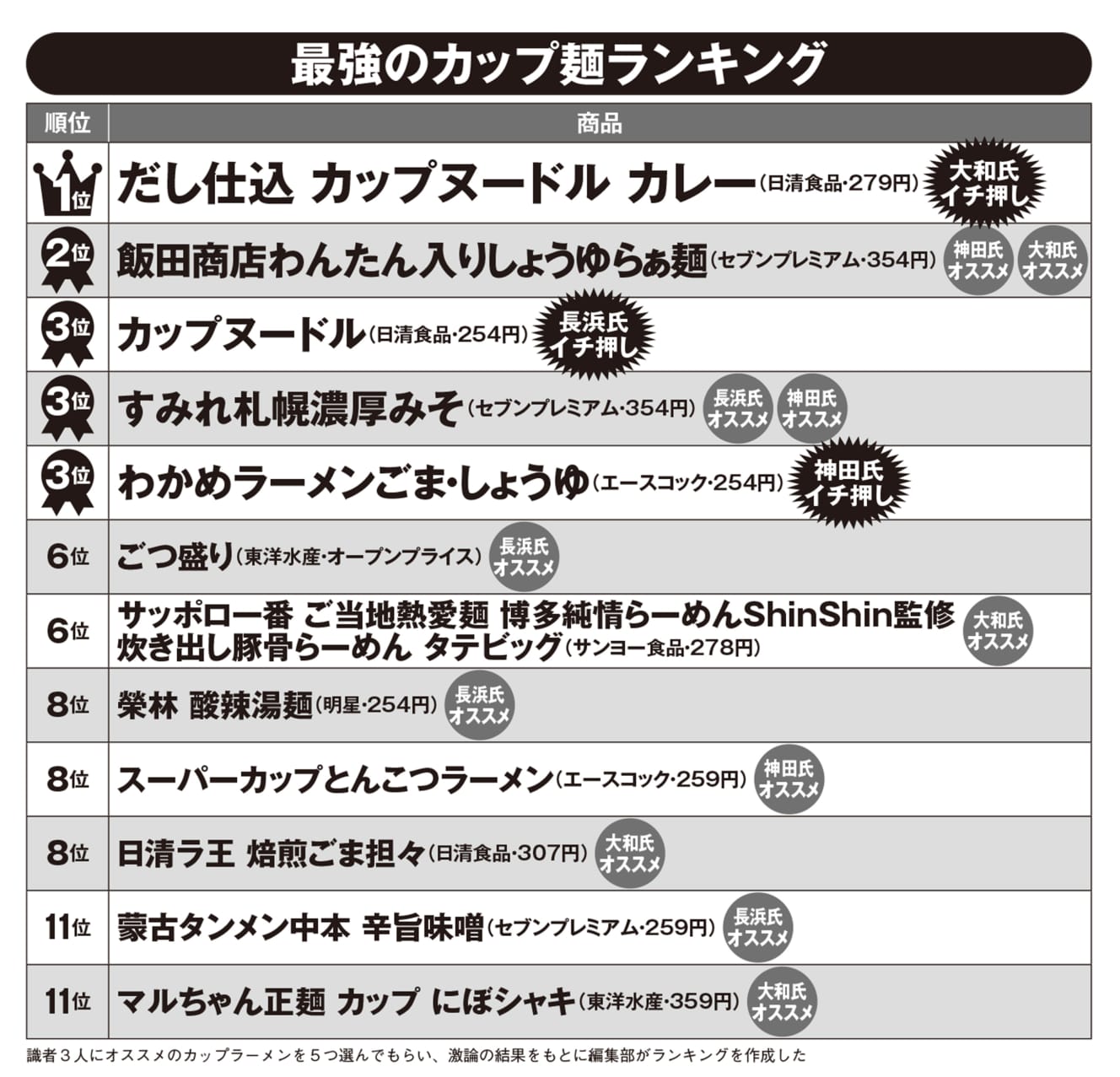
Yamato: The quality of “Sumire All Stars” is definitely the best, but its high price and difficulty in obtaining it are obstacles. Since it is a “cup ramen,” we would like to focus on easy availability and cost performance. I would like to cast my vote for “Dashi Shirikomi Cup Noodle Curry,” which is reasonably priced at supermarkets and convenience stores and has an outstanding taste.
Nagahama: Nissin’s “Cup Noodle” series is still the best, isn’t it? In 1971, Nissin pioneered the world’s first cup noodle market, and while running solo, the company repeatedly made improvements. It is the undisputed king of the market.
Kanda My personal No. 1 is Ace Co.’s “Wakame Ramen,” but I have no objection to “Cup Noodle. There is no alternative, and it is even a genre of Cup Noodle. Among them, “Dashi Shirikomi Cup Noodle Curry” is the pinnacle. The shrimp flavor comes through in the first bite. Curry tends to mute other flavors, but this product was delicious with the shrimp flavor all the way through. The soup is thick and the noodles are the thickest of the three in the “Dashi Shirikomi” series. The simplicity of pouring in hot water and waiting three minutes is also highly appreciated.
The “strongest cup ramen,” which was the result of a heated debate among the three, was a product that symbolized the dynasty’s solidity, with a sense of security and novelty.



From the August 8 and 15, 2025 combined issue of “FRIDAY