At 90, Former Sony Executive and Active CEO Reflects on Lessons From the Company’s Two Founders
Long Interview Part 1


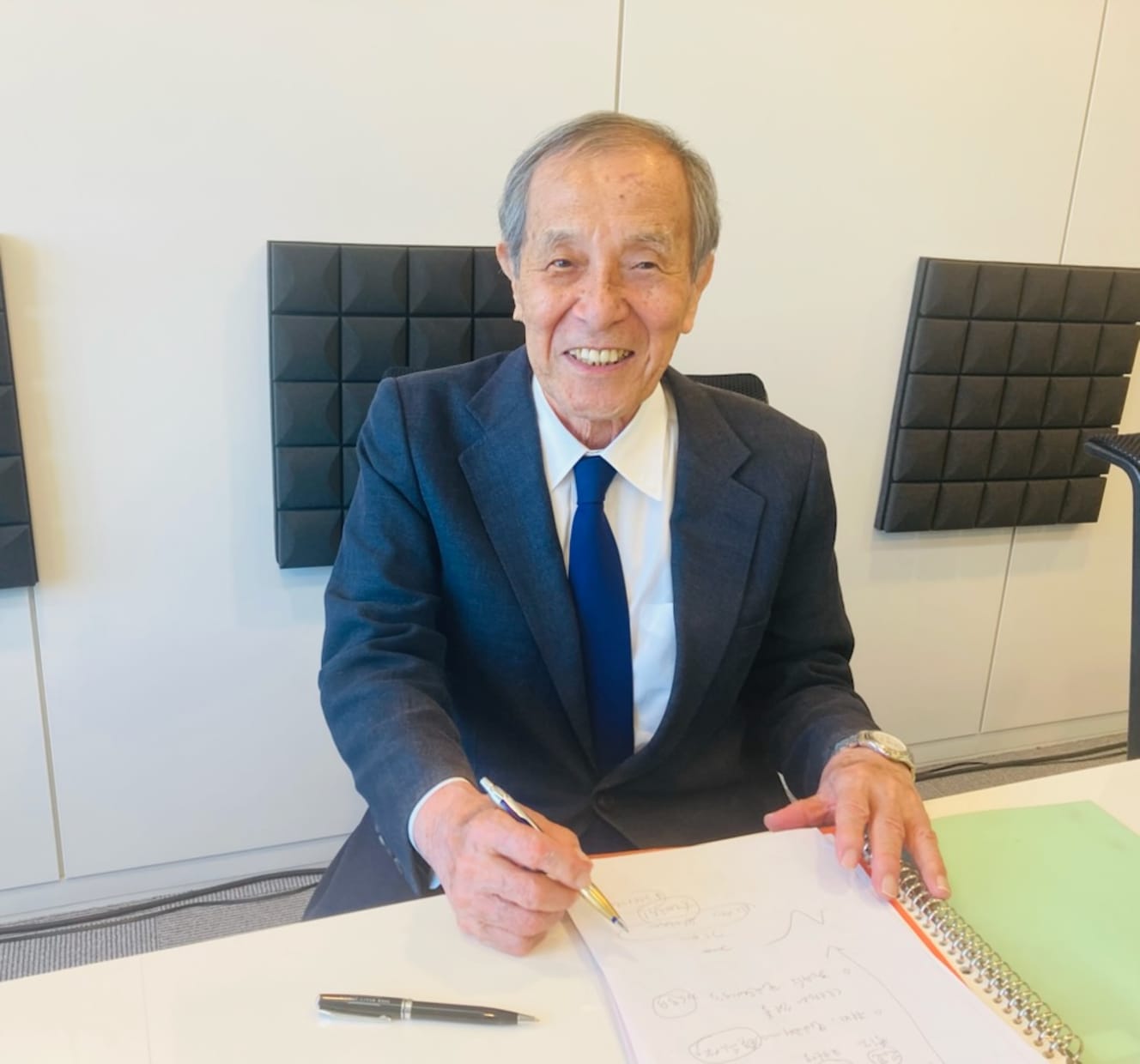
Born in 1935, Shirō Koriyama is now 90 years old, yet he still commutes five days a week as the active president of his company. He himself says, “Right now, I feel the happiest I’ve ever been in my life when it comes to working.”
Despite a glittering career at Sony—serving as an executive and later as president of a group company—why does he feel that now is the happiest time of his life? Before hearing his own words, let’s look back at his profile.
After graduating from Hitotsubashi University’s Faculty of Economics, Koriyama worked at Itochu Corporation before joining Sony in 1959. He was deeply trusted by founder Masaru Ibuka, who often asked him to interpret, and he also received lasting influence on life and work from co-founder Akio Morita, two great leaders who shaped his outlook.
Although he briefly left the company in 1973, he returned to Sony in 1981, where he served as Director of the Information Equipment Division, Managing Director and Head of Corporate Strategy, Head of Procurement, Head of Logistics, and later as President and Chairman of Sony PCL. After leaving Sony, he founded the recruitment company CEAFOM in 2004 at the age of 69, becoming its President and remaining in that role today. Koriyama explains:
“I call the ability to continue working energetically after retirement ‘Senior Freshman.’ If this idea spreads among seniors, it will help bring about real reform in how older generations work.”
Indeed, the way one chooses to work after retirement can greatly raise their happiness in later life. Let’s hear in his own words what Koriyama has discovered as the happiness of continuing to work as a businessman, even in old age.
“I want to experience the detested American society.”
There were three major turning points in Mr. Koriyama’s life. The first was the gunfire he experienced during the war and the sight of the white face of an American pilot.
Born in Ibusuki City, Kagoshima Prefecture, Mr. Koriyama spent his childhood in an era steeped in militarism, and by the fourth grade of elementary school he was already being trained to throw hand grenades. One day, while taking his younger sister, who suffered from dermatitis, to a nearby hot spring inn, they were strafed from behind by an American aircraft. Both narrowly escaped with their lives.
Looking at the face of the American pilot flying low and tilting his plane, Koriyama thought, “What a white face.” Though America was the enemy nation to him—he had lost his homeroom teacher and many acquaintances in the war—he began to think, “I want to experience that detested American society.” The trauma of his wartime experiences and a strong curiosity about America propelled the young Koriyama forward.
After graduating from university, he joined Itochu Corporation with the hope of working in the U.S., but he was assigned to a domestic sales division instead. In his days of disappointment, he noticed a newspaper ad from Sony reading, “Urgent recruitment: trade personnel.” Sony, which had sold Japan’s first transistor radio in 1955, was expanding its market to the world. In the hiring exam, one of Sony’s founders, Akio Morita, decided to hire him, saying, “He’s an interesting guy who says big things.” He was 24 at the time.
Thrilled at the prospect of finally handling overseas business, he was instead assigned to the import division, selling products brought in from the U.S. to the domestic market. Feeling let down, he was soon asked by Morita and the other founder, Masaru Ibuka, to serve as their interpreter. This became the second turning point in Koriyama’s life.
“I had studied English and French at La Salle High School (Kagoshima) and at Hitotsubashi University, but at Itochu they told me, ‘That level is useless.’ Yet at Sony, people were astonished, saying, ‘That’s amazing.’ I even interpreted for the company president and chairman. It must have been a very different standard from what we consider normal today.”
It’s important to be of service to the country
The experiences of serving as an interpreter for Ibuka and Morita had a profound impact on Koriyama’s later life.
“Ibuka was a man of character who believed that what mattered most was being useful to people and to the nation. For him, work was for Japan, with the primary aim of serving the national interest and ensuring the preservation of the country. From his perspective that the degree to which a society protects the weak is the measure of its progress, Sony actively hired people with disabilities.”
With his insatiable curiosity, Ibuka valued what was interesting, and his motto was, “Create things that bring joy to many people.”
“Morita, on the other hand, sometimes did not hesitate in his choice of means to achieve an objective. He was resilient in times of crisis and adversity because he firmly believed that ‘failure is part of business.’”
From Morita’s words, “Sometimes you succeed. A little success is what business is,” Koriyama learned the importance of a spirit of challenge.
“Sayings like, ‘Use the present for the future’ and ‘Take good care of your reputation’ still live on in my heart as a businessman today.”
Later, after an assignment in Switzerland, Koriyama was sent to the United States in 1964 to promote the sale of home-use VTRs. He was 29 at the time. It was through Ibuka’s vision and Morita’s execution that Japan’s electronics industry was on the verge of conquering the global market.
【Next part: “Happiness After Retirement Lies in the Three Y’s of Not Insisting on Salary”】
Photography and text by: Kaoru Natsume
Columnist, novelist, and writer. Born in Akita Prefecture. Graduated from Rikkyo University, Department of Japanese Literature, and has interviewed more than 20,000 working women about their work, love, marital life, and marriage. She has written a column from a woman's point of view, "'Expiration Date' Makes Women Uncomfortable" (Gendai Business), as well as a movie column. Her reports include "Alumni Love" (Fujin Koron) and "The Poverty of Highly Educated Women" (Sunday Mainichi). She has also written about marital problems in such articles as "Women Who Don't Divorce Strategically" (Shukan Asahi). In April 2020, her article in Nikkan SPA ranked No. 1 overall in Yahoo! In 2007, she was cured of Guillain-Barré Syndrome, an intractable disease that affects only one in 100,000 people, without any aftereffects.