Why is the “labor productivity” of Germans about 1.5 times higher than that of Japanese, even though they take 30 more days off per year than Japanese?


Germans don’t do “discovery” with their bosses.
According to OECD statistics, Japan’s per-capita labor productivity in 2011 ranked 34th, far behind the U.S. (4th), France (13th), Germany (16th), and South Korea (26th). What is causing the decline in labor productivity?
In Germany, you don’t have to be disciplined by your boss. I think this is a major factor.
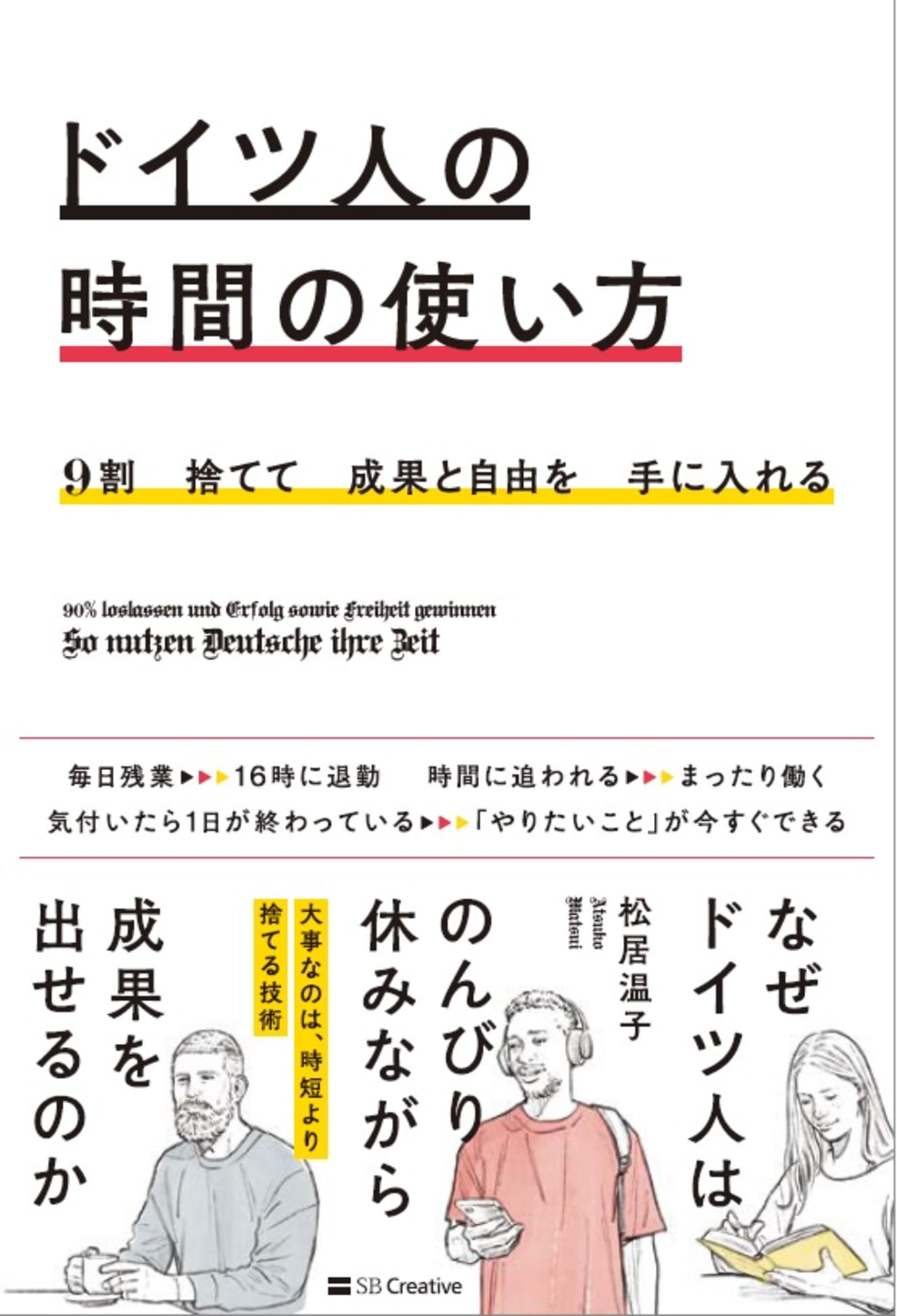
Ms. Atsuko Matsui, author of “How Germans Use Time to Get Results and Freedom by Discarding 90%,” has lived in Germany for a total of 17 years, including her childhood, after working for the Bank of Japan and an education-related company.
The reason why I discipline my boss is because I am concerned about his/her evaluation. If I want my boss to evaluate me, I may work overtime, and it is difficult to say anything that I disagree with him at meetings. As a result, if an employee attends a meeting but does not speak up, his or her productivity for that hour is zero.

In Germany, there is no such thing as “discovery by superiors,” according to Matsui. This is because it is not the boss who makes the evaluation.
In Germany, for example, if you want to become a manager, you have to undergo training, take an examination, and if you pass the examination, you are qualified as a manager and paid accordingly. If you improve your own reputation through “expertise + leadership training,” your job description and responsibilities will change, and your salary will increase.
Some of the larger companies have in-house training programs, but there are also cases where training and exams are given at outside institutions, and basically there is no relationship at all between relationships and career advancement.”
There are no seniors or juniors, and there are no academic cliques. If you are good at what you do, you will be promoted.
Therefore, there is an environment in which power harassment is unlikely to occur. If a subordinate feels pressure from his or her boss and wants to talk about it, there is a well-developed system for consultation. Perhaps because of this, Germans have no sense of harassment, and they are very surprised when I tell them that power harassment and akaharassment exist in Japan.
What will I learn if I join this company?” …… This is not the case in Germany!
With the recent continuation of the seller’s market, I hear that some job hunters in Japan ask, “What will I learn if I join this company?
This is also unthinkable in Germany. German companies want people who can work immediately.
So, by gaining work experience through internships while still in school, university students can show off their achievements and experience by saying, ‘I had an internship at such and such a company,’ or ‘I have such and such skills,’ etc., and thus be able to get a job. It is not enough to just study while in school.”
In Japan, there is a culture of carefully nurturing new employees, but until they are nurtured, productivity is naturally low.
Also, in Germany, there is an educational system called the “dual system” whereby students do not have to attend university, but can become professionals in their desired occupations. After graduating from high school in Japan, students work for a company, study as trainees, and in parallel study at school to become professionals in their respective occupations.
It is no exaggeration to say that in Germany, a company is supported by a group of specialists. In Germany, a group of specialists supports the company. If you want to become a manager, you need to acquire the skills to do so and obtain a manager’s position after having some expertise.
Recently in Japan there has been talk of a labor shortage due to the declining birthrate, but is this the case in Germany? According to the German Federal Statistical Office, the population of Germany as of June 2011 was approximately 85 million. This is less than in Japan.
The problem of a declining birthrate is also present in Germany. For this reason, we have a system to actively accept talented people from abroad. In addition, there are areas where IT In addition, there are many fields where people are no longer needed due to the advancement of IT. For example, in the manufacturing industry, product processes can be left to robots, so although people who handle those robots are needed, people who make products are no longer needed.
The people who will no longer be needed are laid off at an early stage. In Germany, unemployment insurance is provided for up to two years, and retraining programs allow people to work in completely different jobs during the period of unemployment.
It is not uncommon for people who have worked in automobile manufacturing plants to change careers to something completely different, such as becoming IT engineers.
As mentioned earlier, Germany also has a dual system, whereby workers work three to four days a week at a company and spend the remaining days at a vocational school to become professionals in their respective occupations.
Even if you lose your job, there is a safety net that allows you to find another job, so even if you are laid off, it is not as serious as it could be.
With two years of unemployment insurance and a dual system…… Germany has an education system that allows people to become professionals in various occupations, so there is no sense of danger of going off the rails and ending up on the street, as is the case in Japan.
You say that you are actively accepting human resources from overseas as well,
Even so, just because there is a labor shortage doesn’t mean that we are accepting just anyone,” he said. German language skills are a must.
In Germany, we want talented specialists to stay in Germany, so we have a well-developed system for this. Those who become professionals in their respective occupations are granted permanent residency. I don’t think any other developed country has a system to offer permanent residency under such conditions.
Permanent residency is granted to foreigners who have become professionals in specific occupations. For hard-working and dedicated foreigners, it is attractive to have the opportunity to work and live in Germany, where the working environment is good and they can work and live in peace.
Do the Japanese have more potential than the Germans?
However, low productivity does not mean that Japanese people are less capable, according to Matsui.
Rather, I believe that the potential of each individual is higher than that of the Japanese.”
In Japan, for example, it is common for a waiter in a family restaurant to take your order and then tell it to the waiter as he or she walks by,
In Germany, if you approach a person who has taken an order at another table and ask him to take your order as well, he will say, ‘I’ll go get your order after I pass this one,'” he said. They don’t take two or three orders at the same time.
Japanese people are highly skilled at getting the job done in a short period of time. It is said that a job that would take three or four days to complete in Germany can be done in just one day by the Japanese.
So why is productivity so low?
I think they are not receiving proper compensation for the added value of their services. It can also be said that there is a branding issue.
For example, in Germany, service is not free. For urgent work, the price goes up. There is also a tipping system. The idea is that all services are paid for.
In terms of branding, cars such as the Mercedes Benz AMG, stamped by Germany’s highest qualified Meister, sell very well. Japanese cars don’t break down, and their maintenance support is very friendly and reliable, but their value is not reflected in the price as compensation.”
According to Matsui, the reason for low productivity may lie in the fact that value is not properly expressed and reflected in the price, and that branding is weak.
Omotenashi is another area where the Japanese excel,” Matsui said. Some Europeans now think that if they go to Japan, they will get everything done for free.
I feel that the services that Japanese people provide out of goodwill and conscience are valued but not reflected in the price.
I think that Japan should also charge a price for its services. Productivity will not increase if service is considered free. Service is a great value. People spend a lot of time devising and providing services for others. I think it should be calculated as a respectable cost.
Perhaps, Japanese people do not realize the value of Japanese people. When I go abroad, I often feel that Japanese people’s service is still great. It seems important to monetize these points as value.

Atsuko Matsui attended a local school in Germany for 6 years from the age of 8 to 13 due to her father’s job transfer . After graduating from Keio University, Faculty of Law, Department of Law, she worked for the Bank of Japan. After receiving numerous requests for advice on the lack of hope for the future, she found a solution in the German Meister System and established DaVinci International, Inc. with Tetsuo Takano. Ltd. with Tetsuo Takano.
Interview and text by: Izumi Nakagawa PHOTO: Afro