Are Pre-Owned Condos Really a Bargain? Reasons Behind the Hype and Tips for Smart Buying


The price of a new condominium exceeds the price during the bubble period
140,490,000 yen.
What kind of figure is this? It’s the average price of newly built condominiums released in May in Tokyo’s 23 wards. In the past, a home price was considered affordable if it was around five times your annual income. But now, it’s said to be six to seven times. By that metric, only those earning over 20 million yen annually would qualify. While we frequently hear about rising labor costs and building materials, hasn’t the price increase gone a bit too far?
“In Tokyo, the average condo price is now 18 times the average income—creating a market that leaves real demand behind. But remember, this is just the average, not the median.
The central city has demand as an investment destination, prompting developers to roll out ultra-luxury condos—so-called ‘oku-shon’ (100-million-yen-plus condos). Some are priced at 1 or even 2 billion yen, and those push up the average. In more livable, slightly outlying areas of the 23 wards, new condos are still being sold for around 60 million yen, which is just within reach. So don’t be misled by the average figures. That said, current prices have already surpassed those of the bubble era, so I recommend looking at used condos.”
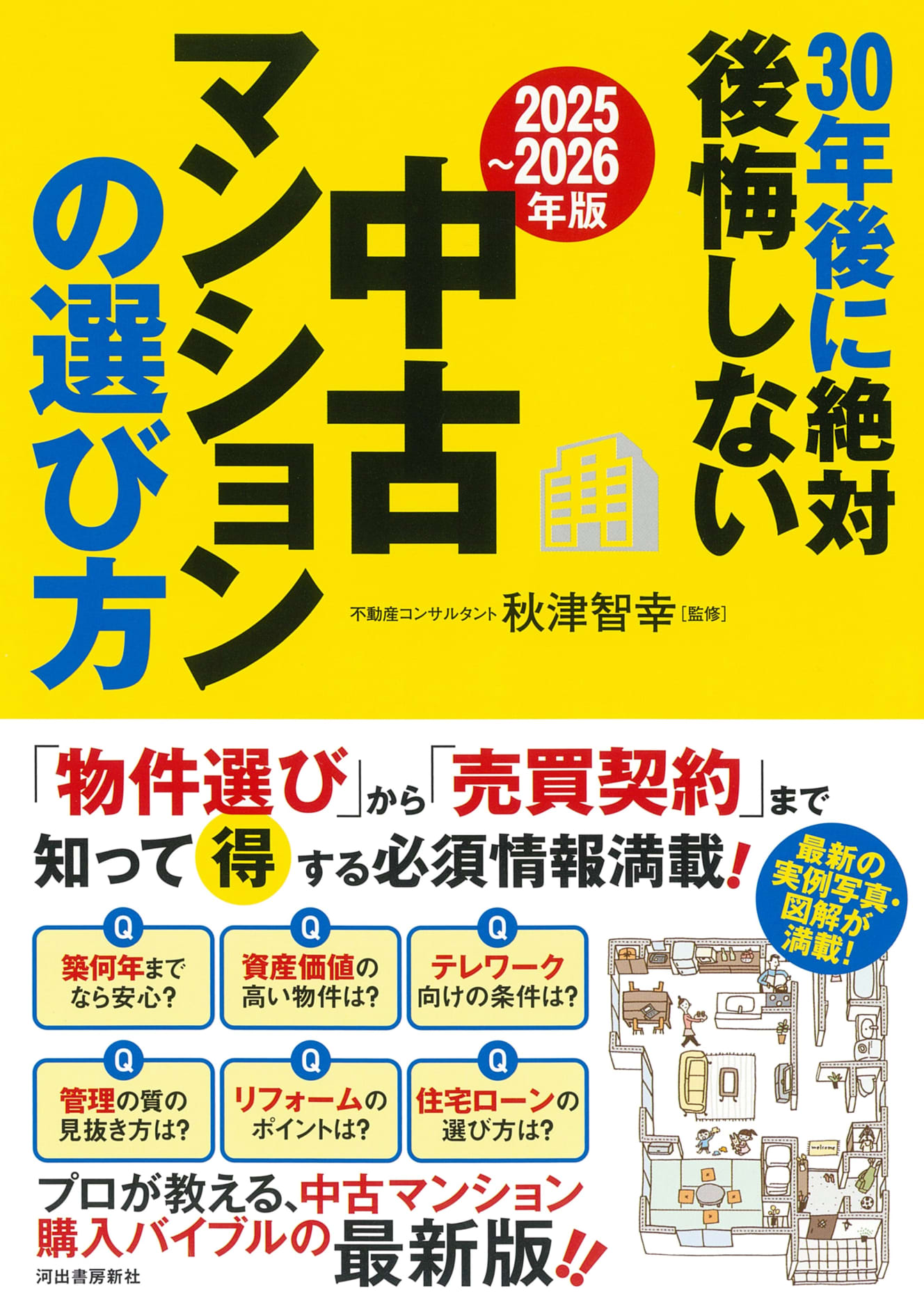
So says real estate consultant Tomoyuki Akitsu, who supervised the book “How to Choose a Used Condo You’ll Absolutely Never Regret in 30 Years” (Kawade Shobo Shinsha).
The surge began with rising rice prices, and food costs continue to climb. The Bank of Japan has raised its policy rate to 0.5%, ending its long-held zero interest rate stance. Fixed-rate housing loan rates are also on the rise. While prices go up, wages haven’t kept pace—making it hard to say that household finances are healthy. In light of this, turning one’s eyes to pre-owned condos as a realistic option feels only natural. Akitsu adds, “There are several reasons why buying used is actually advantageous,” and continues.
In some cases, sales tax is not charged.
“Newly built condominiums include costs for model rooms and advertising. Model rooms are often constructed before the building is even completed, furnished to look appealing and make people want to buy—but eventually, they’re torn down. While some developers create model units within the building itself to cut costs, a typical model room can cost several tens of millions of yen, and in some cases, exceed 100 million. These costs are all added onto the sale price.
Also, if a well-known celebrity is used as the campaign’s image character, their appearance fee is added as well. Labor costs, company profits—all of these are factored into the price of a newly built condo,” explains Akitsu (all following comments are also by him).
Naturally, used condos don’t carry those additional costs. Unlike new properties, the only extra fee for a secondhand condo is typically the brokerage commission. And if both the seller and buyer are individuals, there’s no consumption tax either.
“If the seller is a real estate company, consumption tax does apply, but if the seller is a private individual, it’s tax-exempt. There are companies that renovate and resell used condos, but since the seller in those cases is a real estate company, the sale is subject to tax.”
Common facilities should be simple properties.
The so-called “hidden gems” you hear about in the market are virtually nonexistent. While it might seem like there are properties being sold below market value by financially distressed owners, most listings are priced in line with market rates.
“If a seller wants to unload a property below market price, the real estate agency is the first to find out. They’ll often buy it themselves, mark it up, and then resell it at the going rate. On the flip side, if a seller lists a property at an unreasonably high price, it won’t attract buyers. Eventually, they’ll have to accept a large price reduction, which still ends up around the market level in the end.”
One thing to watch out for when purchasing is the shared facilities. Large-scale condo buildings sometimes feature guest rooms, kids’ playrooms, fitness rooms—even fountains at the entrance.
“Those shared amenities aren’t necessarily for practical use—they’re often just for standing out from other properties. But over time, as you keep paying monthly maintenance fees and reserve funds for repairs, you may start to resent covering the upkeep of guest rooms or kids’ spaces you never even use.
To give an extreme example: if you live on the first floor, you never use the elevator—but as a unit owner, you still pay your share of its maintenance. Water features like fountains or biotopes are particularly expensive to maintain, which is why newer buildings tend to avoid them. While luxurious shared facilities may look attractive at first glance, they become a burden on residents. That’s why you should opt for a building with simpler, more practical common areas.”
So when is the right time to buy?
For readers who don’t yet own a home, one of the biggest questions is likely: “Is now the right time to buy?” With prices on a steady upward climb, is it better to wait?
“Even experts thought prices would drop after the Tokyo Olympics—but instead, they’ve continued to rise. If you come across a property that feels right, I’d say go ahead and buy it. Interest rates are starting to climb, but they’re still around 1%. Back in the early Heisei era, even the so-called ‘low’ rates from the Government Housing Loan Corporation were over 4%. By comparison, today’s rates are still a bargain.”
The zero-interest era following the burst of the bubble economy—Japan’s so-called “lost 30 years”—was the anomaly, not the norm. With the Bank of Japan expected to raise its policy rate to 1% in the near future, mortgage rates will inevitably follow. Meanwhile, the effects of a shrinking population are unavoidable; even Tokyo, which has seen continuous population inflow, is projected to enter population decline by 2040.
“As housing loan interest rises, the total repayment amount increases, limiting the pool of potential buyers. We’re also approaching a generational shift: children of baby boomers will soon start inheriting their parents’ homes, particularly in urban areas like Tokyo. At some point soon, demand will sharply decline.
That said, no one knows exactly when that shift will happen. It’s like the stock market—if you buy into a company because you believe in it, you’ll likely hold onto it regardless of fluctuations in stock price. If you find a condo you truly want, the same logic applies: whether prices go up or down afterward, you probably won’t regret the purchase.”
So why not start by going to view some secondhand properties?

Interview and text by: Daisuke Iwasaki