Remote Posters Signal Shiori Yamao’s Unexpected Election Surge


The Liberal Democratic Party’s Platinum Badge remains intact an incredibly lavish kick-off rally as well

The Hotel New Otani, which served as a filming location for the Sean Connery movie You Only Live Twice (1967), houses the “Fuyo-no-Ma” banquet hall, often used for receptions by prominent figures from various fields.
On July 7th, this Fuyo-no-Ma hosted a kickoff rally for Daichi Suzuki (58), who is running as the Liberal Democratic Party’s official candidate in Tokyo’s electoral district for the 27th Regular House of Councillors Election. Suzuki, a gold medalist from the Seoul Olympics, said:
“I’ve jumped into pools many times before, but this time, I’m taking the plunge into the political arena.”
The rally was attended by Tokyo Governor Yuriko Koike (73), LDP Secretary-General Hiroshi Moriyama (80), former Olympic Minister Toshiaki Endo (75), Barcelona Olympic gold medalist Kyoko Iwasaki (46), and Hanae Ito (40), who competed in both the Beijing and London Olympics, among others. Representatives from various groups that have long supported the LDP’s elections also gathered, alongside LDP members of parliament and Tokyo Metropolitan Assembly members.
“We want you to energize the country and Tokyo through the power of sports,” said Governor Koike, who had also shown strong presence in the June Tokyo Metropolitan Assembly election, prompting enthusiastic applause from the audience.
In Nagatacho, becoming an official LDP candidate is referred to as the “Platinum Badge.” The party has long cultivated strong ties with groups such as agricultural cooperatives, post offices, religious corporations, medical associations, and the construction industry.
Not only national lawmakers but also many city council members belong to these groups, and securing official endorsement is often seen as almost guaranteeing election. Suzuki’s confident demeanor as he bowed his head in a prestigious hotel spoke volumes.
Labeled a fringe candidate but changes are happening around her

At nearly the same time as Suzuki’s kickoff rally, former House of Representatives member Shiori Yamao (50), running as an independent, was sweating it out giving a street speech near Takashimaya by Futako-Tamagawa Station with five volunteers.
“I have run as an independent candidate in the House of Councillors election. I talked about the foundation of this country, such as the issue of a female emperor and constitutional revision.”
On June 10, she held a press conference announcing her candidacy as a proportional representative candidate officially endorsed by the Democratic Party for the People (DPFP), but she faced heavy criticism over past infidelity scandals and had her endorsement revoked on June 11. Since the House of Councillors election districts are on a prefectural basis, many assumed she would not run. However, on July 1, she announced her independent candidacy for the Tokyo electoral district.
“The Tokyo district election is a combined election for 7 seats — 6 up for re-election plus 1 vacant seat. Though it seems there are many chances with 7 seats, winning requires roughly 600,000 votes, a tough number for an independent candidate. She was mocked as a desperate candidate, considered a long shot, but lately crowds have started gathering around Yamao,” said a political reporter from a national newspaper.
During the first half of the street speech, Yoshinori Kobayashi (71), the manga artist and author of “Gomanism Declaration,” took the microphone and helped draw the crowd. On the last Sunday before the official campaign end on July 13, fellow DPFP members who were Yamao’s election-year peers when she was elected in 2009 — now independents — House of Representatives member Nobutaka Fukushima (54, Ibaraki 1st district) and former House of Councillors member Toshio Ogawa (77) spoke in support.
After the speech, Fukushima expressed confidence in her chances:
“This election is strange, with xenophobia rampant and both right and left shouting loudly, but the moderate center is wide open. Yamao’s policies are squarely centrist, and the audience reaction has been good. If she can overcome this election, she could become a major political figure.”
After the isolated press conference, people have begun to gather. Although she isn’t even mentioned in major newspaper polls yet, the number of volunteers accompanying her increases daily. Interestingly, even Liberal Democratic Party staffers are paying close attention.
Ishimaru’s Posters Everywhere at Zero Cost
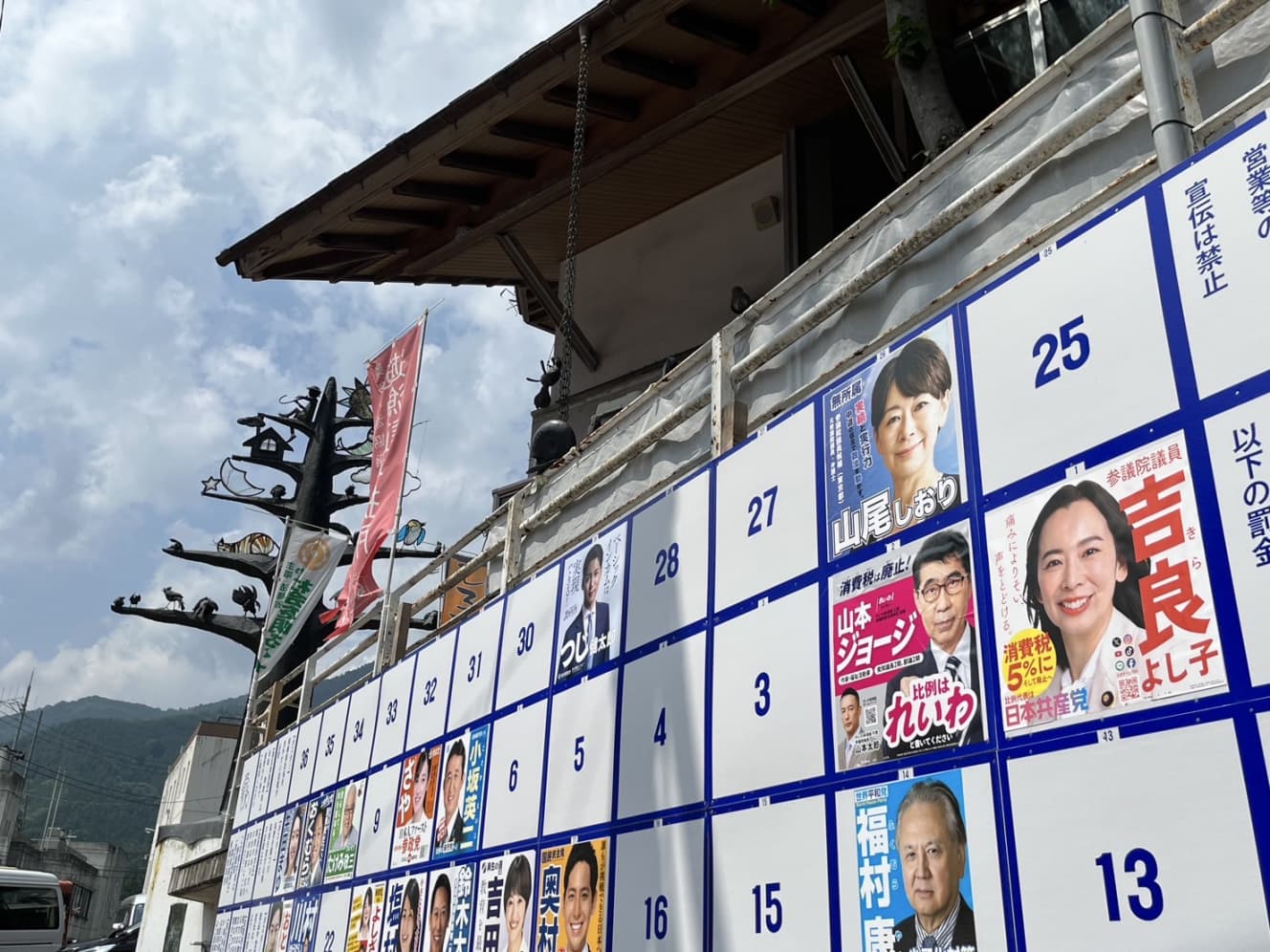 Thanks to volunteer cooperation, posters of Shiori Yamao are put up in almost all locations across Tokyo. (Provided by Yamao’s office)
“Paying Attention to Poster Placement”
A party staffer who has handled election campaigns in many tough districts spoke on condition of anonymity, saying:
“Candidates affiliated with national political parties pay money to moving companies or courier services in block units to post their posters all over Tokyo. It costs a considerable amount, but the posters are up by the official campaign start date, and the election campaign system is set up. Independent candidates without party backing don’t have money, so they rely on volunteers.
There are about 14,000 poster boards across Tokyo, and even within the 23 wards, some places inevitably go unposted. But Yamao’s posters are being put up with tremendous momentum. Shinji Ishimaru, who surged to second place in last year’s Tokyo gubernatorial election, had volunteers running around the city and achieved posting on all locations at zero cost, which became a hot topic in Nagatacho. I feel that Yamao has that same momentum.”
On the 13th, confirming with Yamao’s office revealed that out of the 14,000 poster boards in Tokyo, almost 90% have been posted through volunteer efforts, with about 1,300 lefts. Yuko Kimura, a volunteer in charge of the Okutama area, said:
“For an independent candidate, even posting one poster is tough. But Takahiro Yasuno, an AI engineer (34), developed a map for poster placement using programming in the last gubernatorial election, and he has made the program code and know-how public so it can be used in other elections. Still, we have to go to each location and put up posters by hand.
The Okutama area is so green it hardly feels like Tokyo. I barely managed to get to two poster boards in front of the Nippara Limestone Cave. There is also a poster board at the end of the Mitake Mountain cable car, but considering efficiency, I skipped it. I used five days of holidays and posted on 300 boards, but I was struck by the difference in organizational power when I saw the two LDP candidates’ posters everywhere.”
As the only local politician volunteering, Asako Tanaka, a Suginami ward councilor, wiped the sweat dripping from her brow and said:
“On the first day, we held the first speech in front of JR Kichijoji Station where our office is, then moved to Mitaka and Musashisakai stations for speeches around Musashino City. Actually, we didn’t have an election car yet, so that’s why.
On the second day, I went to Oshima Island also without an election car, posting posters along the way.
After three days from the official campaign start, we finally got an election car and could tour Tokyo. I was worried inside, but now there are even people joining the rallies waving Yamao fans like at an idol concert. Local politicians also greet us at campaign stops, saying ‘We support you’ and taking posters and flyers. I feel we may be reaching a turning point.”
After the speech on the 13th, when approached, Yoshinori Kobayashi said:
“I expect Daichi Suzuki will top the election.”
But he added:
“Still, that means politics will continue under old customs. Holding gatherings at luxury hotels costs money. Governor Koike attending Suzuki’s rally is likely due to political interests and alliances. Organizing a campaign with support from national and local politicians — how much longer will we keep doing these outdated things? We need to send people to politics who work for the public good.”
On days exceeding 30 degrees Celsius, Yamao finishes her speeches and quickly rushes to shake hands with the crowd. She seemed to have fallen while running, bruising under her chin. Councilor Tanaka said:
“I’m not helping because I feel sorry for her. She is as capable as a party leader, and I want her back in the Diet, so I support her. The House of Councillors election period lasts 17 days, so something might happen.”
In the fiercely contested Tokyo election with 32 candidates vying for 7 seats, will Yamao become the dark horse?


Interview, text, and photos: Daisuke Iwasaki