LDP’s Massive Party Fees Linked to Ghost Members Paid for Official Registration


The party fees are a major source of income for the Liberal Democratic Party (LDP). With over one million party members, the total amount of party fees for the LDP is said to reach nearly 4 billion yen annually. However, doubts have arisen regarding the actual existence of the members paying these fees. This report delves into the reality of the so-called ghost members list said to exist within the LDP.

“Who on earth is letting something like this circulate?! I’ve been cooperating as a party member, but seeing a list like this is just troubling.”
Kazuo Sugiyama (pseudonym), who lives in Yokohama City, Kanagawa Prefecture, changed color the moment the FRIDAY Digital interview team showed him the membership list. The list in question was the Liberal Democratic Party’s membership roster collected by Tomohiro Yamamoto, former Deputy Defense Minister (Kanagawa 4th electoral district, lost in the 2024 House of Representatives election).
However, there is one puzzling point about this list, which contains names of LDP supporters: nearly 30 party members are registered at a single apartment unit where Sugiyama lives. Of course, 30 people do not actually live in Sugiyama’s home. In other words, the list includes names of ghost members who don’t really exist.
As the investigation into this strange ghost membership list progressed, it revealed the reality that the party membership system—intended to allow citizens to participate in politics and have their voices reflected in party decisions—has become merely a numbers game for politicians seeking official endorsement. What issues lurk behind the LDP’s huge party fees, involving over one million members and nearly 4 billion yen moving annually?
50 people registered as living in one apartment
Under the LDP’s party membership system, regular members pay an annual fee of 4,000 yen, while family members pay 2,000 yen. After maintaining membership for two years, members gain voting rights in the party leadership election. However, this system has been abused, and ghost members lurk in the membership lists.
In 2018, the membership list collected by Mr. Yamamoto included dozens of members—ranging from 30 to 50 people—registered under the home addresses of his secretaries and multiple supporters. The list featured one surname like “Toyama” or “Shimada” (pseudonyms), followed by a long lineup of given names such as Rokuro, Shinrokuro, Rokurouta, Shinrokurota, Kume, Tome, and so forth.
The residence of Mr. Sugiyama mentioned earlier is an ordinary apartment building, yet nearly 30 members were registered there as well. Additionally, one secretary lives in an apartment roughly the size of a one-room (1DK), but 51 ghost members were registered at that address, making it physically impossible for all to reside there.
When visiting the home of another supporter where 40 members were registered, a family member admitted, “I was asked by Mr. Yamamoto’s office secretary.” regarding the fictitious registrations. When asked about the payment of membership fees for those 40 people, they admitted, “No, we haven’t paid.”
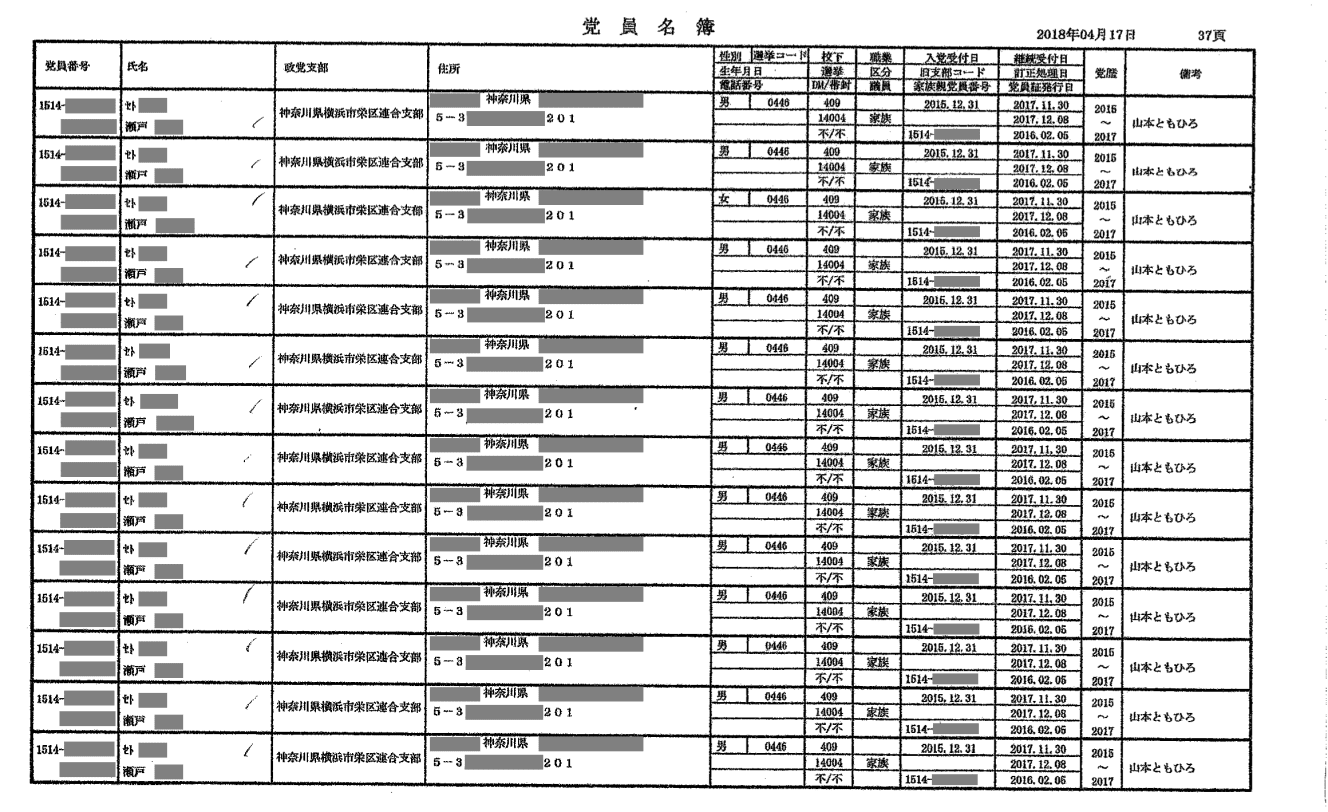 A portion of the ghost member list showing the address of the apartment in the photo. This address was listed as the residence of as many as 51 party members. However, when reporters actually visited the site, it was clear that the space was far too small to accommodate 51 residents.
Quota system that pressures lawmakers
Why did Mr. Yamamoto register phantom party members? Professor Hiroyuki Uwaki of Kobe Gakuin University, who has long investigated political funding issues, points out, “Behind the phantom party members lies a structural problem within the Liberal Democratic Party (LDP).”
“The LDP had 5.47 million party members at its peak in 1991, but this number plummeted due to the neoliberal Koizumi structural reforms. The rise of non-regular employment and cuts to public works widened social disparities, causing many party members to abandon the party. Later, after the Democratic Party took power in 2009, by the time the second Abe administration started at the end of 2012, party membership had dropped to around 730,000. In response, the party-imposed quotas on lawmakers to recruit party members, but in an expanding disparity society, few people were willing to pay money to become party members. As a result, lawmakers began creating phantom party members to avoid penalties.”
The quota imposed on lawmakers by the LDP requires national parliament members to gather 1,000 party members, prefectural assembly members 200, and city council members 50. Failure to meet these quotas generally means no party endorsement. “Mr. Yamamoto’s mass creation of phantom party members was largely driven by this quota,” revealed an LDP insider.
“Yamamoto came parachuting from Kyoto to Kanagawa’s 4th district in 2012 with a very weak local support base. He admitted it would be hard to win in the single-seat constituency and ran his campaign relying on a strong relationship with former Prime Minister Yoshihide Suga (76) and a proportional revival seat. Because of this, his motivation to gather party members was low, and it was considered impossible to collect 1,000 members on his own.”
This is not just about Mr. Yamamoto. After the October general election last year, it was revealed that LDP member Hiroaki Tabata (52), elected from Toyama 1st district, registered 262 phantom or unauthorized party members. Tabata explained that relatives registered employees of companies as party members and paid the fees, but no evidence was presented proving the members’ actual existence, leaving it a mystery whether those members were real.
The LDP insider said, “Only lawmakers with strong local power who can always win their constituencies can gather over 1,000 members. Except for a few, like Shigeharu Aoyama (about 12,000 members) and Sanae Takaichi (about 8,000 members), most can only manage a few thousand at best.” However, the party headquarters continues to impose strict quotas amid a declining local economy.
“They impose quotas without creating an economic environment where members can be recruited. Ultimately, the LDP’s policy failures are strangling lawmakers, forcing them to create phantom party members,” said Professor Uwaki.
As noted earlier, the original purpose of the party member system is to enable citizens to participate in politics and reflect their voices in decision-making. But currently, opaque methods are used just to meet quotas, turning the system into one where paying money guarantees party endorsement, lamented an LDP official.
“Being able to gather party members is proof of a lawmaker’s support. But the membership system has become mere number padding unrelated to real support. It’s absurd to endorse lawmakers who inflate membership with untraceable money.”
The suspicions don’t stop here. This phantom party member list may also be used to launder corporate donations. The next article will investigate this reality.