How Fake Salons and Pretty Faces Are Fueling a New Wave of Scams
Bijinkyoku Case Files [Part 2



Sex industry journalist Akira Ikoma explains the various tactics of modern-day honey traps in the second part of “The Honey Trap Case Files”. This article highlights cases involving tactics used on SNS and in men’s esthetic salons, referencing past incidents.
Honey traps using social media are also on the rise.
In March 2024, a tragic incident occurred in Osaka when a 22-year-old male university student fell to his death from the rooftop of a building while trying to escape a honey trap. The Osaka Prefectural Police arrested a 14-year-old girl in her second year of junior high school and a 15-year-old boy in his third year of junior high on suspicion of robbery resulting in death. Additionally, a 13-year-old boy, who was in his second year of junior high at the time, was referred to a child consultation center.
The girl and the second-year junior high school boy pretended to be a fictitious 17-year-old girl on social media and lured the university student to the building. The plan was for the boys to then appear and extort money from him.
Similar incidents have occurred in Shizuoka City, Yokohama City, and Matsue City. Social media isn’t necessarily a tool specialized for meeting the opposite sex, but since it’s easy to pose as a woman by using someone else’s images, it is often exploited for crimes. Many platforms do not require strict identity verification, making it relatively easy to create accounts—one reason why the perpetrators tend to be very young.
Honey traps are also frequently occurring in men’s esthetic salons.
On March 5 of this year, a former YouTuber and current men’s esthetic salon owner (31) and a university student (20) who conspired with him were arrested by the Tokyo Metropolitan Police on suspicion of extortion, after they falsely accused a man in his 30s of touching a female employee and extorted a total of 500,000 yen.
The YouTuber had previously been active as a “citizen arrest”-style YouTuber advocating for the eradication of groping. The honey trap group they belonged to is said to have extorted nearly 80 million yen in total from around 240 victims.
“Get the customer excited and make him touch you.”
In August 2022, a business owner and a female employee were arrested for setting up a men’s esthetic salon for the purpose of conducting honey traps.
The owner instructed the female employee, “Get close to the customer on purpose, get him excited, and make him touch you,” effectively encouraging prohibited acts. The owner and the manager monitored the scene via surveillance cameras from another room, and once the customer acted, they would barge in and extort money from him.
One of the victims was threatened by the manager and others with lines like, “It would normally be 2 million yen, but we’ll take 500,000. If you don’t pay, it’ll become a police matter—what do you want to do?” and “You’ll end up in prison.” He was forced to pay 100,000 yen on the spot and sign a settlement agreement to pay the remainder in installments. Since he had signed a consent form before the session agreeing to pay 2 million yen if he touched the woman, he didn’t particularly question the settlement.
While male victims who engage in prohibited acts despite agreeing not to bear some responsibility, many men’s esthetic salons offer sexually suggestive services to attract customers. These despicable acts exploit the gray zone of legality and prey on customers’ desires. Precaution is necessary, such as checking online reviews and forums in advance to confirm whether the salon is legitimate.
Honey traps by street prostitutes in Shinjuku are also malicious.
When the woman goes to a hotel with a customer, she keeps her phone call connected so that her accomplice knows the room number. After receiving money from the customer, she hesitates to undress. Then the accomplice bursts in, accusing the customer: “You’re trying to rape my woman,” while taking photos of his face and ID. The customer is then forced to withdraw around 300,000 yen from an ATM. The extortion continues into the following week, using the photos as blackmail.
It is said that a honey trap group was once actively operating in Shinjuku. A woman in on the scheme would agree to meet with a customer, then be tailed to the hotel. She would suggest filming, then accuse the customer of secretly recording her, extracting a “nuisance fee.” Although they pretended the accomplice had rushed to the scene after being contacted, he had actually been waiting nearby in a park.
There are many other honey trap variations, such as claims of “you came inside me without permission” or “I’m underage.” Cases where the woman insists on choosing the hotel or is constantly contacting someone on her phone are often strong signs of a honey trap, so caution is advised.
Be wary of offers that seem too good to be true
Honey traps are also carried out in the sex industry.
A common tactic involves a call girl from a delivery health service (deriheru) encouraging the customer to engage in full sex, only for a male staff member to then show up and demand a fine. The customer is shouted at with threats like, “She says she was raped — we’re calling the police,” or “She’s crying and says she wants to quit because of you — what are you going to do about it?” These confrontations are thinly veiled demands for money.
If you give in to the woman’s advances and a staff member shows up immediately afterward, it’s almost certainly a honey trap. There are also cases where the customer’s driver’s license or business card is taken and photos are snapped, followed later by threats to expose the incident to family or their workplace.
As covered in both parts of this series, honey trap techniques have grown increasingly diverse and sophisticated. The best response when confronted by a threatening man is to “leave the scene immediately.” If that’s not possible, telling them “I’m calling the police” may be enough to make them back off.
However, it’s extremely difficult to respond well in the chaos of a sudden intrusion by a stranger. That’s why the most important thing is prevention before falling into the trap. Being cautious of overly tempting offers or excessive services is the smart approach.
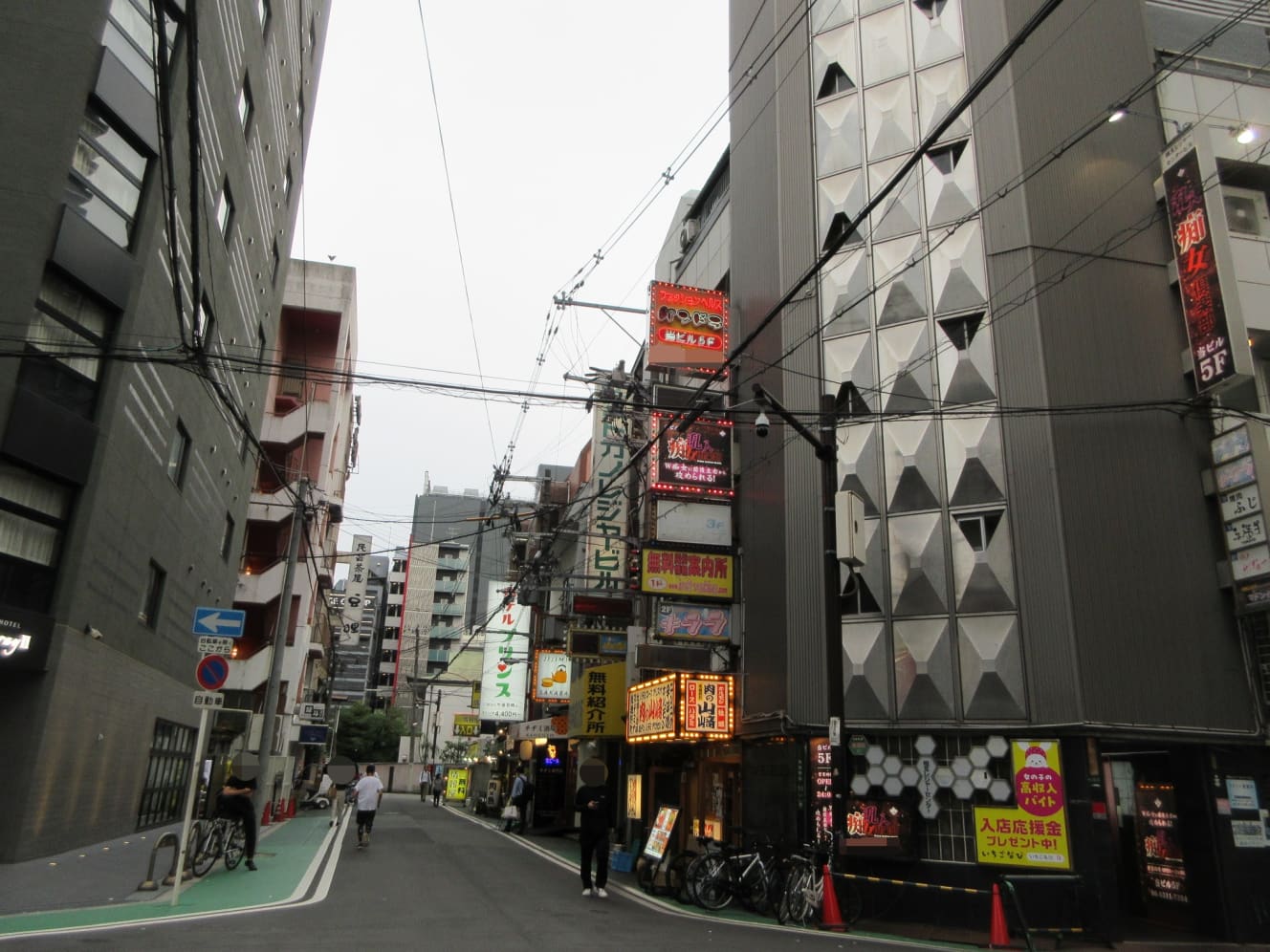 In the Osaka incident, a university student fell from a building while trying to escape a honey trap set by teenage boys and girls… (All photos below are for illustrative purposes only and not related to the honey trap incidents.)
 It is said that there are also honey trap victims among the streetwalkers around Okubo Park in Shinjuku.
 In delivery health services, it has long been a common tactic for staff to rush in, claiming the customer engaged in full sex acts (Photo: Love hotel district in Uguisudani).
Interview, text, and photos (2-4): Akira Ikoma