Why the Tokushima Prefectural Museum of Modern Art was tricked by a swindler into releasing for free a “fake masterpiece” it bought for 67 million yen.


Why were they deceived? The trap set by the forgeries
As a professional, I am truly sorry to those who viewed the work.
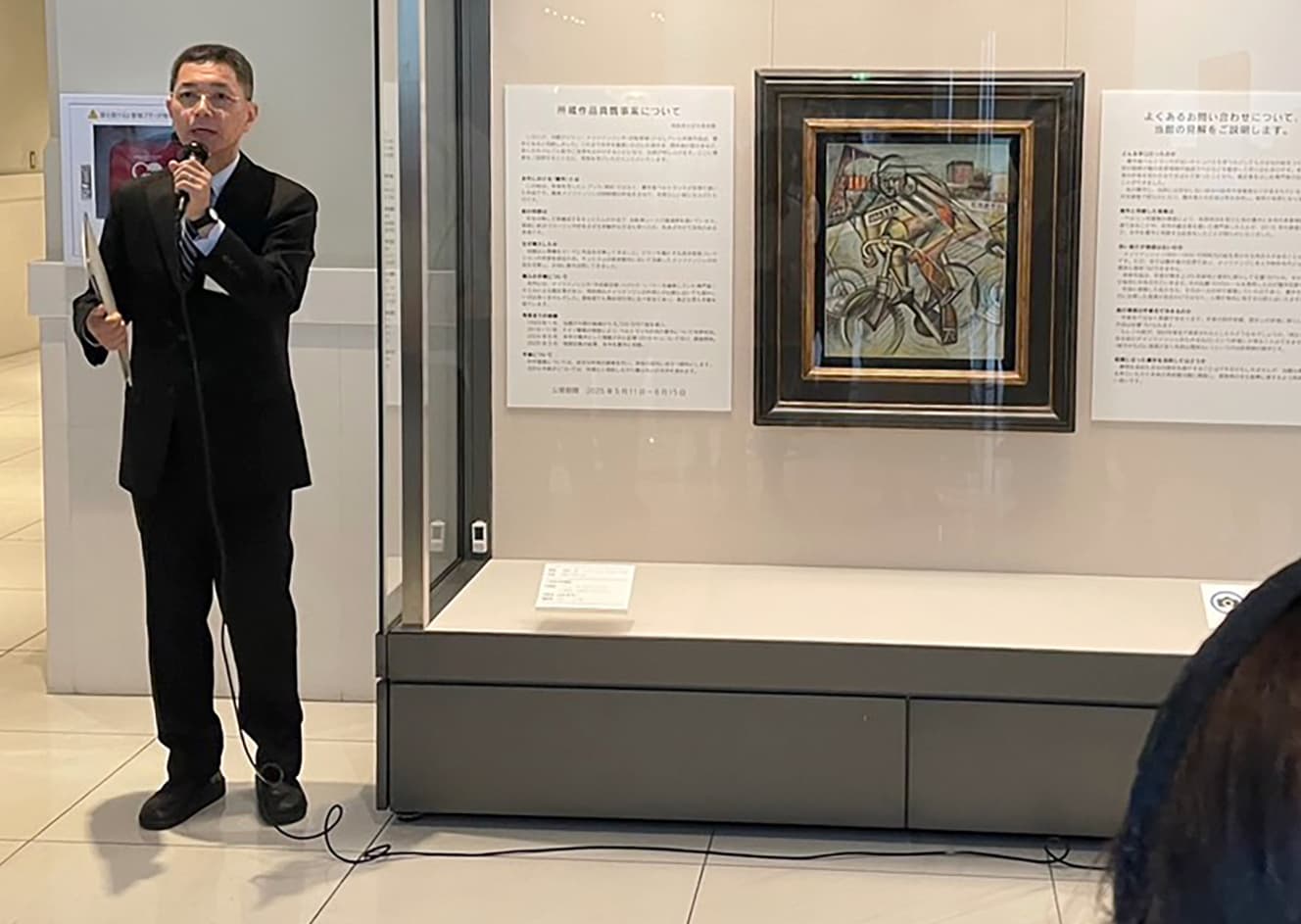
The man in a suit bowed deeply in front of about 40 people gathered at the museum.
A painting with “something to say” hangs in the first-floor lobby of the Tokushima Prefectural Museum of Modern Art, an oil painting entitled “Bicycle Rider” (second photo) by Jean Metzinger, a famous French painter active in the first half of the 20th century.
There is a reason why the man at the beginning of this article, Toshio Takeuchi, the museum’s senior curator, apologized to the visitors. The reason is that the work, which had been in the museum’s collection for about 26 years, was actually determined to be a forgery by a German, Wolfgang Bertolacchi, 74.
The discovery was triggered by information received from an official of the National Museum of Western Art in June of last year. Later, in July, Bertolacchi himself announced his claim that “I painted it. On March 25 of this year, the museum’s director, Tojo Yohko, held a press conference to announce the results of the investigation.
This year marks the 35th anniversary of the museum’s opening. Why was a museum with a long history deceived? The art dealer said, “The art dealer was a very persistent forger, and he was trying to trick us into believing that the artwork was a forgery. An art dealer said, “Bertolacchi was a forger.
Bertolacchi’s usual method is to purchase old canvases at antique markets and other places and paint them with pigments appropriate to their age in order to deceive scientific experts. He also prepares fictitious biographies, fake certificates of authenticity, and sometimes fake letters purporting to be written by the artist, and releases the forgeries on the market with them.
His obsession with forgery was so great that he imitated not only the techniques of the artist but also the environment in which the work was created. He was convicted of fraud in 2011, but his forgeries are still scattered all over the world.
The museum purchased the work in question, “Bicycle Rider,” for 67.2 million yen from an Osaka gallery in 1998. A certificate of authenticity was also attached. The museum staff did not have any doubts because the work was scheduled to be included in a catalog of all the artist’s works at the time, based on the certificate of authenticity.
Regrets expressed by the person in charge
When the author visited the site on June 11, a middle-aged man who was carefully looking at a forgery said, “I can’t tell from the painting that it is a fake. It’s a good work, so I think it’s fine.
Takeuchi, the senior curator of the museum, said, “People often ask where the real paintings are.
I am often asked, “Where is the real painting? But the real thing doesn’t exist. This painting is a fabrication, imitating only the way Metzinger painted in France at that time. In the end, everyone from the galleries to the experts have been deceived.”
Then he continued.
I can’t speak too ill of him because he has already served his time, but I can’t say anything bad about him because he said, ‘The artist’s name is no longer important, everyone was impressed. I was stunned to hear him say in a TV interview, ‘The author’s name doesn’t matter now, everyone was impressed. That is the sophistry of a swindler.
I have been explaining that these paintings are wonderful. That is why I find this issue very frustrating and disappointing. If a viewer who believes the painting is a genuine work thinks, “I don’t understand art after all,” that’s not true. (It is the museum that is at fault for introducing them to the public.
His voice was calm, but there were times when he choked up, perhaps out of frustration.
I would like to apologize to each and every one of you who came to the museum,” he said. However, that is difficult to do, so I decided to explain and apologize as best I could.
With this in mind, the museum opened the exhibition to the public free of charge from May 11 to June 15. The attitude of the curatorial director in faithfully fulfilling his accountability to the audience is commendable.
In the future, the painting will be scrutinized by a scientific research organization, and in parallel, the museum will explore the possibility of cost-sharing and refund requests with the gallery.
However–. The problem is not limited to the museum. In fact, the Museum of Fine Arts, Kochi, has just discovered that a work titled “The Girl and the Swan” was a forgery by Bertolacchi. The museum has likewise indicated that it plans to open the forgery to the public starting in September.
Many media outlets describe Bertolacchi, who is the focus of attention this time, as a “genius forger,” but there is no way that one can easily praise a fraud who deceives people.

From the July 11, 2025 issue of FRIDAY
Photography and text: Hironori Jinno (Nonfiction writer)