Save 60,000 yen a year! 9 “Cheap Smartphones” to Switch to Now!
Urgent Report】Counter the rising prices! Communication costs can be drastically reduced! Thorough verification of Mercari Mobile, y.u mobile, Aeon Mobile, Majimova, and others!


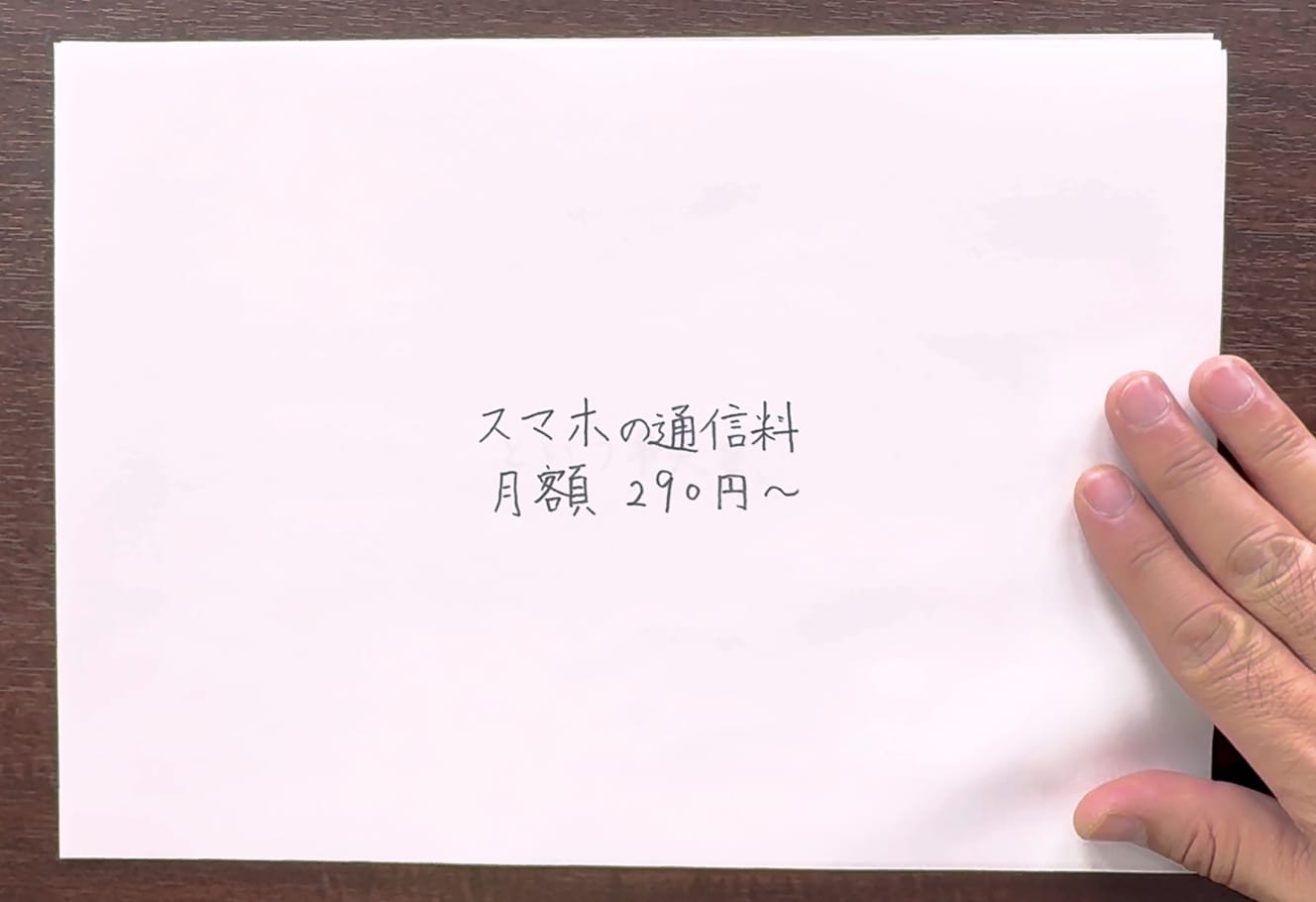
Actually, it is easy to cut! Significant savings by reducing communication costs
High prices continue to put pressure on household budgets. With the successive price hikes of food and daily necessities, we have been racking our brains for a few years now to see if there is anything we can cut back on in our budget.
Mr. Toruhito Ayuhara, the representative of Mobile Phone Review Honpo, a company that provides FP advice to clients on how to review their cell phone bills, provided this magazine with some useful information. He says, “Communication expenses, as typified by cell phone bills, are a fixed cost that is relatively easy to cut.
This is because many people tend to sign contracts with major telecommunications carriers without doing their due diligence. If you find the best carrier and switch to a plan that suits you, significant savings can easily be achieved.
Cheap SIM carriers are the best way to reduce communication costs. Mr. Ayuhara explains.
Cheap SIM companies provide inexpensive communication services by renting the airwaves provided by major carriers. Cheap SIMs have been around since around 2010, but the government of Suga Yoshihide, which took office in 2008, made “lowering cell phone rates” a key policy, lowering the barriers to entry, and many operators began offering the service.
The “Unlimited Gigabit Plan” offered by major carriers is generally priced at around 7,000 yen per month. Simply switching to a low-cost SIM provider can save 5,000 yen per month, or nearly 60,000 yen per year, depending on the plan you choose.
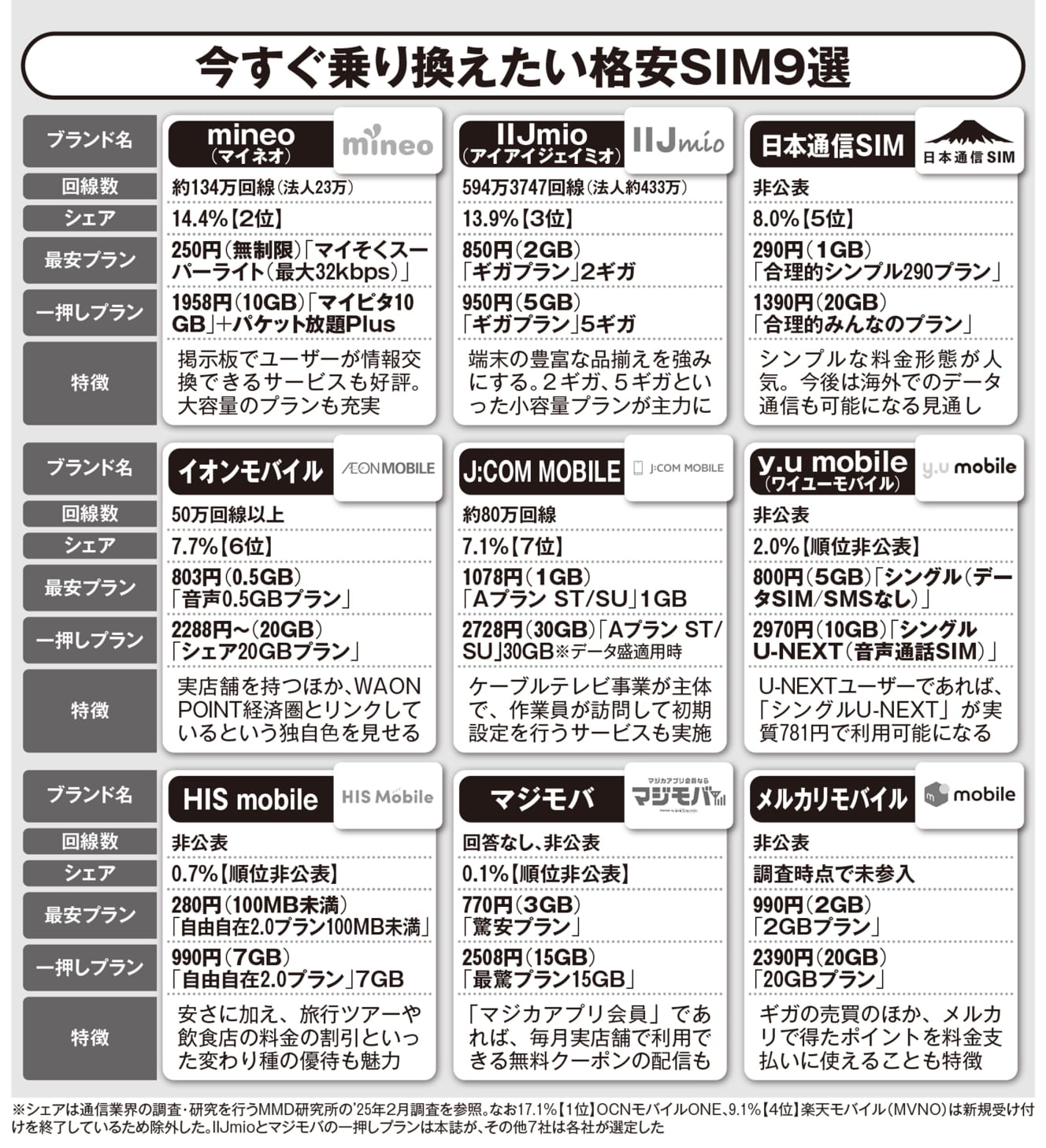
Let us explain the features of the 9 “Cheap SIMs to switch to now” selected by telecommunication and cell phone experts.
The SIM that features not only low communication costs but also low calling rates is the Japan Communications SIM, which is offered by Japan Communications, a long-established company in the telecommunications industry founded in 1996. Cell phone journalist Junya Ishino says, “Many low-cost SIM operators are offering low-cost SIMs.
Many low-cost SIM providers charge 22 yen per 30-second call,” says mobile phone journalist Junya Ishino. Japan Communications SIM, however, has been able to cut that rate in half to 11 yen per 30 seconds through persistent negotiations with DOCOMO.
If you choose a plan with 20 gigabytes of data and an option for free calls of up to 5 minutes, the monthly price is an unbelievably low 1,390 yen.
Since the budget for commercials and marketing has been cut to the limit in order to reduce costs, the company is still “a brand known only to those in the know. However, a new experiment is scheduled to begin soon.
Next year, we will be able to issue our own SIM cards, which has not been possible with low-cost SIMs, and this will increase the possibility of ‘international roaming’ in the future. This will allow us to offer data communication overseas ahead of other companies,” said Ishino.
Even “off-line meetings” are planned
Mineo, operated by Optage, a group company of Kansai Electric Power Company, is another long-established name in the low-cost SIM world. Let’s hear an explanation from Atsushi Ishikawa, a journalist who covers the smartphone industry.
We offer a service that allows users to share their excess gigabytes. They also put a lot of effort into building a community among users, and in addition to providing a community site called “Mineo,” where users can interact with each other, they are also planning “off-line meetings.
The pricing structure is also unique,” said Ishino.
There are two main types of plans: ‘My Pita,’ which sets the price by data volume, and ‘My Soku,’ which sets the price by maximum communication speed. Although we are a low-cost SIM provider, we are also aggressively expanding our high-capacity plans, offering plans for users who use 50 gigabytes per month.”
Along with mineo, IIJmio, provided by IIJ, the first company to introduce Internet access services in Japan, is considered to be one of the “two major players.
IIJmio’s handset lineup is on par with that of major carriers. They also sell distinctive models such as the Xiaomi 15Ultra, which was jointly developed with Leica and has high camera performance, and the Jelly Star, which is one of the world’s smallest smartphones. We are also happy to offer discounts on the cost of models when you sign a line contract,” said Ishino.
For example, with a used iPhone 15, the cost of the model can be significantly reduced to 87,000 yen as a transfer price.
One of the drawbacks of low-cost SIMs was that users had to do the initial setup themselves in order to reduce labor costs. This has been a bottleneck in attracting customers such as the elderly who are not confident about setting up their own phones. However, some service providers are responding to this situation by offering extensive support.
J:COM MOBILE is an affiliate of JCOM, a cable TV provider. After subscribing to the service, customers can receive telephone, in-home, and remote support through optional services for a fee.

Can also be used for “poikatsu
As the barriers to entry have been lowered, companies from other industries that were not originally telecommunications carriers have been entering the market.
One company that is making its presence felt is AEON Mobile, which leverages the strengths of its parent company, a major retailer.
The company has physical stores in AEON stores throughout Japan, making it easy for customers to stop by while shopping. Even those who are not familiar with the telecommunications situation can easily make the switch with the store staff, which is why it is gaining support from the elderly as well,” said IT journalist Hiroshi Mikami.
In recent years, major carriers have been issuing “common points” to attract users, as exemplified by Docomo’s “d-points. Aeon Mobile allows users to accumulate “WAON POINT.
When you pay the usage charge with an AEON credit card, you earn 4 “WAON POINT” points for every 200 yen spent. The points can be used at AEON and its affiliated stores, so in addition to saving money, you also get the added benefit of points.
As for services provided by other industries, “I am interested in HIS mobile, which is provided by HIS, a travel agency,” says the aforementioned Mr. Ayuhara.
The cheapest plan starts at 280 yen per month, and the company is working hard to compete on price, but subscribers can also rent pocket Wi-Fi for use at overseas destinations at a 50% discount and receive up to 3,000 yen off the cost of travel tours through HIS.
If you are a user of U-NEXT, a major video streaming service, we recommend switching to y.u mobile, which is a subsidiary of U-NEXT. Mr. Mikami, the aforementioned mobile operator, makes an impassioned speech.
U-NEXT is currently priced at ¥2,189/month, which means you can get 10 gigabytes for ¥781/month. This means that you can use 10 gigabytes as much as you want for only 781 yen per month.
The company offers a “perpetual carry-over” service that allows users to carry over their excess gigabytes up to a maximum of 100 gigabytes without expiration date, making them the best of the big players.
Majimova, an affiliate of Don Quijote, known as the “Don Quijote of low prices,” offers a unique service to customers of Don Quijote’s brick-and-mortar stores.
Every month, we distribute a coupon called “This month’s treat,” which can be redeemed for products at the store, to Majimoba customers.
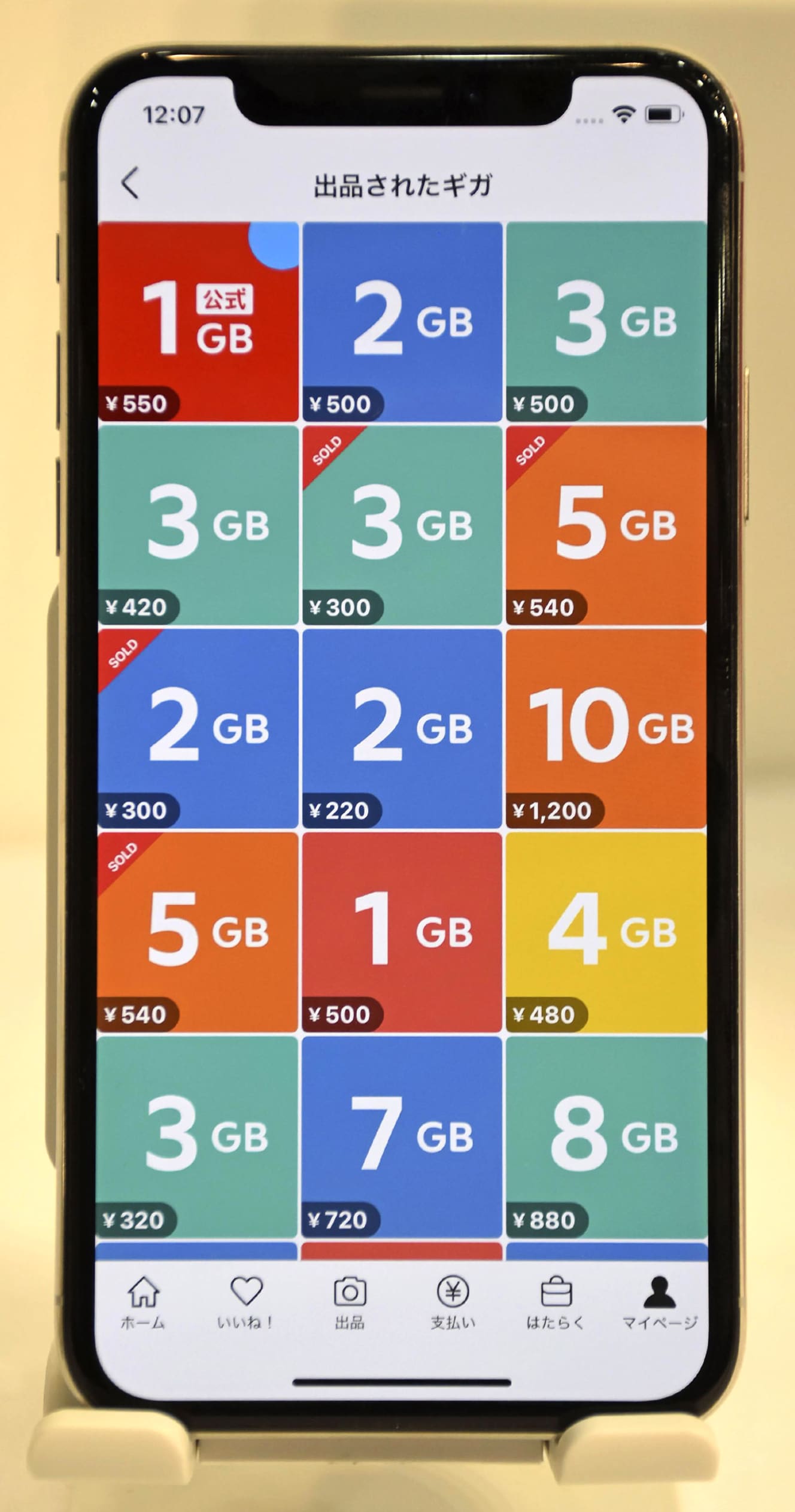
Mercari Mobile, which just launched its service in March of this year, has surprised users by offering an innovative plan that allows users to “buy and sell gigs. Mr. Ishino, mentioned above, reveals the reason for the shock.
There are only two plans: 2 gigabytes and 20 gigabytes. By leveraging the strengths of its parent company, Melcari, a flea market app, users can ‘list’ their data for a minimum of 200 yen and a maximum of 500 yen per gigabyte, so that if they run over their capacity at the end of the month, they can buy it from other users at a discount.
Major carriers charge nearly 1,000 yen to purchase an additional 1 gigabyte if you have exceeded your capacity. Other low-cost SIMs charge around 220 yen for a gigabyte, but it is possible to purchase a larger capacity for about the same price. This has the potential to drive the entire telecommunications market down even further.
Whether it is simple affordability, special offers, or after-sales service, why not try to find the plan that best suits your needs?


From the June 6-13, 2025 issue of “FRIDAY
PHOTO: Provided by Japan Communications SIM (1st photo), Kyodo News (2nd and 6th photos), y.u mobile (4th photo)