Brother Korn, Noritake Kinashi, and Hiromi Share How the Nightlife Taught Them to Balance Work and Play
Special Roundtable Discussion] Three best friends who met in Tokyo during the height of the bubble economy talk about the hottest decade of the '80s.


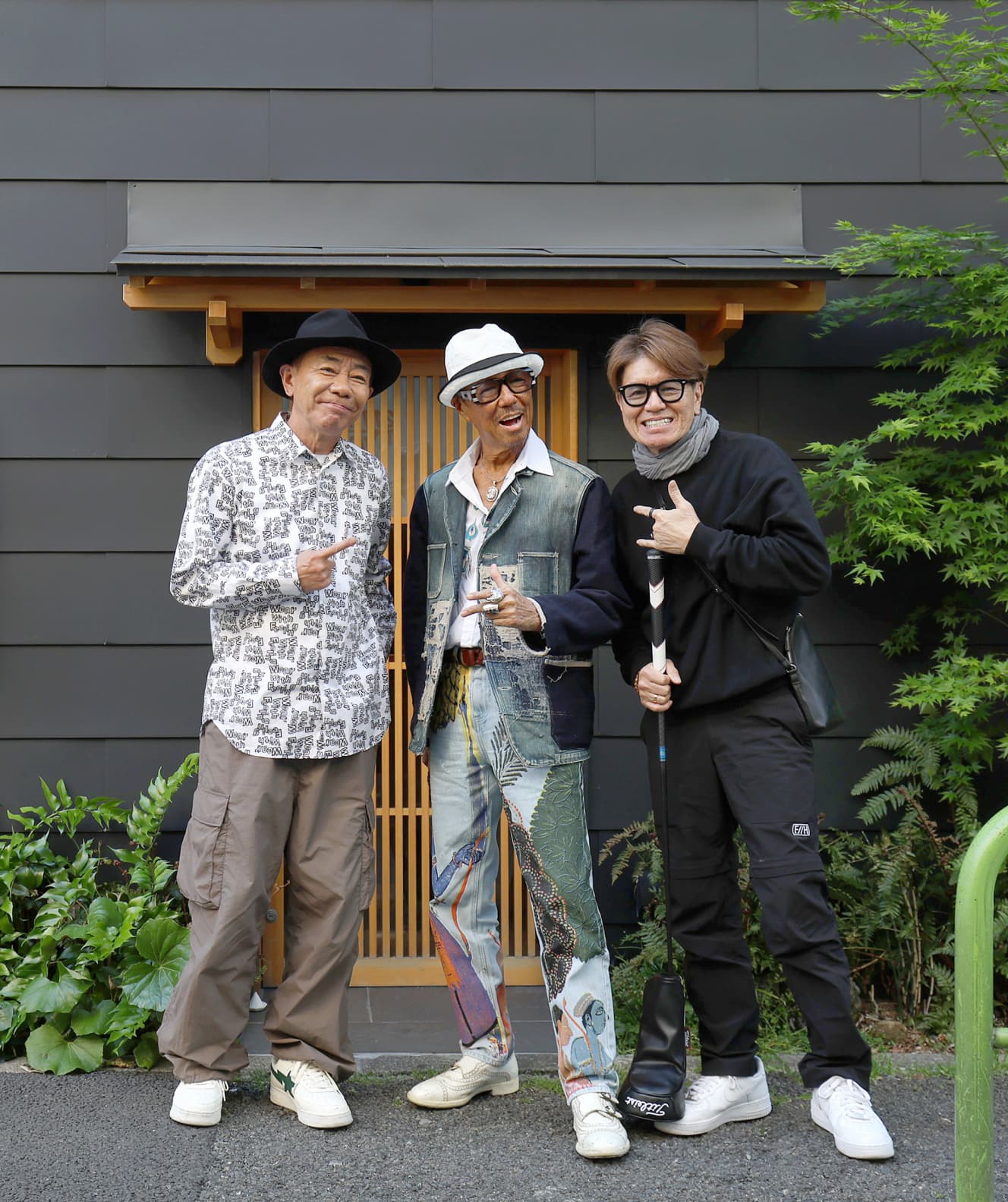
We met at a show pub in Shinjuku
Kinashi: Ever since I met Kon-chan when I was 18, we were together almost every day, hanging out at discos in Shinjuku and Roppongi. As a junior, he really took care of me, but it wasn’t just about spending money and having a wild time — he taught me how important it is to play with style.
Corn: I think I was around 24 back then. Even though Noritake become such a big name, he’s always treated me the same as in those days. He’s a truly important friend to me.
When asked “Who’s your closest friend in showbiz?” Brother Corn (69) of Bubblegum Brothers immediately answers, “Noritake Kinashi (63) from Tunnels.” The two first met around 1980, back when neither of them had made a name for themselves.
Now, ahead of Corn’s milestone 70th birthday, he’s published an autobiography “WON’T BE LONG — A Life That Rode the Bubble” (Kodansha) on May 21. To celebrate, a long-awaited talk session between the two best friends took place. Thanks to Kinashi’s arrangement, Hiromi (60) made a surprise appearance, and the three of them reminisced about their first meeting, wild nights during the bubble era, and their thoughts on today’s TV world.
Kinashi: I first met Kon-chan at a show pub called Kon in Shinjuku. I already knew about him from his appearances on Tobidase Monomane Daisakusen (Fuji TV). I was about to go say hi, when he called out to us like, “Hey, you two, come sit and drink here!” and had us join him.
Corn: I knew Noritake too, because he was working with (Takaaki) Ishibashi (63) as Takaaki & Noritake.
Kinashi: At the time, I’d just started working at Daihatsu. But Kon-chan told me, “You’re gonna be a regular office worker now? You better quit immediately.” And I was like, “Understood!” and quit right away. From that day on, we started partying every night in Shinjuku and Roppongi.
Corn: After partying until morning, it became routine for the three of us — me, Takaaki, and Noritake — to crash at my place in Koenji before heading home. And along the way, Hiromi joined our crew.
Hiromi: I was the youngest, so I just tagged along wherever Kon-chan and Ken-chan went (laughs). If they said “Let’s drink here,” we’d drink there. If it was “Ramen for the nightcap,” then it was ramen. Since I was still in my 20s, I could hang with them till morning. Now that I think about it, no matter what place we went to, the staff always knew Kon-chan, so we barely spent any money.
Kinashi: Right, even if we drank good stuff, it was super cheap for us. And there was this rule that other customers would sometimes cover our bill.
Hiromi: It was the bubble era after all. I guess whatever they didn’t charge us for, someone else picked up the tab (laughs).
Kinashi: At places Kon-chan went, you’d see (Akina) Nakamori, Toshi-chan (Toshihiko Tahara), (Fumiya) Fujii, Koji Kikkawa, RIKACO the coolest people always gathered around him. I couldn’t stay home, you know? I kept thinking — what if they’re having a blast without me, or maybe I’ll meet a new star tonight — and it felt like a loss if I didn’t go.
Behind the scenes of “All Night Fuji”
The hit of Bubblegum Brothers’ signature song “WON’T BE LONG” was actually sparked by Tunnels playing it repeatedly on the final episode of All Night Fuji (Fuji TV).
Corn: I wrote about this in my autobiography too, but Noritake kept saying, “Hey, Kon-chan, let’s play that song!” and they played it two or three times. After that, the station got flooded with calls asking, “What’s that song?” I’ll never be able to sleep with my feet pointed toward Noritake’s direction.
Hiromi: All Night Fuji only had one rule: as long as you finished before the morning shows started, anything went. Back then, no other network really aired programs that late at night. So if you were up, your only choice was to watch All Night Fuji.
Corn: Tons of celebrities used to drop by the studio unannounced too.
Hiromi: Yeah — like Ann Lewis would just show up, sing “Roppongi Shinju”, and leave. There was a bar counter inside the studio too, so some folks would swing by for a drink after finishing other shoots.
Kinashi: Even on the final episode, though there were planned segments, none of them were all that exciting. So I thought, “Forget it, let’s just blast ‘WON’T BE LONG’ and turn it into a party.” Sure enough, once we played it, everyone got up and started dancing.
Corn: And on Tunnels’ Thanks to Everyone (Fuji TV), there was a segment called “SOUL TUNNELS”, where viewers would compete with their disco dance moves. It was so stylish. I actually told (Masayuki) Ishii-chan, who just became president of Kyodo Television recently, “Let’s do that again!” But he shot me down, saying, “Everyone’s around 70 now — their bodies won’t move like that anymore.”
Hiromi: No better time to do it, though — it’d be great rehab! (laughs)
Being introduced was a status symbol
Around 1991, when WON’T BE LONG became a huge hit, it was actually a tough time for Hiromi. During the filming of a variety show he was on, he suffered serious burns and had to be rushed to the hospital. The ones who supported him then were his close friends Corn and Kinashi.
Hiromi: Back when I still couldn’t walk at all, Kon-chan came to visit me with a pair of NIKE shoes. He said, “Wear these — it’ll help with your rehab” (laughs).
Corn: Did I say it like that? (laughs)
Kinashi: When I went to see him, his burns were way worse than I’d heard, and I honestly thought, “Is Hiromi gonna die?” But because I kept hearing positive updates from Kon-chan, it made me believe he was gonna pull through.
Hiromi: Kon-chan kept saying, “Even if it’s tough, just walk.” (laughs)
Kinashi: But you know, that’s just how Kon-chan is — he’s always been super considerate toward younger folks. That’s why there’ve always been people gathering around him.
Hiromi: Every time a new person joined the circle, he’d introduce them right away. That’s how it was for me too. Like, “Hey, this is Hiromi. This guy’s on the rise. He’s gonna blow up.”
And then when you’d meet someone at a show later, they’d remember, “Oh, you’re the guy Kon-chan introduced the other day.”
Back in the bubble days, getting introduced by Kon-chan at a party was kind of a status symbol. And that’s how so many talented people naturally connected around him.
Kinashi: Even now, when you go to one of Kon-chan’s live shows, you run into tons of old friends like, “Hey, how’ve you been?”
Hiromi: His concerts are like a class reunion.
Kinashi: At those shows, we’re Kon-chan’s ultimate WON’T BE LONG squad.
Corn: As soon as that song starts, you guys just hop on stage on your own (laughs). There was this one time, Noritake dragged my wife on stage and started dancing with her — I was laughing so hard, I couldn’t sing.
Kinashi: That’s because Kon-chan loves surprises. The audience loves it too.
Hiromi: From way back, whenever Kon-chan called us up, we could never say no. There aren’t many people like that in this business.


“Jackie Chan?”
At this point, Hiromi had to leave for work. “We’ve talked quite a bit, huh,” he said, but even with just the two of them left, the conversation never ran out.
Corn: Back in the bubble days, TV stations had way more money than now, and we were always doing overseas shoots.
Kinashi: Yeah — when we were filming in New York wearing kimono, some New Yorker asked me, “Jackie Chan?” and I couldn’t be bothered to explain, so I just said “Yes!” (laughs)
Corn: Overseas shoots back then got greenlit on the lightest of whims. Like, during a staff meeting, they’d ask, “Where should we go for location shooting?” and if I tossed out, “How about Hawaii?” they’d actually set it up in Hawaii.
Kinashi: And then we’d go so far as to bring in world-class surfers and film wave-riding scenes. And when the day’s shoot wrapped, we’d throw cocktail parties with Hawaiian drinks at night — it was the standard routine.
Corn: Looking back, it was practically like playing around. But the thing about the bubble era was that playing was work. None of the directors or producers ever objected to us doing things our way.
What do these two, who lived through that hot-blooded, energetic era, think about today’s TV and entertainment industry?
Kinashi: I’m thinking of living properly and by the rules. How’s that sound? (laughs)
Well, kidding aside — I’m just planning to have fun in ways that suit the times.
Corn: Yeah, that’s it. You just go with the flow of the era and do your thing.
Kinashi: Sometimes these days, a director will invite me on a show and say, “I grew up watching you guys in the bubble days.” And then they’ll tell me, “It’s fine, Noritake-san, just go wild like you used to.”
But if I play it too safe, they’ll complain, “You didn’t do anything today.” (laughs)
Corn: The directors who say that are usually the ones who won’t be held responsible for whatever happens.
Kinashi: But see — TV work isn’t about just acting crazy for the sake of it. The important thing is the process of thinking through how to make something genuinely fun together with the performers and staff.
Even when you’re out partying, it’s not about just throwing money around and going wild. It’s about doing it stylishly and with class. That’s one of the lessons I learned from you, Kon-chan.
Honestly, most of my taste in fashion, music, hobbies — it all comes from you.
Corn: It’s not like today’s era is bad. But on the other hand, I do think there’s something that can only be felt from the attitude and human drama of people who lived through the bubble days.
You know, it might actually be interesting to make a movie set in the ‘80s and ‘90s.
Kinashi: Yeah — Hiromi and I were just talking about that too. We want to gather actors who know what that era felt like and shoot something together. I wonder if we can pull it off somehow.
Corn: Hey — maybe we can. If it happens, I’ll take those memories with me to heaven.

The behind-the-scenes story of their million-selling hit that sold 1.7 million copies, and friendships with big-name celebrities, are detailed in the autobiography.
“WON’T BE LONG — A Life That Rode the Bubble” (Kodansha), now on sale at bookstores and online nationwide.

From the June 6 and 13, 2025 combined issue of “FRIDAY”
PHOTO: Ichiro Takatsuka, with assistance from Azabu Fugu Takeshi