Strange Ads from Meiji to Pre War Japan with Realistic and Now Inappropriate Expressions


Iconic advertisements reflecting the values of their time
Today’s advertisements face severe backlash from the public if they include even slightly inappropriate content. Recent examples include the animated commercial for the cup noodle “Akai Kitsune” being criticized for being sexual, and the video commercial for “Yu-Pack” titled “Women Who Absolutely Do Not Want Their Bare Face Seen” sparking outrage for mocking women. Moreover, strict regulations such as the Act against Unjustifiable Premiums and Misleading Representations and the Pharmaceuticals and Medical Devices Act restrict unfair claims and exaggerated expressions.
But does that mean advertising was freer in the past when compliance was more lax? Not necessarily. In Strange Ads from Meiji, Taisho, and Showa (Kawade Shobo Shinsha), author Tomohiro Fukuda writes:
“The Meiji period included the First Sino-Japanese War and the Russo-Japanese War; the Taisho period saw World War I; and the Showa period experienced World War II. Businesses operated under hardship during wartime, and this also influenced advertising. Unique regulations existed at the time, and socially considerate expressions were required.
Therefore, many expressions now considered inappropriate, or copies not linked to products, can be found. Viewed alone, these may seem like strange ads, but understanding the historical context reveals the values of that era.”
In addition, advertising media in the early Meiji period mainly consisted of “hikifuda” (flyers) similar to modern leaflets, and posters displayed at stores. Newspaper ads appeared in the late Meiji period, and from the Taisho to early Showa period, magazine ads began to catch the general public’s attention. TV commercials only emerged after the war. Given the printing and production technology of the time, the range of expression was quite limited.
Within these constraints, Meiji, Taisho, and Showa advertisements did their best to appeal to consumers, and many of these ads appear strange to us today. However, considering the historical background, these ads are far from simply weird; they contain many points that modern creators still refer to. Below are just a few examples from Strange Ads from Meiji, Taisho, and Showa.
The well-known Ebisu-sama from Reiwa is now on a bicycle! Tokyo Yebisu Beer / Nippon Beer (Mid-Meiji Period)
When you think of the Ebisu deity on YEBISU beer, the familiar image is him carrying a fishing rod over his shoulder and holding a sea bream under his arm. However, in a rare mid-Meiji period flyer (hikifuda) believed to be from a little after the beer’s launch in Meiji 23 (1890), Ebisu is shown riding a bicycle while holding a Tokyo YEBISU Beer flag in one hand. At first, one might think he’s delivering beer, but actually, bicycles were still relatively rare and considered luxury items at the time. So this might have been a stylish and cool portrayal of Ebisu. By the way, the flyer’s text includes the phrase “kittte mo hatsubai shirisōrō” (“stamps also on sale”), which is thought to refer to what we now call beer coupons.
Morinaga’s Western confectionery / Morinaga Confectionery, 1908 (Meiji 41)
In a waterside scene within a blooming forest, a nude woman holding a box of Western-style sweets stands alongside two angels. The poster, painted in a style reminiscent of Western art, was an advertisement for Morinaga Confectionery when it was known as “Morinaga Western Confectionery Factory.” In other words, the two angels are a realistic version of Morinaga’s Angel Mark. The nude woman, believed to be a goddess, was depicted with realistic detail, including her nipples. Morinaga Western Confectionery Factory was founded in 1899 (Meiji 32), and the company adopted its current name in 1912 (Taisho 1).
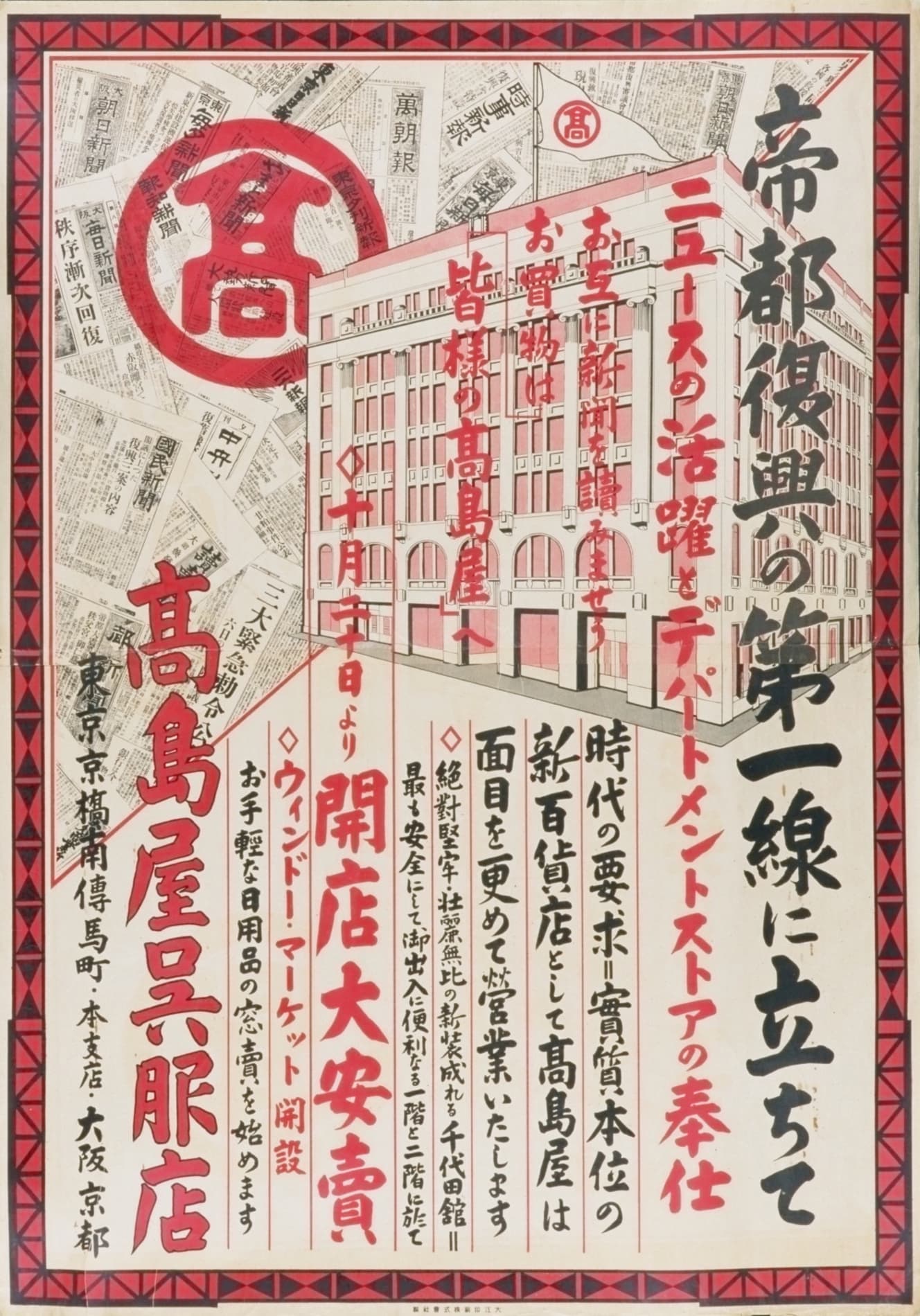
A Bold and Assertive Department Store Poster: At the Forefront of Tokyo’s Reconstruction / Takashimaya Gofukuten, 1923 (Taisho 12)
The striking poster, dominated by the dramatic headline “At the Forefront of the Imperial Capital’s Reconstruction,” is filled with bold red and black brushstroke-style text. It was released in 1923 (Taisho 12), the year of the Great Kanto Earthquake. Although Takashimaya was completely destroyed in the disaster, it reopened in a different location the following month. The copy, stating “In response to the demands of the times—as a practical and substance-focused department store, Takashimaya renews its commitment to business,” reflects this determined spirit. Phrases like “Absolutely sturdy and magnificently unparalleled new Chiyoda building” and “The safest and most convenient first and second floors” also hint at the impact of the earthquake.
Incredibly Impactful But Who Is This? Morinaga Milk Caramel / Morinaga Confectionery, 1935 (Showa 12)
This poster, featuring a sumo wrestler holding a box of caramel with a big smile, makes a powerful impression. Its boldness prompts the question, “Who is this?” — but this man is actually the prewar grand champion Futabayama Sadaji. His record of 69 consecutive wins and five consecutive perfect tournament victories starting in 1934 (Showa 11) remains unbroken to this day. When this poster was released, he was in the midst of extending his winning streak and was a smile familiar to every Japanese person at the time. Morinaga Confectionery hired him to promote a healthy image and generate buzz. Perhaps commercials featuring Shohei Ohtani will be met with the same “Who?” reaction nearly 100 years from now.
A Strict Yet Somewhat Gentle Wartime Poster: Grow Pumpkins No Matter What / Tokyo Metropolitan Government, 1944 (Showa 19)
Next to a large illustration of a yellow pumpkin is a bold red slogan: “Grow pumpkins no matter what.” This poster almost forces you to grow pumpkins without question. It was created by the Tokyo Metropolitan Government in 1944 (Showa 19), when the war situation worsened and food shortages became serious.
In the lower left, it says “Sure victory, absolute food security,” promoting pumpkin cultivation.
Despite the strong main slogan, there’s a softer side: small text provides details like “Planting time is mid to late April” and “Please ask your neighborhood group leader about seeds and how to grow them.” Various pumpkin varieties are also illustrated, adding a touch of kindness and charm.
At first glance, these strange old ads may seem odd, but understanding the historical context lets us feel the values of that time and sense something that still connects to modern culture.