Japan’s Open-Door Land Policy, Are We Powerless as Foreign Buyers Snatch Up Property?


“I think the figure released by the Ministry of Agriculture is off by one digit, or even more.”
Is Japan’s land being bought up en masse by foreign capital?
In Kitanomine, a district of Furano City, Hokkaido—which has seen the highest residential land price increase in Japan for two consecutive years according to the Ministry of Land, Infrastructure, Transport and Tourism’s annual land price publication—demand from foreign investors for land and accommodations remains high. Furano is even being called the second Niseko.
Foreign acquisitions of land have been a long-standing concern, such as the purchase of land in Tsushima, Nagasaki by South Korean interests and the acquisition of forests in Hokkaido by the Chinese capital. Japan is the only country in the world where foreigners can freely buy and sell land without any restrictions, prompting growing calls for the introduction of certain regulations.

When did foreigners begin purchasing land in Japan, and for what purpose? How much land in Japan is currently owned by foreigners?
“The large-scale acquisition of Japanese land by foreign capital truly began in 2008.
The Ministry of Agriculture, Forestry and Fisheries (MAFF) publishes annual figures on the amount of forestland acquired by foreign entities. According to an announcement in August last year, the total area acquired from 2006 to 2023 was 10,079 hectares. For farmland, the cumulative total from 2017 to 2023 was 158 hectares.
Let me clarify from the outset: when we talk about foreign capital involved in land acquisitions, we are primarily referring to China.”
So explains Hideki Hirano, director of the National Land and Resources Research Institute and author of books such as Silent Land Acquisition (Kadokawa Shinsho) and Japan Is Already Being Invaded (Shincho Shinsho). Since 2008, Hirano has been conducting nationwide field research on foreign land acquisitions.
“I’ve been following this issue for 17 years, and I believe the figures released by the Ministry are off by at least one digit—possibly more. In reality, the forestland being purchased is not just 10,000 hectares; it’s likely closer to 100,000 hectares.
As for farmland, the actual figure is off by two digits—it exceeds 15,000 hectares. Based on information I’ve obtained, in one particular prefecture in the Kanto region, there are about 4,800 hectares of farmland thought to be owned or leased by foreign individuals or corporations. Of that, 78% is held by Chinese nationals. The remaining 22% is owned by Sri Lankan and Malaysian nationals.”
What about residential and resort areas? And areas around important facilities?
What is the actual situation regarding land acquisitions by foreign capital in areas other than forests and farmland, such as residential and resort areas?
“There are no statistics categorizing foreign capital for residential or resort land, so the actual situation is unclear. However, according to real estate professionals in central Tokyo, about 20% to 40% of housing sales appear to be related to foreign capital.
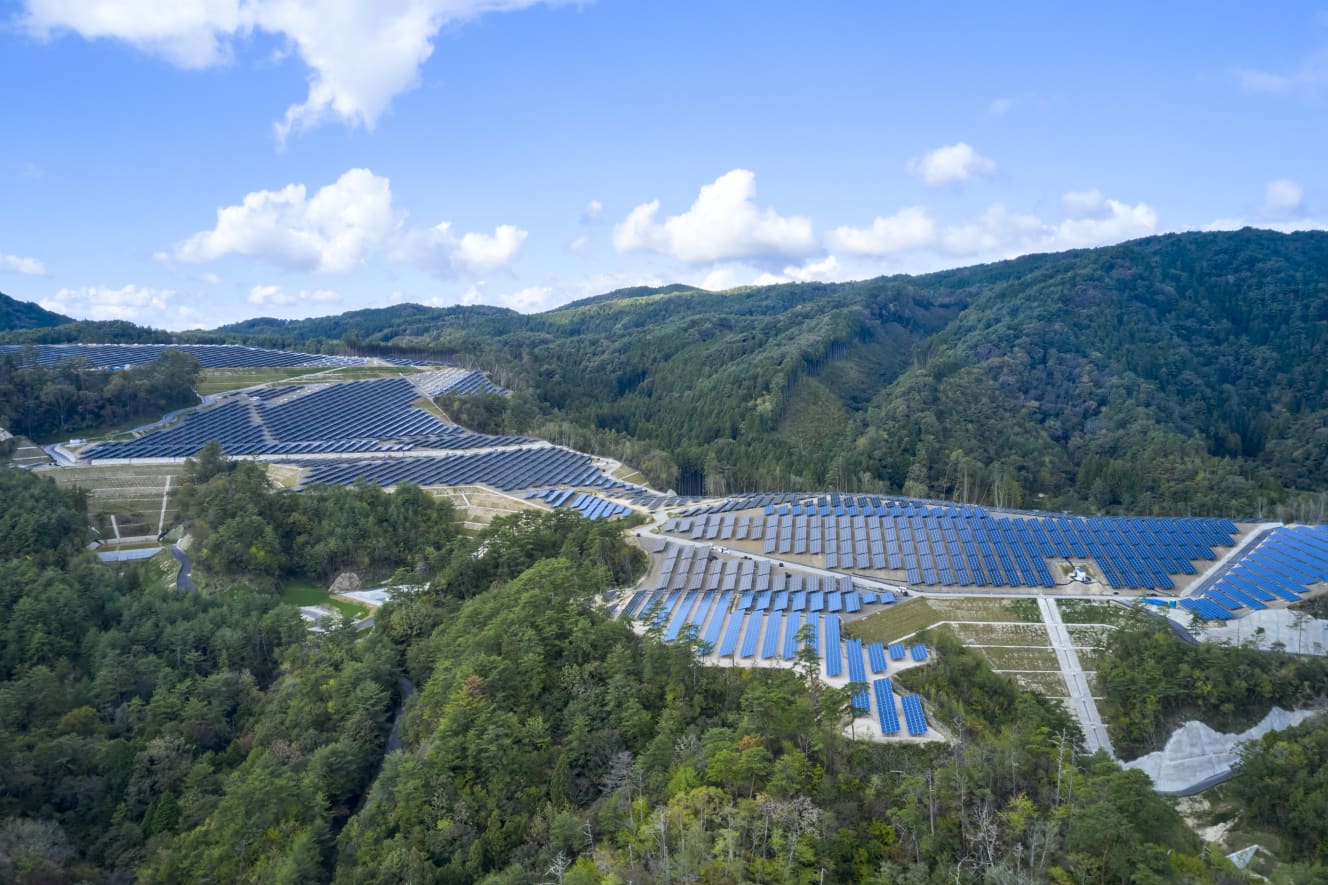
Since the enactment of the ‘Special Measures Law on Renewable Energy’ in 2012, land acquisitions for constructing solar and wind power plants have spread nationwide. I believe a significant portion of these acquisitions are by Chinese companies, including Shanghai Electric. But public data and statistics on renewable energy land do not categorize foreign capital, so there is no data showing how much land foreign capital has obtained.”
Meanwhile, the government held the “Land Use Status Council” in December last year and, for the first time since the enforcement of the “Important Land Survey Act” in 2022, published the results of investigations on land and buildings around nationally important facilities acquired by foreigners or foreign corporations.
The Important Land Survey Act designates areas within 1 kilometer of Self-Defense Force bases, U.S. military bases, nuclear power plants, and border islands as “Monitoring Zones” or “Special Monitoring Zones,” regulating their use. Last year’s survey targeted 399 designated monitoring zones up to fiscal 2023.
According to the compiled results, there were 16,862 acquisitions of land and buildings in 339 designated zones. Of these, 371 were acquired by foreigners or foreign corporations. By country, China was the highest with 203 cases (54.7%).
“Land around military, defense, and nuclear-related important facilities has mostly already been consolidated. Areas around substations have also been bought up. Regarding important land, including data centers, it seems foreign capital’s acquisition activities have run their course.”
What is the purpose of foreign capital acquiring these lands in Japan?
“For example, land around nuclear plants, substations, and Ministry of Defense or Self-Defense Force facilities can serve as a bridgehead and become drone bases. In other words, it is believed they are acquiring the land with a potential contingency in mind.
Resort areas are lucrative, so they are acquiring them as economically valuable locations.
Forests are targeted for their water sources, and Japan’s farmland is very valuable because it is uncontaminated. Forests and farmland are cheap yet valuable, which is why they are being bought.”
Foreign-owned land → Unknown owner → Unpaid taxes: The Hidden Mechanism
Even so, why is it that, as Mr. Hirano pointed out earlier, the land acquisition area by foreign capital announced by the government is one digit or more smaller than the actual situation?
“For example, the three major ski resorts in Hokkaido—Tomamu, Sahoro, and Kiroro—were purchased by China’s Fosun Group (Shanghai). However, Fosun Group resold all of these resorts.
So, who bought them? In the case of Kiroro, for example, it was a limited liability company called Kiroro Management based in Chiyoda Ward, Tokyo.
When you check the registry of Kiroro Management LLC, the representative partner is Kiroro Holdings Co., Ltd. Looking up Kiroro Holdings Co., Ltd., the representative director is a person from Shanghai, China.
In this way, by making the land owner a Japanese LLC and the representative partner a Japanese corporation, Tomamu, Sahoro, and Kiroro cannot be directly said to be owned by Chinese capital.
Currently, most resort areas in forest regions use a method where ownership is set as an LLC or special purpose company, and the investors are anonymous. Because of this, in recent years it looks like foreign capital acquisitions have calmed down, and the forest area acquired by foreign capital announced by the Ministry of Agriculture has not increased much. The camouflage has become thorough.”
It’s not just resort areas. In renewable energy projects such as mega solar power, a high ratio of operators are LLCs as well.
“In mega solar and wind power projects, it is common for the operator to be an LLC, with many such cases in Ibaraki, Chiba, Tochigi, as well as Hokkaido, Miyazaki, and Kagoshima. It is believed that China is involved in most of the foreign LLCs.
In the case of LLCs, the initial members and investors at establishment are public, but after establishment, even if some foreign capital invests 10 billion yen, the registry remains as it was at founding. Only the articles of incorporation, which are internal documents, are changed. Due to this system, the actual controllers of the LLCs are never publicly disclosed.
LLCs are a type of special purpose company established for asset liquidity and fundraising. They have been created in large numbers since 2006 to increase anonymity and attract a wide range of investors. Leaving a system that allows land ownership to become unknown due to anonymity itself is fundamentally a problem.”
What problems arise when the number of lands with unknown owners increases?
“Land purchased by foreign capital is often resold among foreigners, resulting in unknown owners, making tax collection difficult. Not only property tax but also real estate acquisition tax, income tax on resale, and registration license tax related to registration are rarely paid.
In fact, many local governments likely fail to collect local taxes such as property tax and real estate acquisition tax.
However, local governments can, by decision, treat uncollected taxes as irrecoverable losses and write them off, so the amount of missed property tax rarely appears publicly.
In April last year, to resolve ownership of unknown land, obligatory inheritance registration for citizens was enacted. While citizens’ tax evasion is not tolerated, the unknown ownership caused by foreigners is left unchecked. This creates a reverse discrimination against domestic people.”
Countries Strengthen Regulations to Caution China’s Belt and Road Initiative Japan Alone Has No Restrictions on Foreign Land Purchases
Hirono points out that “Japan’s land sale regulations are extremely lax and completely defenseless against foreign capital.” In fact, Japan has no regulations restricting foreign land purchases.
“Three years ago, the Important Land Survey Act was enacted, but it can be said that this law is almost toothless. The regulated area is narrowly limited to a 1-kilometer radius around important facilities. What can actually be done is limited to land use surveys, and it doesn’t go as far as restricting sales. In the end, it’s no real restriction at all.”
How do other countries respond to foreign capital buying up their land?
“In countries such as China, the Philippines, Thailand, and Indonesia, foreigners and foreign corporations are generally not allowed to own land. Since China launched its ‘Belt and Road’ initiative in 2013, many countries have become increasingly wary, and New Zealand and Australia have also strengthened their regulations. Japan is the only country with no purchase restrictions whatsoever.”
So, what kind of measures are necessary in Japan?
“The priority should be preventing ownership obscurity. The number of lands with unknown owners is rapidly increasing, so first, a legal system to resolve this issue needs to be established. The justification for this would be to improve governance.”
Furthermore, Hirono cites Switzerland’s “Lex Koller” law as a model worth emulating.
“The Lex Koller explicitly regulates foreign land acquisitions to prevent excessive foreign ownership. Lands purchased in violation of the notification requirement are confiscated, and resale is prohibited. Foreigners are limited to owning up to 1,500 vacation homes. For strict national land management, a law of this level is ideal.
However, in Japan, Article 29 of the Constitution guarantees property rights to both Japanese and foreigners, so it’s difficult. Restricting foreign land sales could infringe on property rights.”
In Japan, regulating foreign land acquisitions is not easily achievable is this the reality?
“The hurdle may be high. But if things continue as they are, Japan’s land will increasingly be bought by foreign capital and become ownerless.
In any case, speeding up legal reforms is important. I believe the public also needs to raise awareness and demand internationally standard land management.”
Few citizens would be okay with a situation where foreign capital is rapidly buying up their country’s land.
About Hideki Hirono:
Director of the National Land Resources Research Institute and Vice Chairman of the Forest Therapy Society. Graduate of Kyushu University. Former Director of the Environmental Impact Assessment Division at the Ministry of the Environment and Director of the Chubu Forest Management Bureau at the Ministry of Agriculture, Forestry and Fisheries. Senior Researcher at the Tokyo Foundation and Specially Appointed Professor at Himeji University. Author of Silent Land Acquisition (Kadokawa Shinsho), Japan Is Already Invaded (Shincho Shinsho), and Japan, We Buy (Shinchosha).
Interview and text by: Sayuri Saito PHOTO: Afro (2nd photo)