Nintendo Switch 2 vs. Sony PS5 Showdown in the 30-Trillion-Yen Market
With about a month until the world's long-awaited "X-Day," which is the most powerful hardware?


Nintendo Switch 2 set for highly anticipated release
The moment game fans worldwide have been eagerly awaiting is finally here—
On April 2, Nintendo announced it will release the successor to the Nintendo Switch, the “Nintendo Switch 2” (hereafter, “Switch 2”), on June 5. The Japan-only Japanese language version is priced at 49,980 yen, and the multilingual version at 69,980 yen. Considering the current model’s suggested retail price is 32,978 yen, this is a notably bold pricing strategy.
On April 3, a media preview event was held at Yoyogi Gymnasium (Shibuya Ward), packed with prominent influencers like Hikakin (36) and Hajime Syacho (32), as well as a large number of reporters. Game analyst Hisakazu Hirabayashi, who participated in the event, commented:
“The Switch 2 comes with various new features, with the most notable being the mouse function. By detaching the ‘Joy-Con 2’ controller and placing it vertically, users can operate it like a computer mouse.
At the preview, I was impressed by the mouse function in the wheelchair basketball game ‘DRAG x DRIVE.’ Each wheel is controlled by the left and right controllers, and the responsiveness is excellent. Instead of pressing buttons to shoot, the gyro sensor detects actual arm swings.
This combination of gyro and mouse functions offers a truly immersive sports experience. Since PC gaming is becoming a global trend, the mouse function is likely aimed at attracting PC gamers.”
In addition to the mouse function, a new feature can be seen as a hidden anti-resale measure.
“It’s the ‘C button,’ which allows gamers to start game chats with a single press. This feature caters to gamers’ needs but also prevents resale by Chinese buyers. Nintendo has long struggled with illegal resale markets, mainly in China.
However, since China prohibits chat with other countries, the ‘C button’ makes sales impossible. At this time, Nintendo has announced it will not release the Switch 2 in China,” Hirabayashi added.
The Switch series has now grown into the world’s top-ranked hardware, but its path was not smooth.
Nintendo, the publisher, is a well-known industry leader with annual sales of 1.67 trillion yen and has recorded numerous massive hits since the release of the Family Computer in 1983, including the Nintendo DS (2004) and Wii (2006).
However, when Nintendo announced the Switch in 2017, its stock price dropped.
“The stock was falling even during the presentation. This was because the Switch combined both a home console and a portable console. Nintendo previously had two separate segments: home consoles like the Famicom and Wii, and portable consoles like the Game Boy and DS.
Investors likely believed that merging these two segments into one would lead to lower sales,” said Hirabayashi.
However, Nintendo overcome this crisis through internal reform. Until then, the home console and portable console departments were separate, but then-president Satoru Iwata merged their software teams to strengthen development for the Switch.
As a result, while the previous console, the Wii U, considered a failure, released only 3 to 4 games annually, Nintendo succeeded in ramping up development to roughly one game per month. Hits like The Legend of Zelda and Splatoon helped the Switch surpass 150 million units sold.
Building on the Switch’s success, Nintendo’s eagerly anticipated Switch 2 boasts dramatically improved processing speed and graphics compared to its predecessor. The lineup includes realistic-oriented series familiar to Sony’s machines, such as Elden Ring and Yakuza, signaling a strategy aimed at defeating the PS5.


Technology vs. Fun
Sony’s gaming division (SIE), which counters Nintendo, recorded annual sales of 4.27 trillion yen, significantly surpassing Nintendo. Within the group, where the TV and home electronics businesses are shrinking, this division plays a key role.
“Sony has pursued gaming as a grown-up hobby with a focus on realism. The original PlayStation achieved 3D graphics, and the PS2, released in 2000, became the best-selling console in history with 160 million units sold. It made a huge impact in Western markets where more realistic games are preferred,” said IT journalist Munetaka Nishida.
While Nintendo has changed console names with each generation—”Famicom,” “Wii,” “Switch”—Sony has consistently competed with its “PlayStation” series.
“Nintendo has introduced various innovations to the gaming industry, like the Switch’s detachable controllers, but Sony has focused on technical prowess—improving graphics and processing speed to fully express the worlds of major game titles. As a result, the gaming market expanded to include adults as well.
With the PS4, users could stream gameplay online at the press of a button, and the PS5 greatly reduced load times. Sony has pursued a route that satisfies gaming enthusiasts in a way different from Nintendo,” Nishida added.
The PS5 boasts performance far beyond other home consoles. It is expected to maintain strong support, especially among younger users who can’t afford the 300,000 to 400,000 yen high-end gaming PCs.
“That said, Sony’s gaming business is financially strict. In 2021, it effectively shut down the SIE Japan Studio, its game development base, showing a tendency to cut unprofitable divisions. If streaming games—those played without downloading to hardware—gain popularity, Sony will likely make a pragmatic decision, possibly withdrawing from hardware,” he continued.
On the other hand, Nintendo seems to compete on fun. Nintendo’s representative director Shigeru Miyamoto once explained at a press conference why the company remains headquartered in Kyoto rather than Tokyo.
Miyamoto said, “Tokyo is very trend-sensitive, and I’m afraid it would force us to create products following trends. Being in Kyoto allows us to ignore trends and focus on our own way of making things,” said Hirabayashi.
The X-day that will determine the outcome of the global gaming industry’s 30 trillion yen market showdown is steadily approaching.


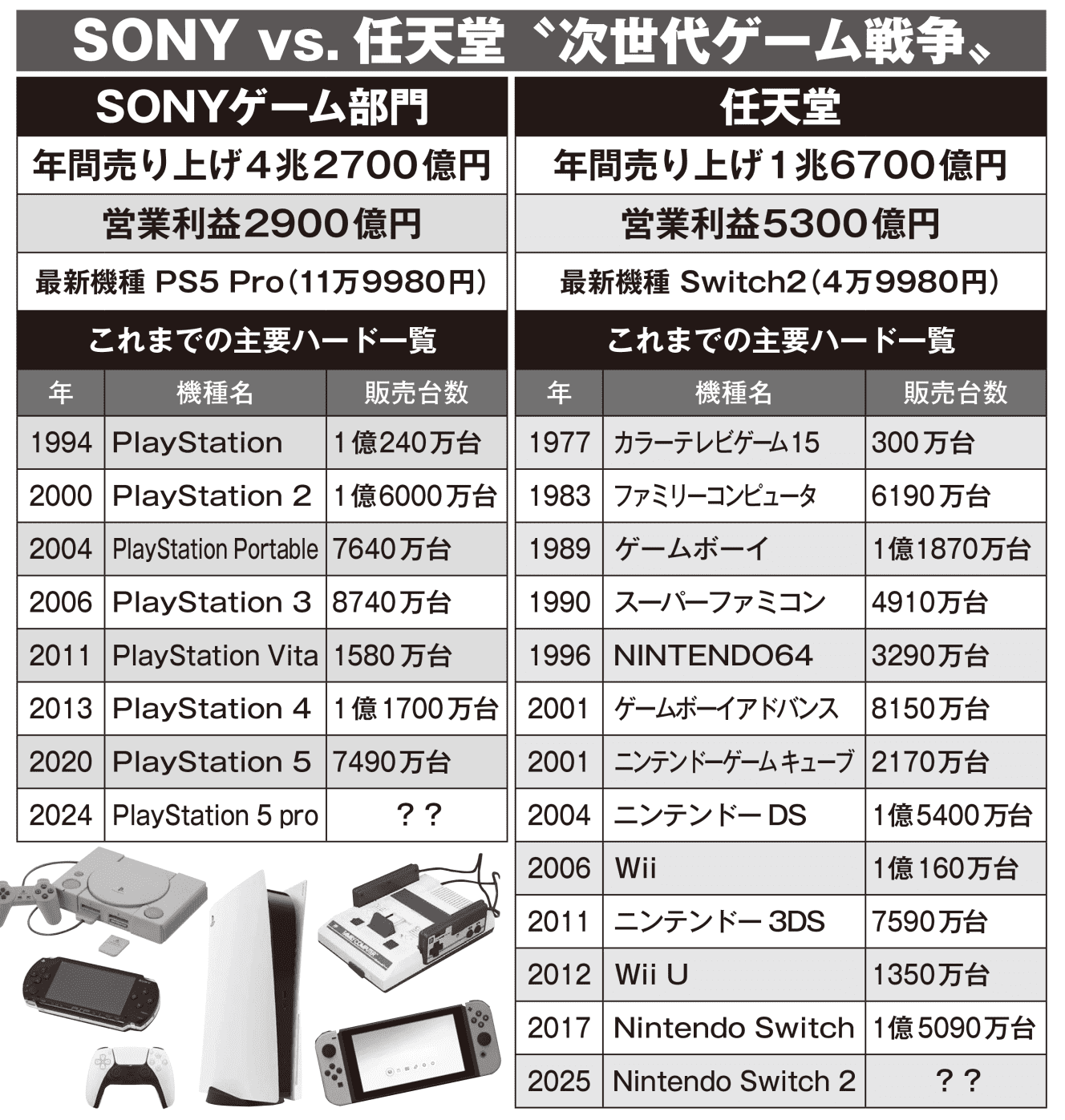
From the combined issue of “FRIDAY,” May 9, 16, and 23, 2025.