Eiji Kawashima Reflects on the Real Character of Leaders He Worked With


Conveying my feelings straightforwardly
As of April 25, 2025, nearly a quarter of the J2 season has passed, and JEF United Chiba, who showed a strong start with six consecutive wins, remains in first place. The only team to have defeated Chiba as of that date is Júbilo Iwata.
Although Júbilo was relegated from J1 after just one year in 2024, they have been steadily accumulating points under the guidance of manager John Hutchinson (45) this season. They are now just a step away from the top two spots, which guarantee automatic promotion. However, since April, they have experienced a slight stagnation and will need a strong push to recover.
Leading the rapidly improving team with strength is the 42-year-old captain, Eiji Kawashima. Although he has been on the bench since the team’s consecutive losses to V-Varen Nagasaki and Kataller Toyama in March, he continues to play a major role as the team’s leader.
Manager Hutchinson praised him as the best leader with the greatest humanity, and defender Katsunori Ueebisu (29) shared, “Before the Chiba match, Eiji-san told us, ‘We’re the only ones who can stop JEF.’ His words really pushed me forward.” There is no doubt that the actions of this battle-hardened veteran have a tremendous impact on the team.
When asked about his leadership, Kawashima smiled and said:
“I’ve always been the type to add a little humor, so I don’t put too much pressure on myself during pre-match meetings. I’m the kind of person who tends to speak from the heart and say things emotionally, so I can’t always say something too constructive but I do try to convey my feelings straightforwardly.”
“We weren’t strict enough.”
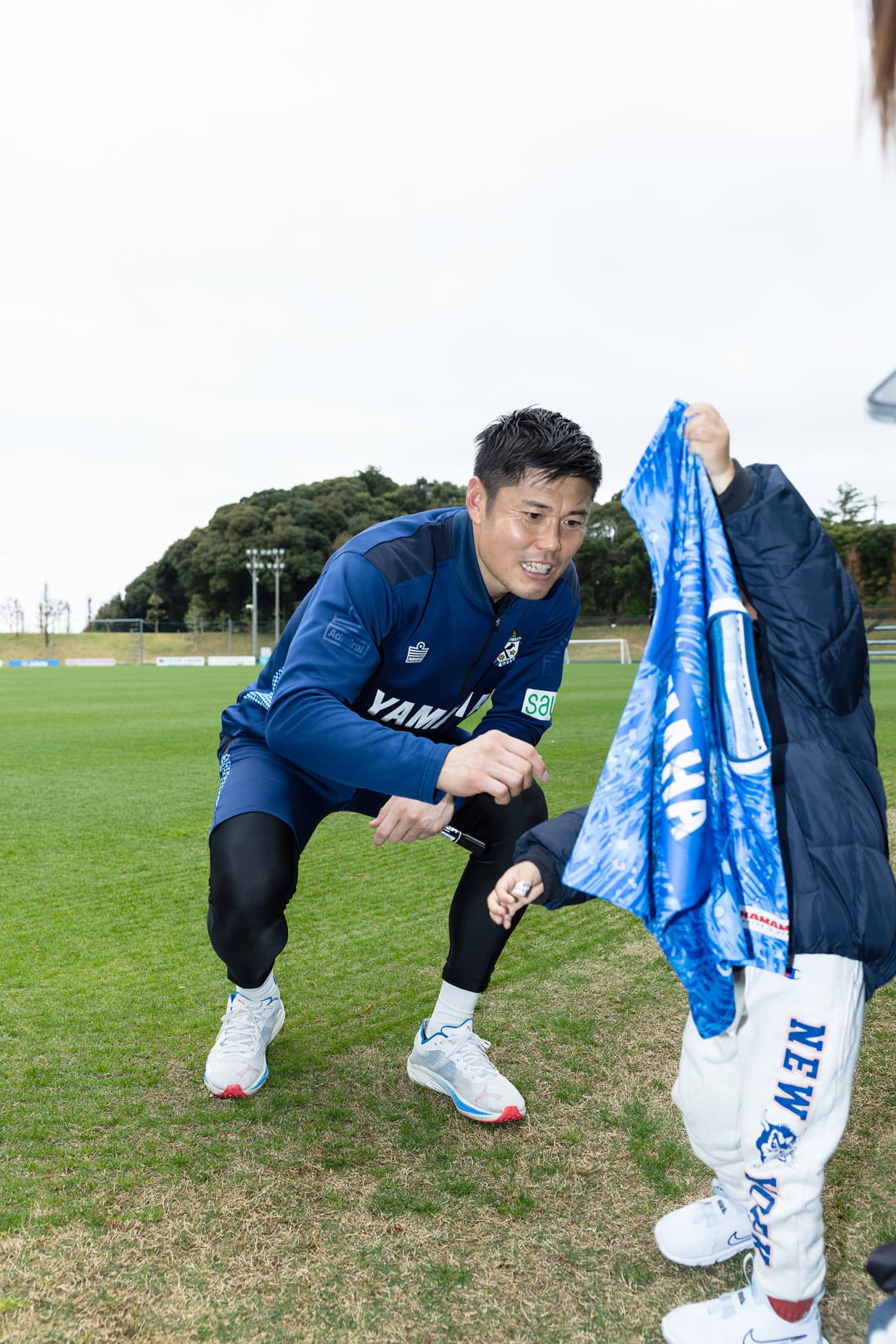
It’s not the first time in his long 24-year career that Eiji Kawashima has taken on the responsibility of being captain. However, there was a time during his younger years in Belgium when he was given the captain’s armband and struggled to express himself, feeling lost.
“When we huddled together, someone said, ‘Captain, say something.’ So, I shouted, ‘Alright, let’s go,’ and immediately I was told, ‘Don’t joke around. You’re really an unreliable captain.’ That was when I realized for the first time that I had to say something meaningful,” Kawashima chuckled while recalling the experience.
At that time, Kawashima was already playing at the forefront for the Japan national team. Since his first call-up in 2007, he had played under captains like Yoshikatsu Kawaguchi (49, Iwata GK coach), Yuji Nakazawa (47, commentator), and Makoto Hasebe (41, current national team coach), hearing many different types of leadership and motivational speeches. He must have had many opportunities to hear from his close friend, Hasebe.
“I’ve been with Makoto for a long time, but to be honest, he wasn’t the type to speak much. Instead, after the 2018 Russia World Cup, it was Maya (Yoshida, 36—LA Galaxy) who became captain and did most of the talking in the huddles. He would quote historical events to motivate the team and deliver great speeches.
Even during the Germany and Spain games at the 2022 Qatar World Cup, Maya said, ‘Let’s change history together.’ Well, to be honest, Maya’s words didn’t always hit home for me (laughs). But having these conversations raises your own bar. Every time, you feel like you have to say something meaningful.”
Of course, the job of a captain is not only about speaking in huddles. When the team is winning, the captain must keep the players focused, and when the team is struggling, the captain needs to discuss issues with both players and coaches to find solutions.
“Towards the end of last year, when we were fighting to stay in J1, I focused on how we could unify the team toward one common goal. I talked a lot with Daiki (Yamada, 36—currently Iwata’s CRO) about ‘How can we win?’ and ‘How can we steer the group in the right direction?’ I did what I could in my own way.”
However, Kawashima strongly emphasized that last season, Iwata lacked players who could be tough and point out issues to their teammates.
“If there were players not doing what they should on the pitch or slacking off, I would call them out. You have to say what needs to be said. The most important thing, regardless of whether you’re a captain or leader, is for each player to have the awareness to give everything for the team and make the group stronger, and act accordingly.”
“We must aim for the top.”
The importance of individual leadership among players. This is something that Japan national team teammates such as Wataru Endo (32, Liverpool) and Ritsu Doan (26, Freiburg) often speak about, almost as a mantra. The former goalkeeper, who has participated in four World Cups, sent a strong message of encouragement to his juniors.
“Since the Qatar World Cup, even after leaving the national team, I’ve been watching their battles closely. They’re competing with the frustration from 2022, fighting through the final qualifiers, and heading toward the 2026 North American World Cup. The current team is aiming for the World Cup title, but that goal is the result of the entire Japanese football community striving for greater heights.
I don’t think many people could have imagined that so many players would be playing in big European clubs so soon. When I turned pro, I couldn’t have imagined it at all. But now, it’s become a reality. That’s why I believe we can definitely aim for the top, and more importantly, I think we have become a group that must aim for it. I truly believe that Japan will one day win the World Cup.”
Looking back, at the 2014 Brazil World Cup, ace Keisuke Honda (38) set the goal of winning the World Cup, but many people felt the target was too high. Even within the team at the time, there were likely some who were skeptical.
“Keisuke was the kind of leader who aimed to take the Japan national team to those higher heights, and he was someone with a strong spirit. Without a player like him, the consciousness to aim for the top wouldn’t have arisen, and we wouldn’t have reached where we are now.”
After the devastating defeat at the 2014 Brazil World Cup, Kawashima was overwhelmed with an immense sense of loss, and Yuto Nagatomo (38, FC Tokyo) was so shocked that he didn’t speak in front of the media for about six months. It is through overcoming those tremendous setbacks that Japan’s current national team and the state of Japanese football have come to be.
As Kawashima says, when everyone fights with leadership, hope for the future will emerge. This applies not only to the national team but also to Júbilo Iwata. The only path to success is for each player to relentlessly push forward, striving to improve with passion.
This is true even for Kawashima himself, who is currently serving as a backup goalkeeper. The most important thing is the daily accumulation of effort.
In the second part of the article, titled “Feeling the Joy of Competing with Nokkatsu-san”, Kawashima shares his thoughts on playing alongside GK coach Kōkatsu Kawaguchi and his future vision.
Interview and text by Etsuko Motokawa: Etsuko Motokawa PHOTO: Hiroyuki Komatsu