30th Anniversary: Black Thunder’s 1.7 Billion Units and Game-Changing Evolution


Discontinued in just about a year?!
“Black Thunder” 30th Anniversary! Apparently.
Upon hearing this, I simply thought, “That’s amazing, congratulations,” but then I started to wonder, “Wait, has it really been around for 30 years!?”
“Black Thunder.” It’s a popular chocolate snack that occupies a strong position in most convenience stores, supermarkets, and sometimes even right by the checkout counter, a spot recognized by almost everyone.
Its price is 40 yen (as of 2024). It’s affordable, and the crunchiness from cocoa cookies and plain biscuits makes it delicious. With cumulative shipments exceeding 1.7 billion units, Black Thunder is quite popular, but it was actually discontinued after only about a year and briefly disappeared from the market. Perhaps this is why the 30th anniversary feels somewhat distant.
Despite its current popularity, the reason Black Thunder was discontinued was because sales weren’t growing. How did a product like that make a comeback and earn its unshakable popularity? The story unfolds.

The Ancestor-like Confectionery and the 10-Yen High Barrier
“Black Thunder” — the black lightning. Although it’s something that couldn’t exist in nature, there’s something cool about it, a kind of coolness that particularly resonates with the hearts of children (especially boys?). The early packaging even featured the words black thunder god.
“Before the release, there were opinions within the company that perhaps another name would be better. However, at one point, the current chairman and the developer at the time locked themselves in a room, and when they came out, they said, ‘It’s decided!’ There’s a story about this, though we don’t know if it’s true or not (laughs).”
This is what Ayako Kitajima from the marketing department of Yuraku Confectionery (headquarters in Tokyo, Kodaira City) says.
Did you know that Black Thunder actually has a progenitor-like confection?
“Choco Nuts 3.” Released in 1986, it was a chocolate snack featuring puffed rice and peanuts coated in chocolate, with a light texture being its major characteristic. Black Thunder was introduced in 1994 as the counterpart to this Choco Nuts 3, a snack with a much denser, more substantial texture, as Choco Nuts 3 was selling well at the time.
However, Black Thunder’s sales initially struggled, and it was ultimately discontinued after about a year. Kitajima points out two reasons for this.
1_ The package was in English!
“‘BLACK THUNDER,’ kids can’t read that, right? (laughs)” (Kitajima, and the same below)
2_ It was 10 yen more expensive!
At the time, the selling price of Choco Nuts 3 was 20 yen, while Black Thunder was 30 yen.
“We didn’t want to compromise on taste, so we had no choice but to make it 30 yen. But for the main target audience, kids, a 10 yen difference is significant.”
Indeed, with that 10 yen, they could have another fun option, like bubble gum, chocolate, stick snacks, or a lottery.

How did the black thunder god, which once disappeared, rise again like a phoenix?
First, a sales representative from the Kyushu area directly appealed to the current chairman to resume sales, leading to a relaunch in 1996.
Next, a phenomenon occurred where sales gradually increased, primarily through university co-ops in the Kansai region.
For university students, the price of 30 yen was now seen as cheap, with a great volume and delicious taste, making it more appealing compared to other chocolate bars.
“The fact that they could get this much volume for 30 yen made it a cost-effective snack for university students, and sales began to grow in university co-ops.”
By 2004, it became the number one snack in the confectionery section of a certain university co-op, and by 2005, it became widely available across the country (incidentally, the product name on the packaging was also changed to katakana in 2003!).
In this flow, witty responses to one-liner cards from students, which were introduced in “Co-op Shiraishi-san,” became a huge talking point and provided a big boost.
And then, an even bigger expansion awaited.
Perhaps it’s no longer necessary to explain, but in 2008, when male gymnast Kohei Uchimura declared it his favorite food during an interview, Black Thunder’s popularity skyrocketed, with two months’ worth of stock selling out in just one week, leading to its current status as a hit product.
30th Anniversary, Aggressive Renewal
Now, the 30th anniversary.
Having firmly established itself as a popular, staple snack, Black Thunder takes an aggressive approach at this milestone moment.
First, the product itself has undergone a major renewal.
The plain biscuits and cocoa cookies that were previously included have been enhanced with a new type of cocoa cookie, further strengthening Black Thunder’s signature crunchy texture and successfully achieving a crunch boost.
Shun Tanaka, who is in charge of product development, says:
“Actually, we’ve been making subtle improvements that customers may not notice, but this is the first time we’ve attempted such a large-scale renewal.”
This renewal is in line with the current trend for texture, but it was crucial that it didn’t feel like a completely different product.
“In the middle of the texture boom, we sampled many products that claim to have a crunchy texture, not just sweets but all kinds of products, and experimented. What we valued the most was maintaining the ‘Black Thunder-ness.’
If it changed too much, we feared that the loyal customers who love the current Black Thunder might be turned away. The challenge of the renewal was balancing the increased crunchiness while keeping the familiar taste of the original Black Thunder. Through repeated trials and tastings, I believe we were able to achieve a more pleasant, enjoyable crunch.” (Tanaka)
Indeed, it is different from the crispness of potato chips or crackers, or the light texture of puffed chocolate. That’s what makes Black Thunder unique.

An Unexpected Lightning Comeback of the Ancestor!?
Born as a counter product to Choco Nut Three, Black Thunder has now become the company’s flagship item, spawning over 300 different variations, including seasonal and regional limited edition versions. Additionally, a range of related products, such as Black Thunder that can be spread on dorayaki or toast, has also been launched.
Among these, one of the most popular is “Shifuku no Butter,” a product with a rich roasted butter aroma, which was introduced in 2020. This product has also just undergone a major renewal as the first release in the new “Koi the Rich” series.
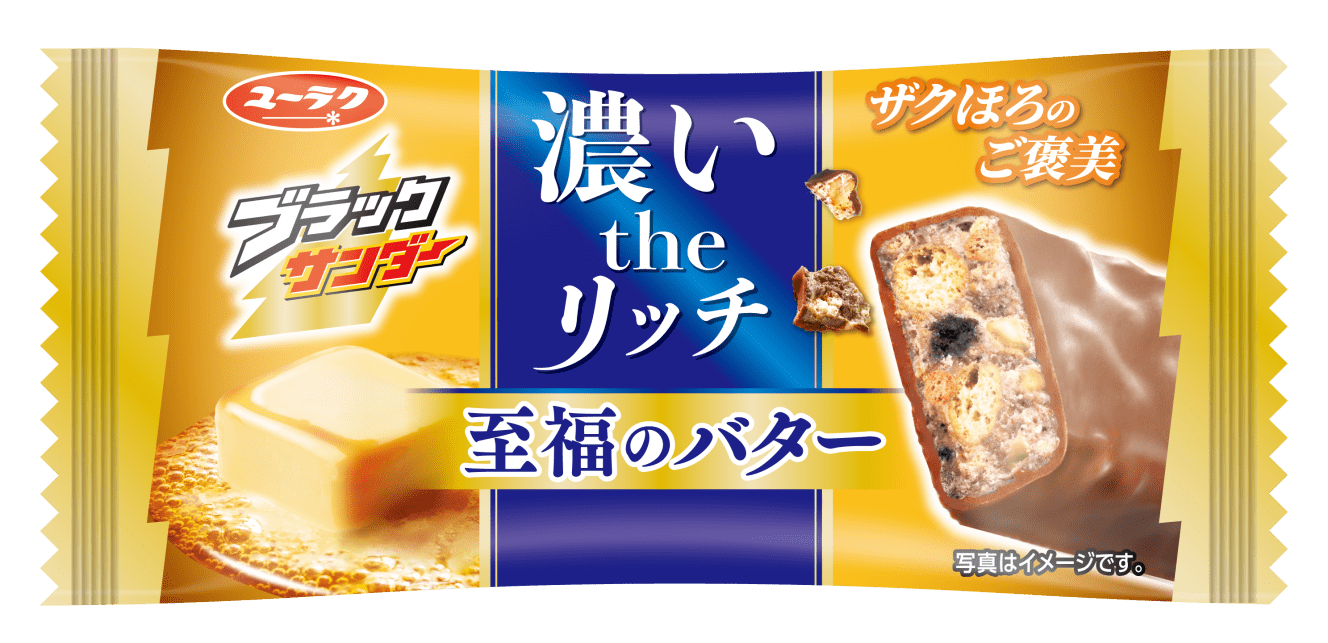
So, which products didn’t receive much of a positive response?
“The product released around the same time as ‘Shifuku no Butter’ was ‘Corn Potage Thunder.’ Of course, we launched it because we thought it would be delicious, and the combination of chocolate and corn is inherently good, but the name ‘Corn Potage’ didn’t seem to resonate well with customers,” says Kitajima.
By the way, what happened to Choco Nuts Three, which can be seen as the origin of Black Thunder? After witnessing the huge success of Black Thunder, it was quietly discontinued, having seemingly fulfilled its role.
However, Choco Nuts Three has now made a limited-time comeback at 100-yen shops, riding the big wave of Black Thunder’s 30th anniversary. This offers a chance to revisit the original, as well as to experience its lighter texture and compare it with the current version.

Moreover, an unexpected collaboration between “Black Thunder” and its rival in the small chocolate category, “Tirol Chocolate,” has been realized. Products incorporating the flavors of both brands were just released by both Yuraku Seika and Tirol Chocolate, adding to the momentum of Black Thunder’s 30th anniversary.
“We see Valentine’s Day in the new year as a major milestone, so we have various plans in the works,” says Kitajima.
The Black Thunder world is clearly still expanding.
Interview and text: Satoru Ota