Excessive Kindness Floods Public Spaces, Putting Japanese Critical Thinking at Risk


Japanese Society Is Becoming Increasingly Infantilized
“Let’s greet each other as residents.”
This type of notice, accompanied by illustrations, was posted in the elevator of an apartment building. While I initially thought it odd for a building where adults live to need such reminders, the reality is that these notices are pervasive across Japan.
In the stalls of a commercial building’s restroom, for example, there were signs reminding users, “Did you forget anything? Please check for your cell phone, wallet, or purchased items!” along with instructions such as “Do not flush large amounts of toilet paper at once” and “Please be careful not to let children’s hands or fingers get caught in the door.”
On refill packages of detergent, we see tips like “Refill after almost emptying to avoid overflow,” and “Be mindful of where you store it to prevent accidental ingestion by individuals with dementia.” Juice cartons are covered in fine print with warnings like “Be careful not to cut yourself on the edge of the straw or cap” and “Be cautious when drinking quickly through a straw to avoid choking.”
And it’s not limited to written warnings. In trains and buses, beyond announcements of stops and transfers, there are constant reminders to “Step back to the yellow line to prevent accidents,” and “For passengers with large bags, please carry them in hand or place them in the overhead rack,” aimed at minimizing inconvenience and ensuring safety.

Psychologist Hiroaki Enomoto, author of “The Pathology of Thoughtless Thinking”, (Heibonsha Shinsho), points out that excessive warnings and announcements can lead people to stop thinking for themselves, raising an alarm about the increasing infantilization of Japanese society.
“For instance, if people can’t drink juice safely without a warning about potential choking or injury, don’t you think that’s a problem?
Recently, I even saw a small bag of bean snacks with a warning: ‘Do not give to children under five years old. Running or crying with beans in their mouth may result in accidental swallowing and choking.’ Even if it’s not written, shouldn’t parents naturally consider these risks?
This rise in overly detailed warnings has led to a decline in people’s ability to be cautious on their own. It seems we have more people who can’t notice things unless they’re explicitly warned.”
Although some may say it’s unavoidable to prevent accidents and disruptions, Dr. Enomoto continues:
“I understand the need to prevent accidents and disruptive behavior, but if people continually rely on warnings and announcements, it only increases the number of individuals who can’t be aware on their own. When more people fail to notice things without warnings, accidents happen, which in turn increases the number of warnings and announcements.
This vicious cycle must be broken at some point. What’s truly necessary, I believe, is to create a society that functions without excessive warnings and announcements.”
Overly Helpful Weather Forecasts That Even Give Clothing Advice
The warning notice about forgetting items in the bathroom that I mentioned at the beginning seems to have not existed a few years ago. It can be imagined that there has been an increase in cases of people forgetting their mobile phones in restrooms, leading facilities to struggle with the situation, but a simple “Beware of Forgotten Items!” should be sufficient to remind people. Writing “Check your mobile phone, wallet, and purchased items one last time!” feels undeniably like too much. What has led to this situation?
“It becomes clear when you go abroad that in most countries, there are not only no warning signs in restrooms, but also no announcements for train transfers. As a result, when foreign visitors hear about the warning signs and announcements in Japan, they often praise it as being particularly kind.
However, this kindness has become excessive. We’re bound by the belief that being overly attentive is kind, leading to a service competition that focuses on helpfulness rather than on the products or services that should actually be sold.”
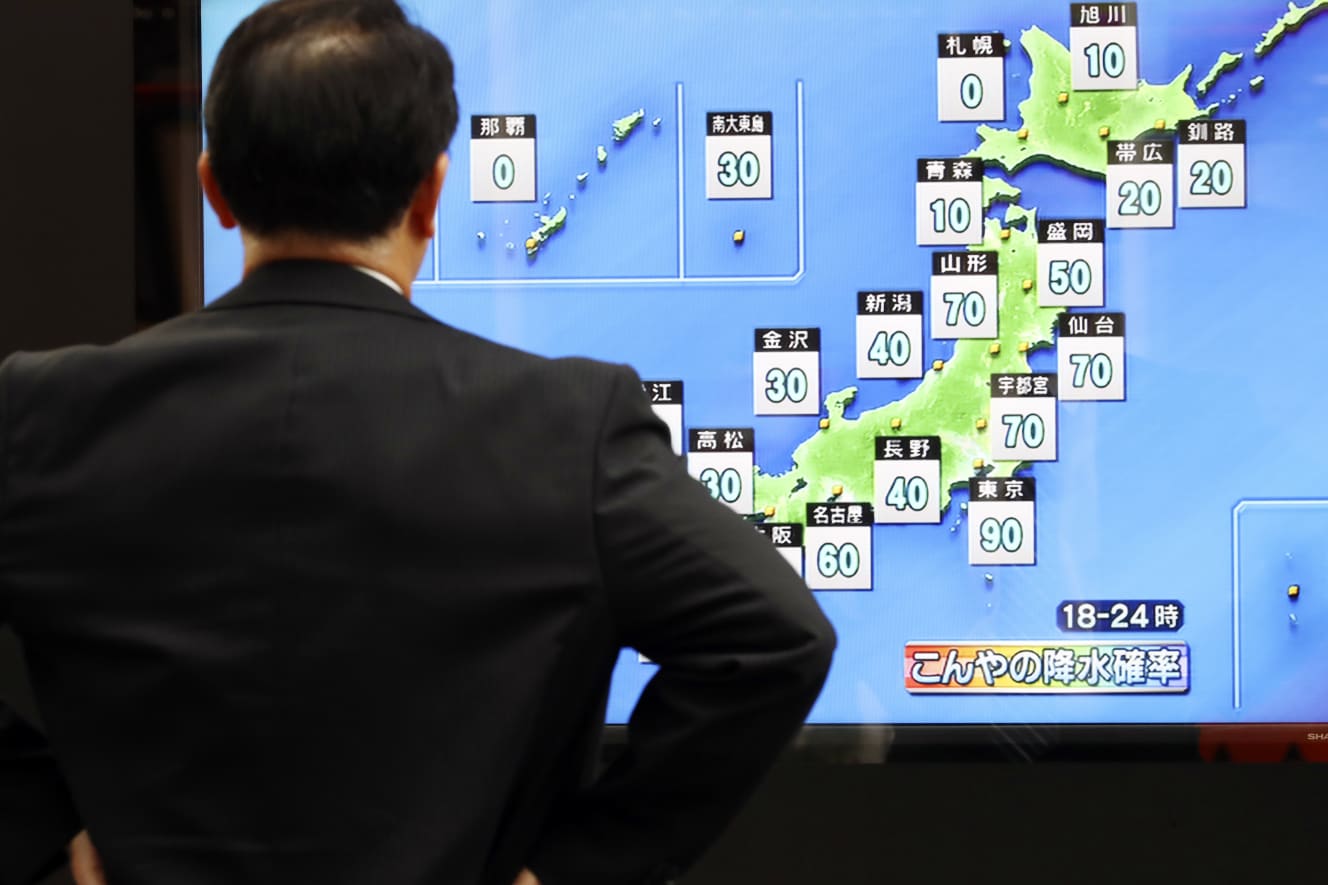
A clear example of this is the increasingly overly helpful weather forecasts.
“Recently, weather forecasts have not only predicted the chance of rain, the highest and lowest temperatures, and temperature changes during the day, but they have also started providing specific advice like ‘It would be best to wear a light jacket’ and ‘You might face delays in transportation, so leave earlier than usual.’
As a result, instead of thinking, ‘If the daytime temperature is 25 degrees, a short-sleeve shirt should be fine, but I might need something to wear for the return trip since I’ll be out late,’ people have stopped considering such things and have started going out dressed according to the advice given.
People may become so accustomed to receiving advice that they might not know what to wear if it isn’t mentioned. This hand-holding kind of advice may lead to a loss of the habit of independently gathering information, thinking critically, and making decisions.”
I can’t reach my destination without my smartphone
Dr. Enomoto, in his book “The Pathology of Thought Stopping”, also contemplates that the tools of civilization, under the guise of convenience, take away our ability to think.
“When many people visit a new place for the first time, they rely on their smartphones, which means they can’t even turn a corner without being instructed by the device, and if the battery dies, they can’t reach their destination.
On the other hand, in the past, many people would check their destination before heading out, allowing them to create a cognitive map in their minds that they could rely on to navigate.
When a convenient tool takes over one’s abilities, people start to depend on it, leading to a decline in their skills. If the brain isn’t used, it deteriorates.
Therefore, while the tools of civilization, helpful notes, and excessive announcements have their conveniences, they can lead to thought stagnation and a decline in our inherent abilities. We should be aware of this.”
The psychology of distrusting people is rude leads to thought stagnation
There are many factors that cause the Japanese to fall into this state of thought stagnation.
For example, the innate goodness belief rooted in Japanese culture.
“In recent years, the number of fraud victims among Japanese people has increased. Since the belief in ‘innate goodness’ is deeply rooted in Japanese culture, people tend to think that it is rude to doubt others. This mindset of don’t doubt others is a kind of thought stagnation, making it easy to be deceived.
On the other hand, in many foreign countries, the belief in innate malice prevails. Some countries even teach in their school systems to doubt others, which is the complete opposite of Japan.
Additionally, Japanese people have the mindset that if I leave it up to them, they won’t do anything bad. When someone orders ‘omakase’ at a sushi restaurant, they trust that they will be served the best dishes of the day, but if you order ‘omakase’ abroad, you never know how much you might be charged (laughs).
The concept of ‘omakase’ has not traditionally existed abroad. Therefore, people in those countries have developed a strong habit of thinking for themselves and making their own judgments, which is necessary for self-protection.”
Recently, however, the concept of omakase has become popularized as “OMAKASE” in high-end restaurants overseas. This “OMAKASE” trend may be a reaction from people abroad who have become accustomed to thinking and making their own judgments and now wish to occasionally relinquish control to the creator and enjoy the food.
“Today, with globalization bringing in various values, crime has become rampant. The attitude of trusting and leaving it to others no longer protects oneself in this era.
Japanese people need to recognize that the mindset of leaving things to others is no longer viable and that they cannot afford to be in a state of thought stagnation. It may be necessary for society as a whole to change.”
Hiroaki Enomoto is the director of the MP Human Science Research Institute and holds a PhD in psychology. Born in Tokyo in 1955, he graduated from the University of Tokyo with a degree in educational psychology. After working in Toshiba’s market research division, he left the doctoral program at the Graduate School of Psychology at Tokyo Metropolitan University. He has served as a visiting researcher at the University of California and as an associate professor at Osaka University. He is the author of many books, including How to Create Your True Self (Kodansha Gendai Shinsho), A Cruel Society of Hospitality, The Pathology of Thought Stopping (both published by Heibonsha Shinsho), and People Who Cannot Follow Instructions (Nikkei Premier Series).
Interview and text by Keiko Tsuji: Keiko Tsuji
