All-Night Coverage of Japan’s Emergency Temple in Shinjuku Promises Solutions in First 20 Minutes
A public service corporation that provides consultation for all kinds of problems.


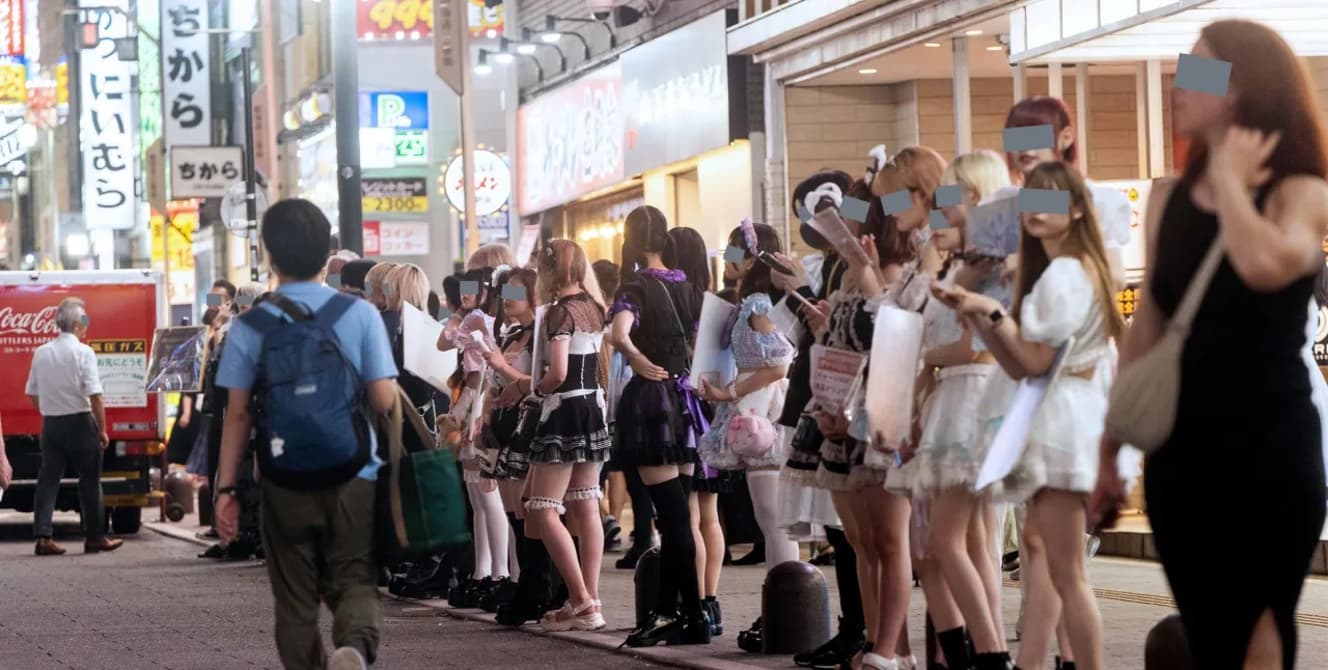
As the sun sets and the surroundings grow dim around 7 PM, Okubo Park in Shinjuku, Tokyo, which was lively with young people enjoying basketball during the day, closes down, and the area is enveloped in a different kind of bustle. Men walk restlessly, eyeing the “street corner” women standing in a row at equal intervals with their backs to the park. Amidst this scene, there is a woman passing something to them.
“I was giving a little skincare and cooling products to women and children on the streets,” says Shiho (alias), 28.
When asked, Shiho reveals that she is a staff member of the non-profit organization “Japan’s Emergency Temple.
“We handle various consultations, such as issues related to domestic violence and ‘papa-katsu.’ Since it’s summer vacation, there are more middle and high school students, so we operate all night,” she explains.
After finishing her rounds around the park, Shiho heads to the street by TOHO Cinemas Shinjuku. There, about eight teenagers huddle together on the ground, drinking energy drinks. As the “Tōyoko Kids” form a circle and chat, they wave at Shiho and rush over, shouting “Ah!”
The kids share updates like, “I haven’t been able to contact [name] lately,” and “It seems [name] has a boyfriend,” while asking Shiho for some advice. When they return to the office, a teenage couple is taking a break, looking at their smartphones. Gen Hidemori (68), the representative director of Japan’s Emergency Temple, has been observing Kabukicho for 22 years.
“We have handled over 50,000 consultations so far. Until about 15 years ago, the street corner women were backed by the yakuza, and over ten gang members would patrol on the 10th and 25th of every month, so there was more order than now. Back then, there were many foreign women working the streets, but after the Organized Crime Exclusion Ordinance was enacted in 2011, yakuza involvement disappeared, and Japanese women engaging in individual prostitution appeared.”
They intentionally taught how to die.
Since its establishment in 2002, Japan’s Emergency Temple primarily resolved love disputes among those over 20 in Kabukicho, but in recent years, there has been an increase in teenagers seeking help from as far away as Hokkaido and Kyushu.
“We often get requests from parents to find their missing children. In such cases, there are usually clues in the trash can of their room. Once, when a parent asked us to find their 17-year-old daughter, we discovered a warranty for a mobile phone registered under an unfamiliar name in her trash. From there, we inquired about the contract details, tracked down the address of the contract holder, and when we went there, we found out that the daughter was living with a 25-year-old man selling T-shirts on the streets of Harajuku. The man had bought her a phone. In the end, since the man was a player, we forcibly separated them,” he explains.
They handle over 1,000 consultations a year. Various issues are brought to them, but Gen states that he offers solutions within the first 20 minutes.
“I think it’s most important to make a decision without hesitation. If someone has escaped from an abusive partner, we’ll provide shelter and help them cut ties with the man physically. If someone wants to claim damages from a man they’ve had an affair with for 40 years, I’ll arrange for a lawyer. There was a case where a corporate employee wanted to recover the 1 million yen he had given to an underage girl he was dating because she ran away. I advised him to drop it, saying, ‘If she counters and claims you’re exploiting her, you could lose everything. She probably enjoyed herself, didn’t she?’ If a young person involved in street recruiting comes to me saying they want to leave the organization but can’t because they are in debt to its members, I’ll use lawyers and the police to help them get out.”
While I was speaking with Gen, several women were coming and going freely in the office. A young woman, seemingly in her late teens, entered casually and exclaimed, “Oh, food! Thank you!” as she accepted some snacks from the staff. Most of those seeking help are women, but there are also cases where men come in.
“Recently, a 34-year-old man with a wife and kids came to me saying he wanted to commit suicide. But his demeanor didn’t convey the urgency of someone truly wanting to die. So, I intentionally taught him how to die. As a final push, I told him that if he was going to die, he should borrow money and send it to his family first, because death would wipe everything clean. I even walked him to the front of a loan shop. Then, suddenly, he started crying, asking, ‘Why aren’t you trying to find out my reasons for wanting to die?’ In the end, we realized his family and relatives were worried and searching for him, so I sent him home.”
Sometimes, he receives thank-you letters from those he has helped, but Gen does not respond.
“I think the true resolution for them is to quickly forget those moments.”
He takes in anyone who comes and doesn’t chase away those who leave. His stance of not getting emotionally involved and aiming for the quickest resolution shapes Japan’s Emergency Temple into a place where people find it easy to seek help.


From the September 20, 2024 issue of ‘FRIDAY.’
PHOTO: Takayuki Ogawauchi