Bear Encounter Risk Rises After Autumn as Food Scarcity Increases Terrifying Situation Revealed by ‘Bear Attack Map’
A succession of brown bears and black bears have been reported in Aomori and Iwate, where we have been thoroughly alerting the public. Aomori and Iwate, which had been thoroughly alerted to the situation, suffered another victim...


“Upon receiving a report that a woman was attacked by a bear, police, fire department, and hunting club members totaling about 20 people went into the mountains. When we arrived at the scene, there was still a sign that the bear was nearby. Therefore, we performed a warning shot, but the bear reportedly did not leave the area.”
The Aomori Prefectural Police official reflecting on the “moment of terror” faced by his colleagues.
On June 25, an elderly woman in her 80s who was on her way to pick bamboo shoots in the Hakkoda Mountains in Aomori City was attacked and killed by a Asiatic black bear. This was the bear they confronted.
“They said that ultimately the bear retreated into the bushes as the distance between them gradually closed, but during that time, they fired more than 30 shots. Everyone was sighing, wondering ‘Doesn’t the bear feel fear of humans or guns?'”
The official from the Aomori City Environmental Policy Division, who had been calling for caution regarding bear damage, also showed no signs of concealment.
“The woman was attacked at a spot where we had repeatedly warned the local media about the danger. We had been on high alert, and this is the first time someone has died in Aomori City. There is nothing but regret.”
Attacks by bears have increased approximately threefold.
Attacks by bears have not ceased.
As of August 5, the FRIDAY editorial department has compiled the number of incidents on a map.
The pace of damage is approaching the record-high number of 219 victims (including 6 deaths) from last year, which was the worst in statistical history. There have already been 2 fatalities. Both incidents occurred in the mountains, where victims were attacked while gathering wild vegetables or bamboo shoots.
In Kazuno City, Akita Prefecture, two police officers who were transporting the body of a man who was believed to have been attacked by a bear in the mountains of Towada Oyu were themselves attacked by an Asiatic black bear and sustained serious injuries.
Professor Koji Yamazaki from Tokyo University of Agriculture explains the reasons behind the rapid increase in bear attacks in recent years.
“The Asiatic black bear population on Honshu is estimated to be at least 55,000 individuals, possibly as many as 100,000. This is the highest number ever recorded. The increase in numbers and expansion of their habitat has been too great. The decline of farming has led to fields being abandoned and returning to forest, creating more comfortable habitats for bears, which has facilitated their reproduction. This is particularly common in the Tohoku region. As bears repeatedly come down into human settlements, some individuals have become indifferent to humans and police car sirens, staying in place.”
On the other hand, while the population of brown bears in Hokkaido has reportedly decreased for the first time since 1990, the number of individuals appearing near human living areas in search of food has increased. In May of last year, a fatal bear attack occurred at Shumarinaiko Lake in Horokanai Town.
Tatsuto Yamagishi, chairman of the Naie branch of the Hokkaido Hunting Club, who has faced brown bears in human settlements for over 30 years, reveals the fear.
“You never know when they might leap out from the shadows, it’s like dealing with a special forces unit of the U.S. military. In the past 7-8 years, the frequency of sightings of brown bears—based on my personal sense—has increased approximately threefold.”

Becoming ‘Aggressive’ in Autumn
Bears that have harmed humans are likely to cause further victims if left unchecked.
“When a bear attacks a human, it learns that humans are prey it can attack without consequence. If cubs witness this behavior, they will learn the same thing. Bears that attack or prey on humans must be promptly eradicated, regardless of the reasons. However, this is not being effectively addressed,” says Yamazaki.
However, hunting clubs responsible for eradication are aging nationwide, and there are no clear plans for nurturing successors. With a shortage of eradication efforts, we are approaching a dangerous season.
“In the case of brown bears, September, when the nuts that serve as food are still not ripe, requires particular caution. September is the month when damage from bears descending into fields is at its highest throughout the year,” says Professor Yoshikazu Sato of Rakuno Gakuen University.
Damage from Asiatic black bears is also expected to surge after autumn. A veteran hunter from Akita Prefecture, which had the highest number of 70 victims last year, explains:
“When the first snow falls on the plains, Asiatic black bears return to the mountains. Just before this, before hibernation, bears become aggressive. As temperatures drop, bears instinctively start preparing for ‘wintering.’ They become more active in searching for food. This behavior can lead to tragedies when they encounter humans. The incident in October last year in Kitakita City, Akita Prefecture, where five people were consecutively attacked by Asiatic black bears, is a typical example of this.”
Asiatic black bears inhabit all of Honshu except Chiba Prefecture. Even in regions where damage has not yet occurred, complacency is not an option. Professor Yoshikazu Sato raises a warning:
“There have been cases of bears wandering into urban areas via green spaces along rivers in Sendai and Morioka. Even in Tokyo, Asiatic black bears inhabit areas around Okutama. There is a significant possibility they could appear in the city along rivers.”
The old norms no longer apply. The impending bear damage is a nationwide crisis.
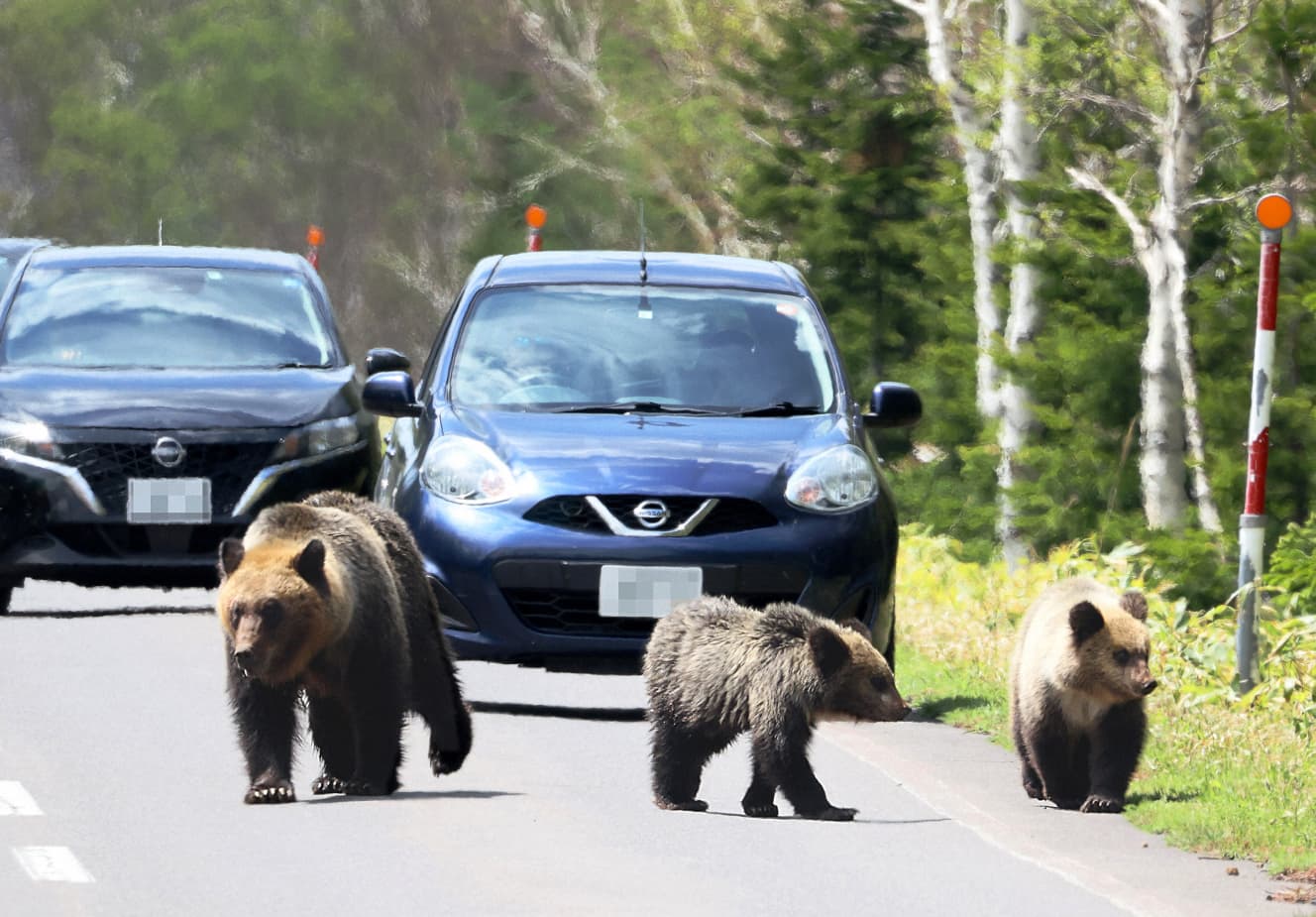


From the September 6-13, 2024 issue of ‘FRIDAY’.
PHOTO: Shinnosuke Futagami (1st and 4th photos) Mainichi Newspapers/Afro (2nd photo)